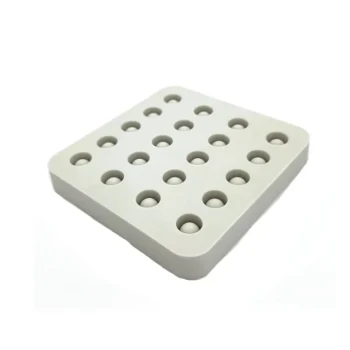
Artificial wax cups serve as the fundamental structural interface between the beekeeper’s production goals and the colony’s biological instincts. Primarily, they function as standardized carriers for grafted larvae, mimicking natural queen cells to induce worker bees to secrete and store royal jelly in precise, harvestable locations.
By replicating the architecture of natural queen cells, artificial wax cups trigger the hive's innate drive to rear queens. This converts a complex biological behavior into a predictable, scalable industrial process for mass royal jelly collection.
The Biological Mechanism
Simulating Natural Architecture
The primary function of an artificial wax cup is biomimicry. By copying the shape and depth of a natural queen cell, the cup signals to the colony that the larva inside is destined to become a queen.
This triggers the nurse bees to shift their behavior. Instead of feeding standard worker food, they instinctively flood the cup with nutrient-rich royal jelly.
Material Affinity and Acceptance
The material composition of the cup is functional, not just structural. Wax provides a critical material affinity that artificial plastics may lack.
Because the cups are made of beeswax (often formed by dipping molds into molten wax), they smell and feel familiar to the hive. This drastically increases the acceptance rate of the grafted larvae, ensuring the colony adopts the "fake" cells immediately.
Operational Efficiency and Standardization
Enabling Mass Production
In a natural hive, queen cells are built sporadically and in small numbers. Artificial wax cups allow beekeepers to force mass production.
By fixing these cups onto wooden bars (typically 15 per bar) within a grafted frame, producers can organize dozens of potential "queens" in a single colony. This creates a high-density production environment that does not exist in nature.
Facilitating Systematic Harvesting
The cups transform royal jelly harvesting from a delicate manual task into a standardized operation. Because every cup has identical dimensions (often around 9mm in diameter), the volume of jelly is predictable.
This uniformity is essential for downstream processing. It allows for efficient, semi-mechanical extraction of the jelly once the secretion phase is complete.
Understanding the Trade-offs
Durability vs. Acceptance
While wax cups offer superior biological acceptance due to their natural scent and texture, they are fragile consumables. Unlike industrial plastic cups, wax cups may deform during handling or require reforming (dipping) after harvest.
Preparation Intensity
Creating artificial wax cups requires specific preparation, such as using hardwood molds and molten beeswax. This adds a layer of labor intensity prior to the grafting process that is not present when using pre-fabricated plastic alternatives, though the payoff is often a higher yield per larva due to better acceptance.
Making the Right Choice for Your Goal
To maximize your royal jelly production, you must align your equipment with your operational capacity.
- If your primary focus is Biological Yield: Prioritize fresh wax cups to maximize material affinity and ensure the highest possible larva acceptance rate by nurse bees.
- If your primary focus is Process Scaling: Utilize the standardized dimensions of these cups to implement mechanical extraction tools, reducing the labor cost per gram of harvested jelly.
By standardizing the vessel, you control the variable of nature.
Summary Table:
| Feature | Function in Royal Jelly Production | Benefit to the Beekeeper |
|---|---|---|
| Biomimicry | Simulates natural queen cell architecture | Triggers instinctive jelly secretion by nurse bees |
| Material Affinity | Uses natural beeswax scent and texture | Increases larva acceptance rates compared to plastic |
| Standardization | Uniform 9mm diameter and depth | Enables predictable jelly volume and mechanical extraction |
| Scalability | Organized arrangement on grafted bars | Facilitates high-density production and industrial efficiency |
Maximize Your Colony’s Potential with HONESTBEE
At HONESTBEE, we understand that commercial success in royal jelly production depends on the perfect synergy between biological instincts and industrial efficiency. As a leading partner for commercial apiaries and global distributors, we provide the full spectrum of professional tools needed to scale your operations.
From precision-engineered hive-making machinery to honey-filling solutions and high-quality industry consumables, our comprehensive wholesale offering is designed to support your growth. Whether you are optimizing larval acceptance with specialized hardware or expanding your market reach with honey-themed merchandise, our expertise is your greatest asset.
Ready to elevate your production yield?
Contact HONESTBEE Today for Custom Wholesale Solutions
References
- Naglaa A. Ghazala, Ahmed A. Taha. INFLUENCE OF BEEVENOM COLLECTION ON SOME HONEYBEE PRODUCTS. DOI: 10.21608/jppp.2014.87979
This article is also based on technical information from HonestBee Knowledge Base .
Related Products
- High-Efficiency 20-Cell Silicone Mold for Beeswax Bee Queen Cup Production
- Clear Black Plain Polystyrene Queen Bee Grafting Cell Cups No Lug for Bee Queen Cup
- JZBZ Type Wide Base Plastic Queen Cell Cups for Base Mounting and Queen Rearing
People Also Ask
- What is the first tip for pouring beeswax into a silicone mold? Ensure a Perfect Release
- What are the technical advantages of using precision silicone molds for the manufacturing of beeswax queen cups? - Scale
- How do beeswax queen cell cups function? Optimize Queen Rearing with Biological Mimicry
- What is the biological function of beeswax queen cell cups? Boost Acceptance in Artificial Queen Rearing
- What are the advantages of using tapered wooden dowels for queen cups? Boost Rearing Consistency & Acceptance