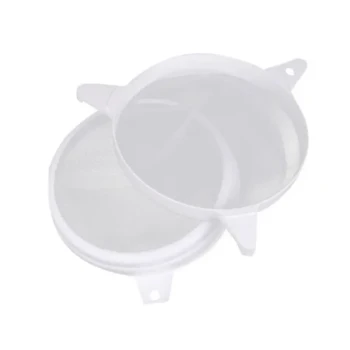
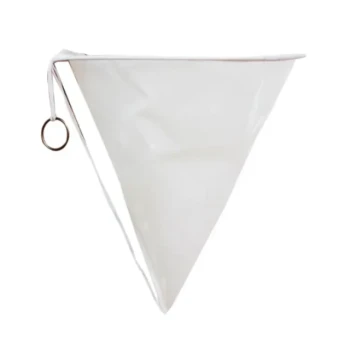
High-precision microporous sieves serve a critical quality control function by strictly regulating the particle size of powdered sugar used in mite treatments. Specifically, these sieves ensure that particles remain below 40 microns in diameter. This precise filtration creates an ultra-fine dust capable of mechanically adhering to the microscopic structures of the varroa mite.
The primary value of the sieve is its ability to filter sugar particles to a diameter of less than 40 microns. This specific size enables a biophysical control method where the powder coats the mite’s tarsal pads, causing them to lose their grip on the honeybee and fall from the hive.
The Mechanism of Biophysical Control
To understand the necessity of the sieve, one must understand the anatomy of the pest. The sieve does not merely refine the powder for application; it engineers the powder to interact with the mite's body.
Achieving the 40-Micron Threshold
The effectiveness of powdered sugar treatment is binary: it works with fine dust and fails with coarse granules. The sieve acts as a strict physical barrier, excluding any granule larger than 40 microns.
Targeting the Arolia (Tarsal Pads)
Varroa mites attach to honeybees using sticky pads between their claws, known as arolia. These pads allow the mite to maintain a powerful grip on the bee's exoskeleton.
Disrupting the Mechanical Grip
When the sieve successfully reduces the powder to the correct micron size, the particles are small enough to coat the arolia. This biophysical action clogs the sticky pads, neutralizing the mite's ability to hold on. Gravity then causes the detached mite to fall to the bottom of the hive, removing it from the host.
Distinguishing Treatment from Monitoring
It is vital to distinguish between the sieves used for preparing treatments and those used for monitoring infestation levels.
Treatment Preparation (Microporous Sieves)
As detailed above, these are used to create ultra-fine powder for physical mite removal. They focus on particle size reduction to facilitate adhesion to the mite.
Infestation Monitoring (Grading Sieves)
Conversely, laboratory grading sieves operate on a different scale. They are used during the washing phase to separate debris. Large-aperture sieves catch bee carcasses, while small-aperture sieves capture detached mites for counting. This is a diagnostic tool, not a control method.
Understanding the Trade-offs
While using microporous sieves offers a chemical-free control method, there are specific limitations to consider.
Reliance on Physical Contact
Unlike chemical miticides which distribute via contact or systemic fluids, this method relies entirely on mechanical interference. If the sieve mesh is damaged or allows particles larger than 40 microns to pass, the powder will fail to coat the arolia effectively, rendering the treatment useless.
Application Precision
The resulting powder is extremely fine. While this is necessary for efficacy, it requires careful handling to ensure it is distributed onto the bees rather than drifting away or clumping due to humidity.
Making the Right Choice for Your Goal
Select your equipment based on the specific phase of pest management you are addressing.
- If your primary focus is active mite control: Prioritize high-precision microporous sieves that guarantee a particle size under 40 microns to ensure successful disruption of the mite's grip.
- If your primary focus is infestation monitoring: Utilize multi-stage laboratory grading sieves to separate mites from bee samples for accurate population counting.
Precision in particle sizing is the difference between simply dusting a hive and successfully breaking the mechanical bond of a parasite.
Summary Table:
| Feature | Treatment Preparation (Microporous Sieve) | Infestation Monitoring (Grading Sieve) |
|---|---|---|
| Primary Goal | Active Pest Control & Removal | Diagnostic Counting & Analysis |
| Particle/Aperture Size | < 40 Microns | Multi-stage (Varies by debris type) |
| Key Mechanism | Coats mite arolia to break mechanical grip | Separates mites from bees and debris |
| Critical Component | High-precision microporous mesh | Laboratory-grade stacked frames |
Elevate Your Apiary Management with HONESTBEE Precision Equipment
At HONESTBEE, we understand that success in commercial beekeeping relies on technical precision. Whether you are a commercial apiary looking to implement chemical-free varroa control or a distributor seeking high-quality industry consumables, we provide the tools you need to succeed.
Our extensive portfolio includes:
- Specialized Machinery: High-precision sieves, hive-making units, and honey-filling machines.
- Full-Spectrum Equipment: A comprehensive range of beekeeping tools and essential consumables.
- Wholesale Solutions: Tailored bulk offerings to support large-scale operations and retail partners.
Ready to optimize your production and hive health? Contact HONESTBEE today to discover how our specialized beekeeping hardware and machinery can transform your business efficiency!
References
- Zoran Stanimirović, V. Stojić. The influence of pulverised sugar dusting on the degree of infestation of honey bee colonies with Varroa destructor. DOI: 10.2298/avb1103309s
This article is also based on technical information from HonestBee Knowledge Base .
Related Products
- Heavy-Duty Ergonomic Grip Galvanized Pollen Shovel
- Professional Stainless Steel Honey Filter with Support Handle
- Nylon Honey Strainer Square Filter Cloth for Honey Filters
- Stainless Steel Double Layer Honey Strainer Sieve Filters
- Stainless Steel Triangle Support Honey Strainer and Filters
People Also Ask
- For what reasons do beekeepers collect bee pollen? Boost Hive Health and Unlock New Revenue Streams
- Why should commercial apiaries focus on the collection of diversified bee products? Maximize Your Hive’s Profit Potential
- How do bee pollen collection tools affect the quality of bee pollen used in functional dairy ice cream production?
- How does a specialized pollen collector facilitate the harvesting of diverse bee products? Automate High-Value Yields
- What is the impact of pollen collectors and associated equipment on the cost structure of pollen production? Maximize ROI