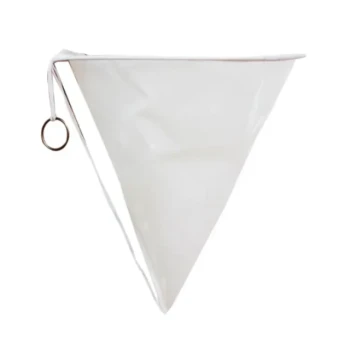
The primary function of filtration in Acacia honey pretreatment is the systematic removal of physical impurities such as wax debris, bee remains, and particulate matter introduced during collection. This purification step is essential to create a homogeneous sample base, ensuring the accuracy of subsequent physicochemical tests and protecting sensitive analytical instruments.
Core Takeaway Filtration is not merely about cleaning the sample; it is a calibration of the sample's physical state to match the analytical method. By eliminating suspended solids and macroscopic debris, filtration prevents mechanical clogging of precision instruments and removes optical interferences that distort chemical and physical data.
The Critical Role of Impurity Removal
Eliminating Macroscopic Debris
Raw Acacia honey inherently contains "coarse" contaminants from the hive environment. Filtration effectively strips away wax crumbs, bee body fragments, and plant tissue. Removing these large particulates is the baseline requirement for any standardized laboratory analysis.
Enhancing Sample Homogeneity
Large particles and pollen clumps create an uneven sample matrix. By filtering these out, the honey solution becomes uniform throughout. This consistency is vital for reproducible results in spectral analysis and general physicochemical profiling.
Protecting Precision Instrumentation
Preventing Mechanical Clogs
Advanced analytical tools like Ultra-Performance Liquid Chromatography (UPLC) and ICP-OES rely on extremely fine injection systems and nebulizers. Without filtration—often using a 0.45 µm membrane—micro-solids would rapidly block these distinct components. Filtration serves as a physical firewall, extending the lifespan of expensive laboratory hardware.
Securing Optical Accuracy
Techniques involving spectrophotometry or refractive index measurements depend on light passing clearly through the sample. Suspended particles scatter light, causing background noise and erroneous absorbance readings. Filtration clarifies the liquid, ensuring that the data reflects the honey's chemistry, not its turbidity.
Understanding the Trade-offs: Pore Size vs. Analytical Goal
The Risk of Over-Filtration
Selecting the wrong pore size can inadvertently strip the sample of valuable data. For example, using a 0.45 µm filter renders a sample useless for pollen analysis because the pollen grains are removed along with the debris. You must match the filter porosity strictly to the target analyte.
Balancing Purity and Concentration
While chemical analysis requires a perfectly clear liquid, contamination analysis (like microplastics) requires the filter to act as a trap. A 30 µm nylon mesh is used specifically to capture targets like microplastics or beeswax for study. In this context, the "debris" on the filter is actually the data source.
Making the Right Choice for Your Goal
The "correct" filtration process depends entirely on what you intend to measure after pretreatment.
- If your primary focus is Chemical Composition (e.g., sugars, minerals): Use a fine membrane filter (approx. 0.45 µm) to remove all solids, including pollen, to protect UPLC/ICP instruments and ensure optical clarity.
- If your primary focus is Melissopalynology (Pollen Analysis): Use a coarse sieve or fine-mesh metal sieve to remove bee parts and wax but allow microscopic pollen grains to pass through for slide preparation.
- If your primary focus is Contaminant Detection (e.g., Microplastics): Use a specific pore size (e.g., 30 µm nylon mesh) designed to capture and concentrate solid residues for identification.
Filtration is the defining step that converts a raw natural product into a reliable scientific variable.
Summary Table:
| Analytical Goal | Recommended Filter Pore Size | Key Benefit |
|---|---|---|
| Chemical Composition | ~0.45 µm Membrane | Protects UPLC/ICP-OES and ensures optical clarity |
| Pollen Analysis | Coarse/Fine Mesh Sieve | Removes debris while retaining microscopic pollen grains |
| Contaminant Detection | 30 µm Nylon Mesh | Captures and concentrates microplastics/solids for study |
Elevate Your Honey Production with HONESTBEE
Are you looking to scale your commercial apiary or distribution network? HONESTBEE specializes in serving commercial apiaries and distributors with a comprehensive wholesale offering. We supply the full spectrum of professional beekeeping tools, industrial honey-filling machines, and essential industry consumables.
From hive-making hardware to specialized processing equipment, we provide the tools you need to ensure product purity and operational efficiency. Contact us today to explore our wholesale solutions and see how our expertise can benefit your business!
References
- Mohammed Elimam Ahamed Mohammed, Helmey Atallah Al-Bushnaq. Some physiochemical properties of Acacia honey from different altitudes of the Asir Region in Southern Saudi Arabia. DOI: 10.17221/428/2016-cjfs
This article is also based on technical information from HonestBee Knowledge Base .
Related Products
- Electric Double Wall Honey Filtering Machine Purifier Equipment for Honey Processing Plant
- Professional Stainless Steel Honey Filtering Machine with Water Bath Heating for Beekeeping
- Professional Stainless Steel Honey Filter with Support Handle
- Professional Honey Filter with Tripod Support Stand
- Honey Concentrating and Filtering Dehumidifier Machine 2T Capacity for Honey
People Also Ask
- What types of equipment are used in honey filtering? Build an Efficient System for Pure, Marketable Honey
- What is the process of filtering honey? A Guide to Clean, Pure, and Market-Ready Honey
- What is the overall importance of using the right equipment in honey filtering? Boost Quality & Marketability
- What are the benefits of drying honey filtering equipment after use? Protect Your Honey Quality & Equipment Investment
- How should honey filtering equipment be properly maintained? Extend Equipment Life & Protect Honey Purity