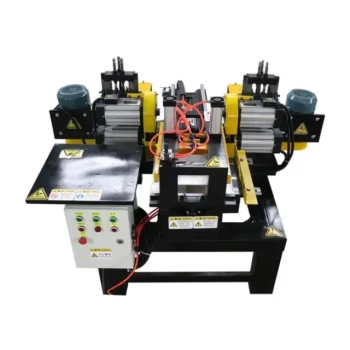
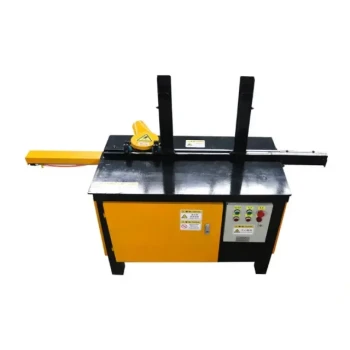
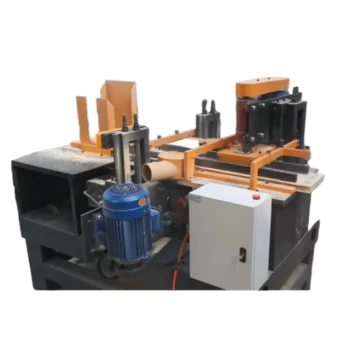
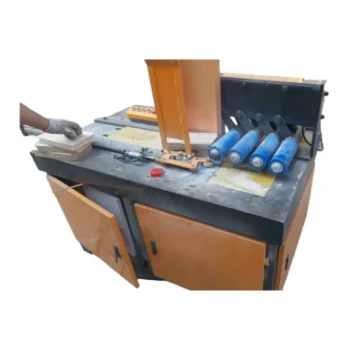
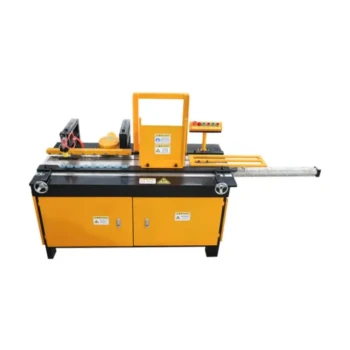
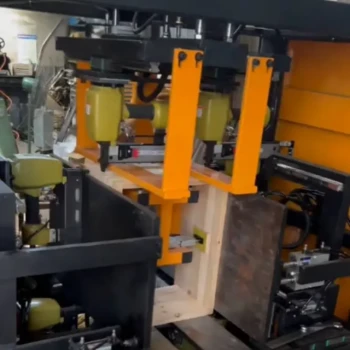
The operational sequence relies on a synchronized interaction between manual loading and automated precision machining. The process begins when an operator positions a wooden strip on the machine bed, which is immediately secured by a pneumatic clamp. Once secured, the operator initiates the cycle, prompting the saw blade assembly to travel across the wood to simultaneously cut it to length and shape the ends.
The core function of this machine is to transform pre-cut wooden strips into finished beehive components through a single-pass operation that combines pneumatic stabilization with multi-blade cutting.
Detailed Operational Workflow
Material Positioning
The operation begins manually. The operator takes a pre-cut wooden strip and places it onto the machine bed. Proper alignment at this stage is critical for the accuracy of the final cut.
Pneumatic Stabilization
Once the wood is in position, a pneumatic clamp engages. This mechanism firmly secures the wooden strip against the machine bed. This clamping action ensures the material remains strictly immobile during the high-speed cutting process.
The Cutting and Profiling Cycle
After the material is clamped, the operator initiates the cutting sequence. A specialized saw blade assembly travels across the stationary wooden strip.
Simultaneous Shaping and Sizing
During this travel, the machine performs two distinct actions at once. It utilizes precision knives to carve the required profiles (shaping) while saw blades perform cross-cuts to establish the precise length (sizing).
Key Technical Characteristics
Multi-Tool Processing
The assembly typically utilizes a combination of four precision knives and two robust saw blades. This configuration allows the machine to carve profiles and cut to specific lengths, such as 483mm or 448mm, in a single pass.
Adaptable Power System
A multi-motor system drives the cutting assembly. This provides the necessary torque to process hard or softwoods without stalling during the shaping profile cuts.
Understanding the Trade-offs
Dependency on Manual Loading
While the cutting cycle is automated, the feed mechanism is manual. The speed of production is partially dictated by the operator's efficiency in loading strips and initiating the cycle, rather than being a continuous, fully automated feed.
Pre-Processing Requirements
The machine is designed to refine strips, not process raw logs. You must ensure your input material is already processed into strips of the appropriate general dimension before introducing them to this forming machine.
Making the Right Choice for Your Goal
To determine if this machine fits your manufacturing line, consider your specific production targets:
- If your primary focus is Consistency: This machine is ideal because pneumatic clamping eliminates the vibration and movement errors common in manual cutting.
- If your primary focus is Versatility: The tooling can be adjusted for different standards (Langstroth, Dadant, British Standard), making it suitable for serving diverse global markets.
- If your primary focus is Total Automation: Be aware that this unit requires a dedicated operator to load and trigger each cycle, unlike hopper-fed systems.
This machine offers the optimal balance between manual control and automated precision for producing high-quality beehive frame components.
Summary Table:
| Operational Stage | Action Taken | Key Component Used |
|---|---|---|
| 1. Material Positioning | Manual placement of wooden strip | Machine Bed |
| 2. Stabilization | Automatic securing of the workpiece | Pneumatic Clamp |
| 3. Cutting & Profiling | Simultaneous shaping and sizing | 4 Knives & 2 Saw Blades |
| 4. Power Delivery | High-torque wood processing | Multi-Motor System |
Scale Your Beekeeping Equipment Production with HONESTBEE
Are you looking to enhance the precision and consistency of your hive frame production? HONESTBEE specializes in empowering commercial apiaries and global distributors with professional-grade machinery and comprehensive wholesale solutions.
Our Top Bar and Bottom Bar Forming Machines are engineered to deliver the perfect balance of manual control and automated accuracy, ensuring your frames meet the highest industry standards. Beyond machinery, we provide a full spectrum of beekeeping tools, specialized hardware like honey-filling machines, and essential consumables to keep your business thriving.
Partner with HONESTBEE today to optimize your manufacturing efficiency.
Contact Our Sales Team for a Quote
Related Products
- HONESTBEE Top Bar & Bottom Bar Forming Machine | Bee Frame Machine
- HONESTBEE Bee Frame Grooving Machine | Precision Slotting for Bee Frame Making
- HONESTBEE Bee Frame Side Bar Forming Machine Precision Engineered for High-Volume Production Bee Frame Machine
- Professional Bee Frame Machine for Side Bar Shaping
- Long Langstroth Style Horizontal Top Bar Hive for Wholesale
People Also Ask
- What is the primary function of the Top Bar and Bottom Bar Forming Machine? Automate Hive Frame Production Excellence
- How does the Top Bar and Bottom Bar Forming Machine process wooden strips? High-Precision Frame Component Production
- What are the key benefits of investing in the Top Bar and Bottom Bar Forming Machine? Scale Your Hive Production Now
- What customization options are available for the Top Bar and Bottom Bar Forming Machine? Engineered for Any Hive Standard
- Does the Forming Machine Create Foundation Grooves? Understanding Beekeeping Frame Manufacturing Stages