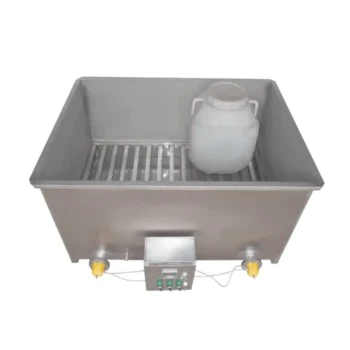
The primary function of thermostatic water bath equipment in honey processing is to provide precise, uniform, and stable temperature control for simulating critical industrial thermal stages. This equipment allows processors to manage dehumidification, liquefaction, and pasteurization while preventing localized overheating. By maintaining a constant thermal environment, it ensures the complete dissolution of sugar crystals and the reduction of moisture without destroying heat-sensitive bioactive compounds.
Core Takeaway: Thermostatic water baths are the gold standard for achieving thermal uniformity in honey processing, ensuring that physical transformations—like crystal dissolution and pasteurization—occur without compromising the honey's nutritional integrity or sensory profile.
Precision Thermal Simulation for Industrial Workflows
Simulating Multi-Stage Industrial Processing
Thermostatic water baths allow for the accurate replication of industrial stages such as dehumidification, liquefaction, and pasteurization. By setting temperatures at specific levels like 50°C, 75°C, or 100°C, operators can observe how honey reacts to heat in a controlled setting. This simulation is vital for determining the optimal parameters for large-scale production runs.
Management of the Maillard Reaction
Controlled heating facilitates the formation of new antioxidant substances through the Maillard reaction. The water bath ensures this reaction occurs uniformly throughout the sample rather than in isolated "hot spots." This consistency is essential for maintaining the antioxidant profile and color quality required for premium honey products.
Physical Transformation and Sample Standardization
Efficient Liquefaction and Crystal Dissolution
Granulated or crystallized honey requires gentle heating to restore its liquid state. A water bath provides the stable heat transfer needed to reach 55 ± 2 °C, ensuring the complete dissolution of sugar crystals. This process restores transparency and fluidity, which is a prerequisite for accurate colorimetric measurement and sensory evaluation.
Homogenization and Air Bubble Elimination
Heating honey to approximately 45°C reduces viscosity and eliminates internal air bubbles. This step is critical for optical accuracy during light absorbance measurements and physicochemical analysis. For distributors, offering equipment that ensures such high levels of sample homogenization is a key selling point for laboratory-grade clients.
Protecting Heat-Sensitive Bioactive Compounds
Excessive heat is the enemy of honey quality, specifically impacting enzymes and vitamins. The thermostatic water bath prevents localized carbonization and degradation by distributing heat energy evenly. This protects the bioactive integrity of the honey, ensuring the final product meets strict nutritional standards.
Understanding the Trade-offs
Thermal Inertia and Response Times
While water baths provide superior uniformity, they exhibit significant thermal inertia. This means they take longer to reach a target temperature compared to direct heating methods. For high-volume wholesalers, this requires precise scheduling and efficient order fulfillment planning to account for longer preparation cycles.
Maintenance and Scalability Limitations
Water baths require regular cleaning and mineral management to prevent scale buildup, which can impair heat transfer. Furthermore, while they are excellent for precision and small-to-medium batches, they may not be the most energy-efficient solution for ultra-large-scale bulk processing where continuous-flow heat exchangers are more common.
Making the Right Choice for Your Goal
As a distributor or reseller, your recommendation should align with your client's specific operational scale and quality requirements.
- If your primary focus is Laboratory Analysis and Quality Control: Prioritize high-efficiency models with digital controllers that offer a precision of ±0.1°C to ensure repeatability in palynological and colorimetric tests.
- If your primary focus is Small-Batch Premium Processing: Recommend units with larger capacities that can accommodate multiple containers, ensuring uniform liquefaction for creamed honey production.
- If your primary focus is Speed and High-Volume Sourcing: Look for equipment with rapid-heat features and robust builds that can handle the rigors of continuous daily operation in a busy fulfillment center.
Utilizing professional-grade thermostatic equipment is the most reliable way to guarantee that honey retains its natural value while meeting the rigorous physical standards of the global market.
Summary Table:
| Process Stage | Temperature / Function | Key Benefit in Honey Processing |
|---|---|---|
| Liquefaction | 55 ± 2 °C | Dissolves crystals and restores fluidity without overheating. |
| Homogenization | ~45 °C | Reduces viscosity and eliminates air bubbles for optical clarity. |
| Pasteurization | 75 °C - 100 °C | Simulates industrial thermal stages to ensure product safety. |
| Quality Control | High Precision (±0.1°C) | Protects heat-sensitive enzymes and bioactive compounds. |
| Maillard Reaction | Controlled Heating | Ensures uniform color development and antioxidant profile. |
Scale Your Honey Business with HONESTBEE Precision
Elevate your wholesale inventory with HONESTBEE’s professional-grade honey processing solutions. As a premier one-stop partner for commercial apiaries and B2B resellers, we provide a full spectrum of beekeeping tools—from specialized hive-making and honey-filling machinery to precision laboratory equipment.
Why partner with HONESTBEE?
- Comprehensive Portfolio: Access everything from industrial consumables to high-tech processing hardware.
- Reliable Fulfillment: Benefit from our ultra-fast delivery and efficient order processing.
- Industry Expertise: Leverage our deep technical knowledge to support your OEM/ODM requirements and maximize profit margins.
Ready to enhance your supply chain with premium beekeeping equipment? Contact our expert team today to discuss wholesale opportunities and custom solutions.
References
- Mahani Mahani, Edy Subroto. Changes of antioxidant properties of Indonesian honey under heat treatment. DOI: 10.35219/foodtechnology.2024.1.06
This article is also based on technical information from HonestBee Knowledge Base .
Related Products
- Professional Stainless Steel Honey Filtering Machine with Water Bath Heating for Beekeeping
- Professional Thermostatic Conical Honey Melter
- Heavy Duty Stainless Steel Honey Processing Machine Decrystallizing Tank
- Double Wall Honey Heating Stirring Homogenizer Mixing Machine with Various Capacity
- Electric Double Wall Honey Filtering Machine Purifier Equipment for Honey Processing Plant
People Also Ask
- Why is filtering honey an important step in honey processing? Ensure Purity, Clarity & Marketability
- Is it necessary to filter honey after extraction? A Guide to Straining vs. Raw Honey
- Why do people filter honey? For Clarity, Stability, and Consumer Appeal
- What is the best way to filter honey? A Guide to Quality, Clarity, and Raw Preservation
- What are the benefits of using honey filters? Achieve Purity, Efficiency, and Market Appeal