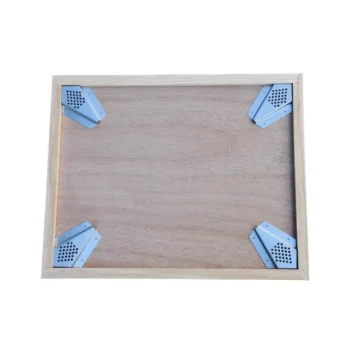
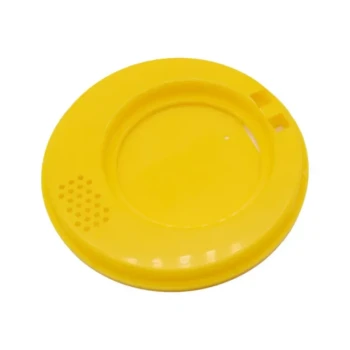
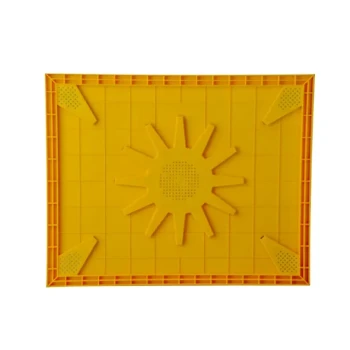
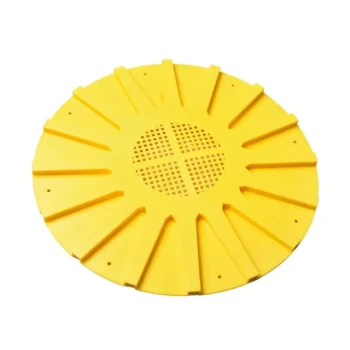
A bee maze serves as a passive filtration system for the hive. Installed specifically between the brood chamber and the honey super, it acts as a mechanical check valve. Its design provides a one-way passage that allows bees to travel down from the honey frames into the brood nest but physically prevents them from navigating back up, leaving the honey super empty and ready for harvest.
The bee maze shifts honey harvesting from an active, high-contact task to a passive, low-stress process. By relying on a one-way exit mechanism, it clears frames automatically over time, eliminating the need to physically sweep or smoke bees off individual honeycombs.
The Mechanics of the Bee Maze
Strategic Placement
The bee maze is a specialized board placed between two specific distinct sections of the hive.
It sits directly above the brood chamber (where the queen and larvae reside) and below the honey super (where surplus honey is stored).
The One-Way Principle
The core function of the board is directional control.
The device contains specific geometric paths or valves that bees can easily traverse in a downward direction.
However, the design makes the return path—moving upwards from the brood chamber to the honey super—confusing or physically impossible for the bees to navigate.
Clearing the Super
Over a period of time, bees naturally move down toward the brood chamber for warmth and to tend to the colony.
Once they exit the honey super through the maze, they cannot return.
This effectively evacuates the upper box, leaving the frames clear of bees for the beekeeper to remove without conflict.
Comparing Removal Methods
Passive vs. Active Clearing
To understand the value of a bee maze, it must be compared to active tools like bee brushes.
Supplementary data indicates that brushes are designed with long, soft bristles to gently sweep bees off frames during inspection or harvest.
While effective, brushing requires handling every individual frame and can agitate the colony if not done with extreme care.
A bee maze eliminates this manual labor, clearing the entire box at once without the beekeeper touching a single frame.
Reducing Chemical Intervention
Another common method for clearing bees involves using a smoker.
Smokers work by generating cool smoke to disrupt alarm pheromones and induce a feeding response, masking defensive behavior to keep the colony calm.
While smokers are essential for safety, using a bee maze reduces the volume of smoke needed during the actual harvest, as the bees have already removed themselves from the area.
Understanding the Trade-offs
Time Requirements
The primary trade-off of a bee maze is that it is not instantaneous.
Unlike brushing or smoking, which allow for immediate harvesting, a bee maze typically requires installation 24 to 48 hours prior to the extraction.
Installation Effort
Using a maze requires two trips to the hive: one to install the board and a second to remove the honey.
Beekeepers prioritizing single-trip efficiency may find this logistical requirement cumbersome compared to active removal methods.
Making the Right Choice for Your Goal
Ideally, the choice of tool depends on your specific harvesting timeline and philosophy.
- If your primary focus is minimal stress on the colony: Use a bee maze to allow bees to vacate the honey super naturally without physical handling or excessive smoke.
- If your primary focus is speed and efficiency: Rely on a bee brush and smoker to clear frames immediately during a single site visit.
Ultimately, the bee maze is the superior tool for beekeepers who prioritize a calm, chemical-free extraction environment over speed.
Summary Table:
| Feature | Bee Maze (Passive) | Bee Brush & Smoker (Active) |
|---|---|---|
| Mechanism | One-way directional exit | Manual removal / Pheromone disruption |
| Colony Stress | Very Low | Moderate to High |
| Time to Clear | 24 - 48 Hours | Immediate |
| Labor Level | Minimal (Passive) | Intensive (Frame-by-frame) |
| Chemical Use | None required | Requires smoke/repellents |
| Best For | Large harvests & calm extraction | Quick, single-trip inspections |
Scale Your Apiary Efficiency with HONESTBEE
Transition to high-yield, low-stress honey production with professional-grade equipment. As a dedicated partner to commercial apiaries and global distributors, HONESTBEE provides more than just tools—we deliver comprehensive solutions for the modern beekeeping industry.
Whether you need precision bee mazes and specialized hardware, industrial-scale honey-filling machines, or a full inventory of essential consumables, our wholesale offering is designed to optimize your operations. From hive-making machinery to honey-themed cultural merchandise, we equip you with the quality and scale needed to succeed in a competitive market.
Ready to elevate your wholesale supply chain? Contact HONESTBEE today to discuss our bulk solutions
Related Products
- High-Efficiency Diamond Maze Bee Escape for Clearing Supers
- HONESTBEE Wooden Bee Escape Board with Triangle Mesh Design for Beekeeping
- Assembled Wooden Bee Frames with Beeswax Foundation Ready to Use by HONESTBEE
- HONESTBEE 4-Way Metal Corner Wooden Bee Escape Board
- Professional Cone Style Bee Escape for Efficient Honey Harvesting
People Also Ask
- How can bees be cleared off honey supers in a Langstroth hive? Use a Gentle Bee Escape
- How can a bee escape be adapted for use in a Warre hive? Effective Customization Methods for Successful Harvesting
- What are some common types of bee escapes and how are they typically mounted? Optimize Your Honey Harvest Efficiency
- What is a bee escape and why is it used in beekeeping? A Guide to Gentle Honey Harvesting
- What is the primary function of a bee escape? Simplify Your Honey Harvest with Stress-Free Hive Management