The primary purpose of heating honey samples to 35-40°C is to significantly reduce viscosity. By maintaining this temperature for several minutes, the honey becomes fluid enough to permit the thorough mixing of all components. This reduction in resistance ensures that internal standard spikes are distributed uniformly throughout the sample matrix, which is the foundational requirement for precise analytical results.
Honey’s natural thickness presents a barrier to accurate scientific analysis. Controlled heating transforms the sample into a homogeneous fluid, ensuring that every aliquot tested is chemically identical and physically representative of the whole batch.
The Mechanics of Sample Preparation
Overcoming Physical Resistance
Honey is naturally viscous, which inhibits the movement of added reagents. The primary reference dictates that heating the sample to 35-40 degrees Celsius lowers this viscosity to a workable level.
This physical change is not merely for ease of handling; it is a critical pretreatment step. It transforms a semi-solid substance into a fluid matrix capable of accepting additives.
Ensuring Chemical Homogeneity
Once the viscosity is reduced, the sample can be thoroughly mixed. This is vital for the uniform distribution of internal standard spikes.
Without this thermal step, internal standards might remain localized, leading to significant variations in data. Proper mixing guarantees that the internal standard signals accurately reflect the analyte concentration across the entire sample.
Optimizing for Optical and Physical Accuracy
Eliminating Optical Interferences
Beyond viscosity, heating serves to dissolve sugar crystals and eliminate trapped air bubbles.
In color analysis or optical measurements, crystals and bubbles scatter light, creating noise in the data. A clear, warmed sample ensures that digital image acquisition and optical readings are based on the honey itself, not physical defects.
Standardizing Particle Distribution
For analyses involving suspended solids, such as pollen, high viscosity causes uneven sedimentation. This can lead to statistical bias where the sample analyzed does not represent the whole.
Heating allows for proper homogenization, ensuring suspended particles like pollen grains are distributed evenly throughout the diluent.
Understanding the Trade-offs
The Danger of Overheating
While heating is necessary, the upper limit of 40°C is strict for a reason. Exceeding this temperature risks degrading heat-sensitive antioxidant components.
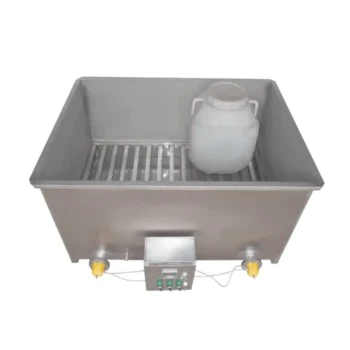
It is crucial to use precise, stable heating methods (like a water bath) rather than direct, aggressive heat. This prevents localized overheating that could alter the biochemical indicators you are trying to measure.
Balancing Dissolution with Integrity
The goal is rapid and complete dissolution, but not at the cost of sample integrity.
A mild, constant temperature facilitates mixing with distilled water or solvents efficiently. However, aggressive heating to speed up this process will compromise the chemical fidelity of the sample.
Making the Right Choice for Your Goal
To maximize the accuracy of your specific analytical method, consider the following:
- If your primary focus is Chemical Quantification: Ensure the temperature is held long enough to allow the internal standard to disperse perfectly evenly.
- If your primary focus is Color or Optical Analysis: Prioritize the removal of air bubbles and the complete dissolution of sugar crystals to ensure clarity.
- If your primary focus is Biochemical Activity: Maintain strict temperature controls to avoid exceeding 40°C, preserving sensitive antioxidants.
- If your primary focus is Pollen Analysis: Use the reduced viscosity to homogenize the suspension, preventing sedimentation bias.
Correct thermal pretreatment turns a variable, viscous natural product into a reliable scientific standard.
Summary Table:
| Objective | Action | Scientific Benefit |
|---|---|---|
| Viscosity Reduction | Heat to 35-40°C | Enables fluid mixing and uniform reagent distribution |
| Chemical Homogeneity | Thorough Stirring | Ensures internal standards are evenly distributed for accurate data |
| Optical Clarity | Crystal Dissolution | Eliminates light scattering from sugar crystals and air bubbles |
| Sample Integrity | Strict Temperature Control | Prevents degradation of heat-sensitive antioxidants |
Elevate Your Honey Processing Precision with HONESTBEE
Achieving scientific accuracy in honey analysis starts with the right equipment. HONESTBEE provides professional-grade tools and machinery designed specifically for commercial apiaries and distributors. Whether you need precise honey-filling machines to handle specific viscosities or comprehensive beekeeping equipment to maintain batch integrity, we have the expertise to support your operation.
From specialized hardware to essential industry consumables, our portfolio is built to enhance your productivity and product quality. Contact us today to explore our wholesale solutions and expert machinery—let’s optimize your honey production together!
References
- Żaneta Bargańska, Jacek Namieśnik. Honey bees and their products: Bioindicators of environmental contamination. DOI: 10.1080/10643389.2015.1078220
This article is also based on technical information from HonestBee Knowledge Base .
Related Products
- Stainless Steel Heated Honey Tank Warming Heating Tank
- Honey Tank Heater Drum Heating Blanket for Honey Barrel
- 0.5T Capacity Honey Dehumidifier Dryer with Vacuum Heating and Thickening Filtering Machine
- Silicone Rubber Honey Drum Heating Belt
- Honey Concentrating Vacuum Heating Thickening Machine Dehumidifier for Honey
People Also Ask
- What are the benefits of precise temperature control in honey heating tanks? Preserve Quality and Efficiency
- How do honey heating tanks offer scalability for growing beekeeping operations? Strategic Equipment Growth Solutions
- What features of a honey heating tank contribute to hygiene? Ensure Purity with Stainless Steel & Sanitary Design
- What is the primary role of a honey heating tank? Enhance Your Honey Processing Flow and Quality
- What is the purpose of using heating tanks or constant temperature water baths in honey dehydration? Optimize Purity & Flow