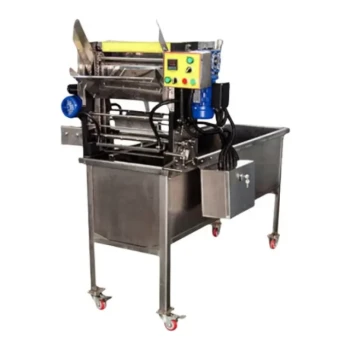
To recover residual honey manually, the recommended method is to hold the wet frames over a honey bucket equipped with a filter and shake them vigorously.
This simple, manual action uses inertia to dislodge the remaining honey that mechanical extractors may have missed or that clings to the comb, allowing you to collect it before the frames are cleaned or put into storage.
Core Takeaway While mechanical extraction removes the bulk of the harvest, manual shaking provides a final opportunity to capture remaining honey. By vigorously shaking frames over a filtered bucket, beekeepers can minimize waste and maximize their total yield without complex equipment.
The Mechanics of Manual Recovery
The Shaking Technique
The primary method for salvaging residual honey relies on physical force. By holding the frame securely and shaking it sharply downward over a collection vessel, you generate enough force to throw the remaining viscous liquid out of the cells.
This process is intended for "wet frames"—frames that have typically already undergone a primary extraction or uncapping but still retain a coating of valuable honey.
The Necessity of Filtration
You must perform this shaking directly over a honey bucket fitted with a filter or sieve.
As you shake the frames, you will inevitably dislodge small particles of wax cappings or other impurities along with the honey. The filter ensures that the final product collected in the bucket is clean and ready for bottling, separating the honey from the debris.
Understanding the Trade-offs
Manual Effort vs. Mechanical Efficiency
While the shaking method is effective for residuals, it is physically demanding. Unlike a honey extractor, which uses centrifugal force to spin honey out of multiple frames simultaneously via a hand crank or motor, shaking is done one frame at a time.
This makes it excellent for maximizing yield on a small scale, but potentially impractical for large commercial operations where speed is the priority.
Comparison to Other Manual Methods
It is important to distinguish this method from "crush-and-strain." Crush-and-strain involves breaking the wax comb entirely to release honey.
The shaking method preserves the structural integrity of the comb (similar to centrifugal extraction), allowing the drawn comb to be reused by the bees.
Safety Considerations
Note that "shaking" is also a term used for dislodging bees from frames. However, when recovering honey, the frames must be completely free of bees.
Shaking frames while bees are present can cause them to become highly active and aggressive. Ensure the frame is clear of livestock before attempting to shake out residual honey.
Making the Right Choice for Your Goal
To determine if this extra step is right for your workflow, consider your volume and objectives:
- If your primary focus is minimizing waste: Incorporate the vigorous shaking method into your workflow immediately after mechanical extraction to capture every possible drop.
- If your primary focus is speed and efficiency: Rely primarily on the centrifugal force of your extractor, accepting that a thin film of honey may remain on the wet frames.
Every drop of honey represents significant effort by the colony; manual shaking is the most respectful way to ensure that effort makes it into the jar.
Summary Table:
| Method Component | Detail | Purpose |
|---|---|---|
| Primary Action | Vigorous downward shaking | Dislodges honey via inertia |
| Equipment Used | Honey bucket with filter/sieve | Collects honey while removing wax debris |
| Target State | Post-extraction "Wet Frames" | Captures remaining honey missed by machinery |
| Comb Preservation | Preserved (No crushing) | Allows for immediate reuse of drawn comb |
| Safety Check | Clear of all bees | Prevents bee aggression and contamination |
Maximize Your Apiary's Efficiency with HONESTBEE
Every drop of honey counts, and having the right tools makes all the difference. At HONESTBEE, we specialize in supporting commercial apiaries and distributors with high-performance beekeeping machinery and essential supplies.
Whether you need precision honey-filling machines to bottle your manual harvest, heavy-duty extractors to reduce residuals, or wholesale beekeeping tools, we provide the hardware and consumables to scale your operations. From specialized hive-making equipment to honey-themed merchandise, we help you optimize every stage of production.
Ready to upgrade your apiary? Contact us today to explore our comprehensive wholesale solutions and boost your yield!
Related Products
- Stainless Steel 3 Frame Manual Honey Extractor Spinner for Bee Honey Extraction
- Manual Hand Crank 4 Frame Honey Extractor Centrifuge for Beekeeping
- HONESTBEE 3-Frame Manual Acrylic Honey Extractor
- electric honey extractor honey centrifuge 3 frame honey extractor stainless steel honey frame extractor
- Stainless Steel Manual 8 Frame Radial Honey Extractor Machine for Beehives
People Also Ask
- Which type of honey extractor is generally more durable? Focus on Material & Build Quality for Longevity
- What are the disadvantages of a manual honey extractor? Overcome Efficiency Bottlenecks in Your Apiary
- What is a manual honey extractor? The Essential Guide to Cost-Effective Beekeeping for Beginners
- Why are manual extractors popular among beginner beekeepers? A Guide to Starting Simple & Saving Money
- What are the primary advantages of utilizing a manual honey extractor? Cost-Effective & Gentle Harvesting