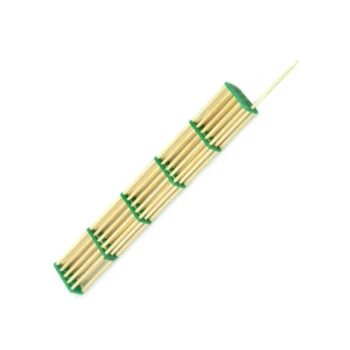
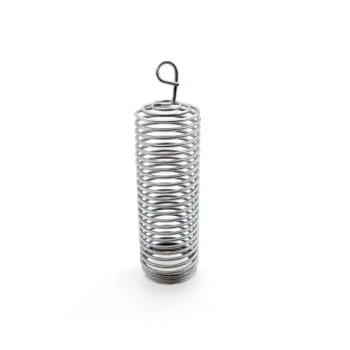
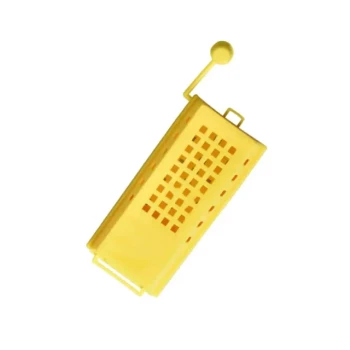
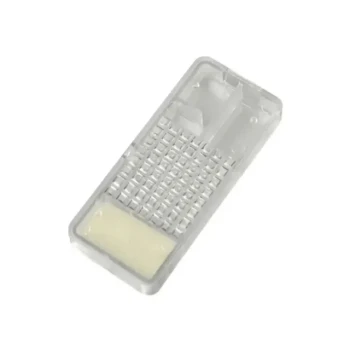
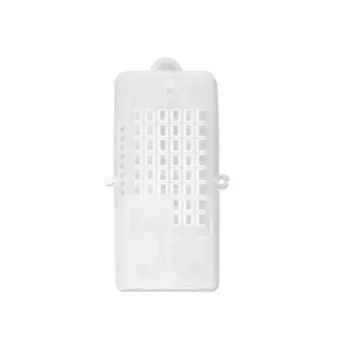
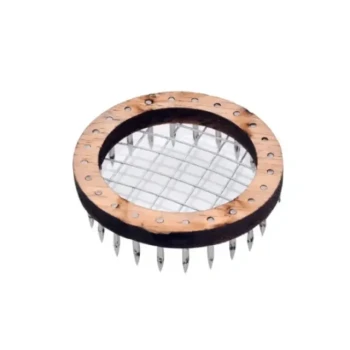
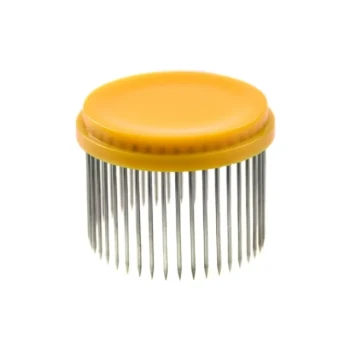
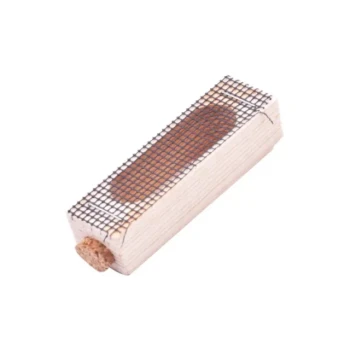
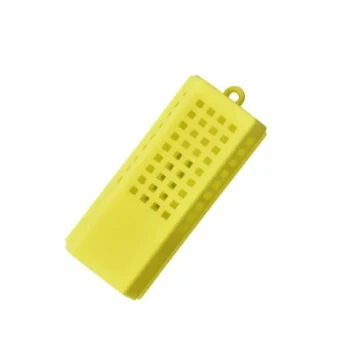
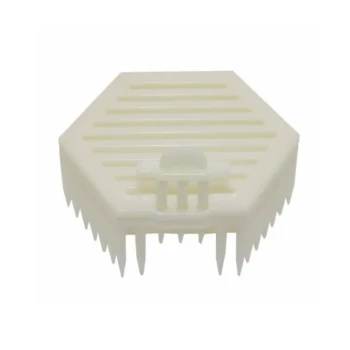
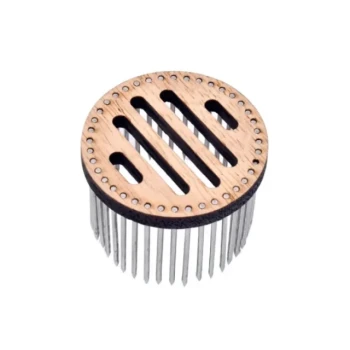
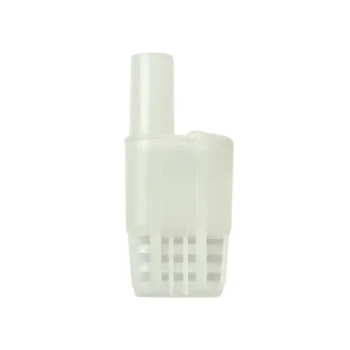
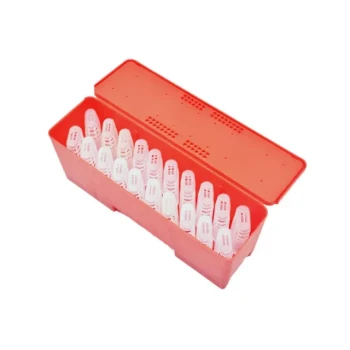
The primary role of specialized queen isolation cages in Varroa management is to artificially halt egg-laying to create a broodless period within the colony. By confining the queen to a restricted space, you force the colony into a state where no larvae are being capped. This eliminates the protective shield Varroa mites use for reproduction, exposing the entire mite population to treatment.
Core Takeaway The greatest obstacle in Varroa management is the "capped brood shield," which protects mites from most chemical treatments. Queen isolation removes this shield, forcing 100% of the mites onto adult bees (the phoretic stage), where they become highly vulnerable to eradication methods like oxalic acid.
The Biological Mechanism
The Challenge of Capped Brood
Under normal conditions, a significant portion of the Varroa mite population exists inside sealed (capped) brood cells.
In this environment, mites reproduce safely on developing larvae. Most importantly, the wax capping acts as a physical barrier, protecting these mites from many liquid and vapor-based miticides.
Forcing the Phoretic Stage
The isolation cage solves this by stopping the production of new brood.
Once the queen is confined, no new eggs are laid. Over the course of approximately 21-24 days, all existing brood will emerge. At this specific moment, the colony becomes "broodless."
Without brood cells to hide in, every surviving mite is forced onto the bodies of adult bees. This is known as the phoretic stage.
Increasing Treatment Efficacy
When the mite population is entirely phoretic, the kill rate of treatments increases dramatically.
Treatments that are typically "soft" or flash-acting, such as oxalic acid, become lethal to the entire mite population rather than just the percentage riding on bees. This allows for a "clean sweep" of the infestation without using persistent, hard chemicals.
Strategic Implementation
Total Brood Interruption
The most common strategy is a complete halt of the reproductive cycle.
The queen is caged for a specific duration (often roughly equivalent to the brood cycle). Once the hive is free of capped brood, a treatment is applied. This method is highly effective for a "hard reset" of mite levels, particularly before winter or during nectar dearths.
Targeted Brood Concentration
Some frame-type isolation tools allow for a slightly different approach: concentrated brooding.
Instead of stopping egg-laying entirely, the queen is restricted to a single frame. This traps the mites into a specific area as they enter the only available cells to reproduce.
Beekeepers can then remove this specific "trap frame" or treat the colony when mites are concentrated, allowing for precise infestation calculations and reduced chemical exposure for the rest of the hive.
Understanding the Trade-offs
Colony Stagnation
The most obvious downside is the pause in colony growth.
By stopping egg-laying, you are creating a future gap in the workforce. This strategy must be timed carefully so it does not coincide with a major nectar flow, as a reduction in population could impact honey harvest.
Queen Stress
Confinement carries risks for the queen.
Prolonged restriction in a small cage can be stressful. If not managed correctly, or if the cage design prevents proper interaction with nurse bees, the queen's health or acceptance by the colony upon release could be compromised.
Management Intensity
This is not a "set it and forget it" method.
It requires precise timing. You must cage the queen, calculate the days until brood emergence, return to treat the hive at the exact right window, and then release the queen. Missing the window allows mites to re-enter new brood cells, negating the effort.
Making the Right Choice for Your Goal
If your primary focus is Maximum Mite Eradication: Use isolation cages to create a totally broodless period, then apply a flash treatment (like oxalic acid) to kill virtually all mites while they are exposed on adult bees.
If your primary focus is IPM and Monitoring: Use frame-restriction tools to concentrate brood, allowing you to measure infestation rates per cell accurately and determine if chemical intervention is actually necessary.
If your primary focus is Reducing Chemical Residue: Utilize this physical intervention to make "softer" organic acids highly effective, eliminating the need for lipophilic (wax-absorbing) synthetic miticides.
By manipulating the biological cycle of the bee, you remove the Varroa mite's greatest advantage—its ability to hide.
Summary Table:
| Feature | Mechanism | Primary Benefit |
|---|---|---|
| Brood Interruption | Halts egg-laying to create a broodless state | Forces 100% of mites into the vulnerable phoretic stage |
| Targeted Concentration | Restricts queen to a single "trap frame" | Concentrates mites for easy removal or precise monitoring |
| Treatment Synergy | Removes physical barriers (wax cappings) | Dramatically increases the efficacy of organic acids (e.g., Oxalic) |
| Chemical Reduction | Uses physical management over synthetics | Prevents chemical residue buildup in wax and honey |
Elevate Your Apiary Management with HONESTBEE
Are you ready to implement a professional-grade Integrated Pest Management (IPM) strategy? At HONESTBEE, we specialize in supporting commercial apiaries and distributors with high-quality, durable beekeeping tools, machinery, and specialized hardware.
From precision queen isolation cages and hive-making equipment to advanced honey-filling machines, our comprehensive wholesale offering is designed to increase your operational efficiency and colony health. Partner with us to access professional-grade consumables and expert equipment tailored for large-scale success.
Ready to scale your beekeeping operation?
Contact HONESTBEE Today for Wholesale Pricing and Expert Support
References
- Mariia Fedorіak, V. Jos. IMPACT OF WAR ON THE WINTER SURVIVAL OF BEE COLONIES IN UKRAINE: MONITORING RESULTS FOR 2023-2024. DOI: 10.31861/biosystems2025.01.131
This article is also based on technical information from HonestBee Knowledge Base .
Related Products
- Professional Bamboo Queen Isolation Cage
- Durable Galvanized Steel Spring Queen Bee Cage
- Professional Queen Cage with Sliding Gate and Feeder Plug
- Professional Queen Bee Introduction and Transport Cage
- Professional Multi-Functional Queen Bee Cage
People Also Ask
- Why are specialized queen bee cages used for the banking of mated queen bees? Maximize Commercial Apiary Storage Efficiency
- What is the mechanism of action for using temporary queen bee cages? Master Successful Queen Introduction
- How does the side ventilation design of a queen bee cage impact the safety of the queen during long-distance transport?
- What should you do if the queen is still in the cage and the worker bees have not accepted her? Protect Your Colony from Queen Rejection
- What technical precaution must be taken regarding the mesh or grill side of a queen bee cage? Ensure Queen Survival