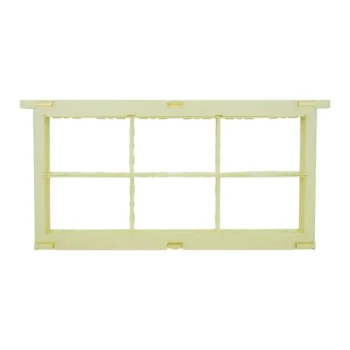
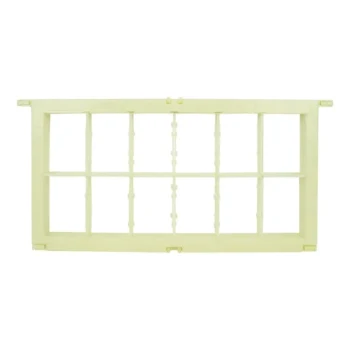
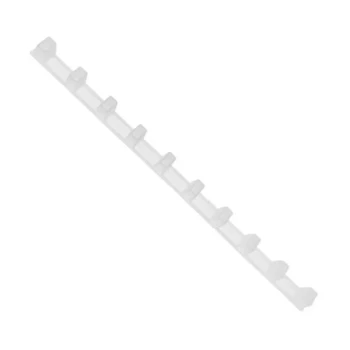
The 5x5 cm square grid frame serves as a precision instrument for converting visual colony observations into hard data. Its specific function is to quantify the area of capped brood on a honeycomb, which allows for the calculation of the queen bee's average daily egg-laying rate. By standardizing the measurement area, this tool provides the objective data necessary to evaluate colony fertility and the effectiveness of supplemental feeding programs.
Core Takeaway This tool bridges the gap between visual estimation and scientific measurement. By segmenting the comb surface into standardized 25 cm² units—where each unit represents approximately 100 cells—it allows apiarists to derive precise reproductive metrics essential for determining the efficacy of nutritional interventions.
Transforming Observation into Metric Data
The Mechanics of Measurement
To evaluate a colony, the grid frame is placed directly over the honeycomb. This physical overlay divides the complex, organic structure of the comb into fixed statistical units.
The Critical Conversion Factor
The utility of the 5x5 cm grid relies on a standard conversion ratio. One grid square (25 cm²) typically corresponds to approximately 100 honeycomb cells.
Eliminating Estimation Errors
Without a grid, assessing colony strength is subjective and prone to "visual estimation" errors. The grid frame forces a count of specific squares, converting qualitative observations of "strength" into precise numerical values.
Assessing Reproductive Performance
Calculating the Egg-Laying Rate
The primary output of this tool is the queen’s average daily egg-laying rate. By counting the squares covered by capped brood and applying the cell conversion factor, technicians can mathematically determine how many eggs the queen is producing over a specific period.
Quantifying Colony Development
Beyond the queen, the grid measures the colony's capacity to rear brood. It provides a specific count of sealed brood cells, which acts as a direct indicator of the colony's current development stage and future population potential.
Validating Nutritional Interventions
Measuring Feeding Impact
The grid is the standard tool for evaluating "input vs. output" in apiary management. It is specifically used to generate data on how supplemental feeding processes impact colony fertility.
Comparative Analysis
When testing different nutritional strategies, such as probiotic supplements or antioxidant agents, the grid provides the baseline data needed for comparison. It allows for a scientific evaluation of whether a specific intervention successfully accelerated colony buildup or improved queen fecundity.
Understanding the Trade-offs
Precision vs. Approximation
While significantly more accurate than visual guessing, the "100 cells per square" metric is an approximation. Variations in cell size or comb irregularities can introduce slight margins of error compared to counting every individual cell manually.
Intrusiveness of Measurement
Using the grid requires opening the hive and manipulating individual frames to overlay the tool. This process is more invasive than external monitoring (like weight scales) and requires careful handling to avoid disrupting the colony or damaging the brood during measurement.
Making the Right Choice for Your Goal
To effectively utilize a 5x5 cm grid frame in your apiary management, consider your specific objectives:
- If your primary focus is evaluating nutritional supplements: Use the grid to take baseline measurements of capped brood before starting the feed, and compare them against measurements taken after the feeding cycle.
- If your primary focus is queen breeding: Use the calculated daily egg-laying rate as a primary selection criterion to identify the most prolific queens for propagation.
Standardizing your measurement protocols transforms beekeeping from an art of observation into a science of precise management.
Summary Table:
| Metric Category | 5x5 cm Grid Function / Value | Practical Application |
|---|---|---|
| Measurement Unit | 25 cm² (approx. 100 cells) | Standardizes brood area data |
| Core Calculation | Queen's daily egg-laying rate | Evaluates queen fecundity and health |
| Colony Growth | Quantifying sealed brood cells | Predicts future population trends |
| Feeding Impact | Input vs. Output data | Validates supplemental feeding efficacy |
| Accuracy Level | High precision data points | Replaces subjective visual estimation |
Transform Your Apiary Productivity with HONESTBEE
Are you looking to scale your commercial apiary operations or expand your distribution portfolio? HONESTBEE specializes in empowering commercial beekeepers and distributors with the high-precision tools needed to turn observation into profit.
From 5x5 cm grid frames and specialized hardware to industrial honey-filling machines and hive-making equipment, we provide the full spectrum of professional beekeeping machinery and essential consumables. Our expertise helps you accurately measure colony performance and optimize your production efficiency.
Ready to elevate your beekeeping business with professional-grade solutions?
Contact HONESTBEE Today to explore our comprehensive wholesale offerings and discover how our equipment can drive your success.
References
- D.A. Blagov, Irina Nukolaevna Kolchaeva. The use of protein and other biologically active substances in feeding honey bees. DOI: 10.28983/asj.y2022i12pp54-57
This article is also based on technical information from HonestBee Knowledge Base .
Related Products
- HONESTBEE Wired and Assembled Wooden Bee Frames Foundation for a Thriving Hive
- Assembled Wooden Bee Frames with Plastic Foundation for Durability and Convenience by HONESTBEE
- Assembled Wooden Bee Frames with Beeswax Foundation Ready to Use by HONESTBEE
- Professional 500g Sectional Comb Honey Frame System for Beekeeping
- Professional Sectional Comb Honey Frame with 250g Cassette System for Beekeeping
People Also Ask
- What role does replacing foundation and frames play in controlling American Foulbrood (AFB)? A Key to Hive Sanitation
- What is the role of frames and foundation in a bee hive? Build a Stable and Productive Apiary with Modern Design
- What is the difference between frames and foundation in a bee hive? A Guide to Hive Structure and Comb Building
- What is the purpose of frames and foundations in a beehive? Achieve a Healthy, Manageable Hive
- How do wooden and plastic hive frames compare in terms of durability? Wood vs. Plastic Longevity & Repairability