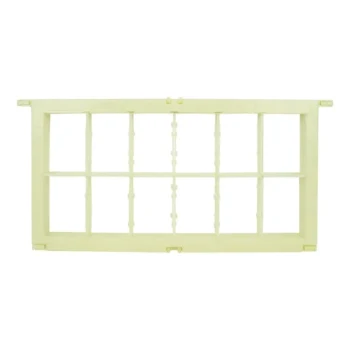
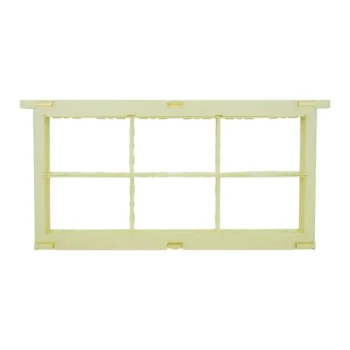
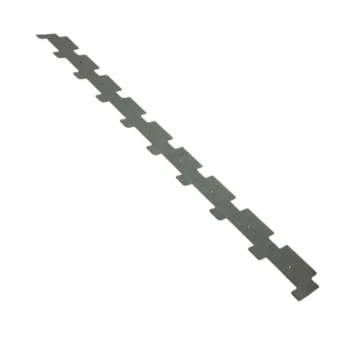
The structure of a honeycomb frame with pre-formed cells functions as a collaborative scaffold between the beekeeper and the colony. Instead of starting from a flat surface or scratch, these frames feature cells that are partially constructed. The bees accept this head start and seamlessly integrate it into their workflow, adding their own wax to finish the walls, filling the cells with nectar to process into honey, and capping them exactly as they would in a natural setting.
The central utility of a pre-formed frame is that it reduces, but does not eliminate, the construction burden on the colony. The core insight is that bees do not treat these frames as foreign objects; they treat them as a foundation to be "completed" using their own natural wax and biological processes.
The Physical Structure
Partially Formed Architecture
The defining characteristic of this frame style is its depth. Unlike a flat foundation sheet, the cells are partly pre-formed.
This provides a three-dimensional guide for the bees. It dictates the cell size and pattern immediately, removing the need for the colony to lay out the initial geometric footprint of the comb.
The Role of Natural Wax
While the base structure is provided, the comb is not "finished" until the bees interact with it.
The reference notes that bees "complete the comb with their own wax." This implies that the bees must secrete wax to extend the cell walls to the appropriate depth for brood rearing or honey storage.
The Colony's Workflow
Processing Nectar
Once the bees have extended the cell walls to their satisfaction, the frame functions identically to natural comb.
The bees utilize the space to store gathered resources. They fill these pre-formed, bee-completed cells with nectar, which they then enzymatically process and dehydrate to create honey.
The Capping Process
The final stage of the honey production cycle remains unchanged by the frame's structure.
Once the honey reaches the correct moisture content, the bees "cap the cells as they would normally." The pre-formed nature of the base does not alter this preservation behavior.
Understanding the Operational Dynamics
It Is Not a "Zero-Labor" Solution
A critical distinction for the user is that these frames are not "ready-to-harvest" upon insertion.
The bees must still expend energy to produce wax. The frame reduces the volume of wax needed compared to drawing from scratch, but it requires active participation from the colony to become functional.
Integration with Natural Instincts
The structure allows for natural biological behaviors to continue uninterrupted.
Because the bees cap the cells normally, the frame supports the standard hive lifecycle of foraging, processing, and sealing.
How to Apply This to Your Project
By understanding that these frames are a hybrid of pre-formed structure and natural finish, you can better predict hive activity.
- If your primary focus is accelerating honey storage: This structure is advantageous because bees spend less time building the hive's foundation and can move quickly to nectar processing.
- If your primary focus is observing natural behavior: Note that while the foundation is artificial, the bees still perform their essential tasks of wax secretion and capping.
These frames effectively bridge the gap between human management and bee biology, providing a head start while relying on the colony to finish the job.
Summary Table:
| Feature | Description | Benefit |
|---|---|---|
| Physical Architecture | Three-dimensional, partially pre-formed cell walls | Provides a geometric guide and dictates cell size immediately. |
| Wax Integration | Bees extend walls with their own secreted natural wax | Seamlessly combines artificial foundation with natural bee biology. |
| Storage Utility | Suitable for nectar processing and enzymatic dehydration | Functions identically to natural comb for honey production. |
| Capping Behavior | Bees seal cells naturally once honey is ripe | Ensures standard preservation and moisture control cycles. |
Maximize Your Honey Yield with HONESTBEE Professional Solutions
At HONESTBEE, we understand the needs of commercial apiaries and distributors. Whether you are scaling your honey production or supplying the industry, our comprehensive wholesale portfolio offers everything from advanced honey-filling machines to specialized beekeeping tools and consumables.
Our pre-formed frame solutions are designed to bridge the gap between human management and natural bee biology, allowing your colonies to focus on foraging rather than foundation building. Partner with us to access high-quality hardware and industry-leading expertise.
Ready to upgrade your commercial beekeeping operations? Contact HONESTBEE today for wholesale inquiries and expert support!
Related Products
- HONESTBEE Wired and Assembled Wooden Bee Frames Foundation for a Thriving Hive
- Heart-Shaped Comb Honey Frame and Honeycomb Cassette
- Professional Sectional Comb Honey Frame with 250g Cassette System for Beekeeping
- Assembled Wooden Bee Frames with Beeswax Foundation Ready to Use by HONESTBEE
- Plastic Honey Comb Frames Cassette Box for Honey
People Also Ask
- What role does replacing foundation and frames play in controlling American Foulbrood (AFB)? A Key to Hive Sanitation
- What is the difference between frames and foundation in a bee hive? A Guide to Hive Structure and Comb Building
- What is the role of frames and foundation in a bee hive? Build a Stable and Productive Apiary with Modern Design
- What is the purpose of frames and foundations in a beehive? Achieve a Healthy, Manageable Hive
- How do wooden and plastic hive frames compare in terms of durability? Wood vs. Plastic Longevity & Repairability