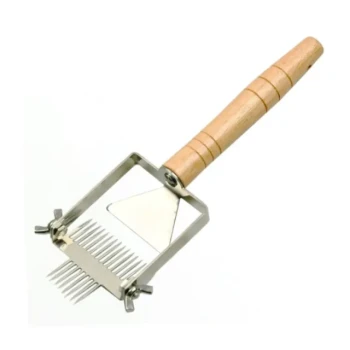
The wax floating method is a passive separation technique used to extract honey by allowing it to settle in a container while lighter wax particles naturally rise to the surface. It is considered the simplest approach to honey extraction, making it the default choice for farmers or hobbyists who do not possess advanced processing facilities or centrifugal extractors.
Core Takeaway This method offers a low-barrier solution for extraction that requires zero machinery. However, it is the most time-consuming technique and carries a significant risk of fermentation if attempted in humid environments, as standing honey absorbs moisture from the air.
The Mechanics of Wax Floating
How the Separation Works
The fundamental principle of this method is density. Honey is significantly denser than beeswax.
The Settling Phase
When the honey and wax mixture is placed in a container, the heavier honey sinks to the bottom. Over time, the lighter wax particles and debris naturally migrate upward to the top of the container.
The Skimming Process
This is not a "set it and forget it" process. The operator must repeatedly skim the accumulating wax particles from the surface to ensure the honey below remains clear.
Why Choose This Method?
Accessibility for Small Operations
The primary advantage is simplicity. It requires no specialized technology, electricity, or centrifuges.
Minimal Infrastructure Required
Because it relies on gravity and time rather than mechanical force, it is suitable for remote locations or farmers without processing facilities.
Critical Limitations and Risks
The Moisture Danger
Honey is hygroscopic, meaning it attracts and holds water molecules from the surrounding environment. Because this method requires the honey to sit exposed for long periods, it is highly susceptible to absorbing moisture from the air.
The Risk of Fermentation
This method is particularly risky during the rainy season or in regions with high humidity. If the moisture content in the honey rises too high due to atmospheric absorption, the quality degrades, and the honey will likely ferment and spoil.
Time Inefficiency
The primary reference explicitly categorizes this as the "most time-consuming" method. It creates a bottleneck in production compared to mechanical extraction methods.
Assessing Feasibility for Your Apiary
The decision to use the wax floating method depends entirely on your resources and your local climate.
- If your primary focus is low-cost entry: This method allows you to process honey without investing in expensive extraction equipment or facilities.
- If your primary focus is product quality in humid climates: You must avoid this method, as the extended air exposure will likely ruin your honey through fermentation.
Choose this method only when the air is dry and time is not a critical factor in your production cycle.
Summary Table:
| Feature | Wax Floating Method Details |
|---|---|
| Mechanism | Density-based passive separation (wax rises, honey sinks) |
| Equipment Needs | Minimal; no machinery or electricity required |
| Main Advantage | Low-cost entry and extreme simplicity for hobbyists |
| Main Disadvantage | Highly time-consuming and labor-intensive (manual skimming) |
| Primary Risk | Moisture absorption leading to honey fermentation |
| Best Suited For | Small operations in dry climates without extraction machinery |
Scaling Your Honey Production with HONESTBEE
Whether you are transitioning from traditional wax floating or looking to optimize a commercial apiary, HONESTBEE provides the industrial-grade solutions you need. As a leading supplier for distributors and commercial beekeepers, we offer a complete range of professional equipment—from high-efficiency honey-filling machines and automated extraction lines to durable hive-making machinery and essential consumables.
Don't let humidity and slow processing limit your growth. Enhance your efficiency, ensure product purity, and scale your business with our premium wholesale offerings.
Ready to upgrade your apiary’s performance? Contact HONESTBEE today for a customized equipment consultation!
Related Products
- Stainless Steel Jack Type Honey Comb Press Machine Wax and Honey Separator
- Stainless Steel Manual Honey Press with Guard for Pressing Honey and Wax
- Honey Wax Separating Wax Press with Metal Screw Wax Separator Machine
- Professional Honey Uncapping Roller for Efficient Harvesting
- Stainless Steel 3 Frame Manual Honey Extractor Spinner for Bee Honey Extraction
People Also Ask
- Can you heat honey to separate from wax? A Guide to Preserving Honey Quality
- How do you separate honey from wax at home? A Simple Guide to Zero-Waste Harvesting
- How do you separate honey from wax cappings? Choose the Best Method for Your Harvest
- How do I separate honey from wax? A Two-Stage Process for Maximum Yield
- What temperature does wax separate from honey? Achieve Clean, Efficient Honey Rendering