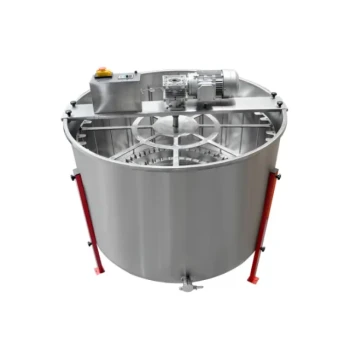
Industrial-scale mixing and pumping machines serve as the logistical backbone for commercial honey bee feeding operations. They facilitate the processing and distribution of massive quantities of high-concentration carbohydrate feeds, such as sucrose solutions or high-fructose corn syrup (HFCS), when natural nectar is unavailable. By automating the mixing and delivery process, these systems ensure colonies receive the rapid, uniform energy reserves necessary to survive resource gaps.
These systems transform supplemental feeding from a manual chore into a precise industrial process, ensuring large-scale apiaries receive safe, uniform nutrition to prevent starvation without the risks of toxicity or inconsistency.
The Logistics of Large-Scale Nutrition
Handling High-Volume Carbohydrates
Commercial operations utilize this equipment to process bulk ingredients when natural forage is insufficient. These machines are capable of thoroughly mixing high-viscosity feeds, such as HFCS or heavy sucrose syrups, which are difficult to handle manually.
Automated Distribution Networks
A primary function of industrial pump systems is to move feed from a central tank directly to hives via automated piping. This creates a rapid distribution network across the apiary, significantly reducing the labor required to haul feed to individual colonies.
Preventing Seasonal Starvation
The speed of these systems is critical during specific vulnerability windows, particularly autumn and early spring. By rapidly deploying energy reserves, beekeepers can prevent colony losses due to starvation before winter or jumpstart colony strength before the first bloom.
Critical Safety and Quality Control
Preventing Toxic Sugar Degradation
Processing sugar syrup carries a chemical risk: overheating can degrade sugars into Hydroxymethylfurfural (HMF), which is toxic to bees. Industrial mixers with precision temperature controls prevent this overheating, ensuring the feed remains safe for consumption.
Avoiding Metabolic Disorders
By maintaining strict temperature limits, these machines prevent the creation of feeds that cause intestinal metabolic disorders or increased mortality. This ensures the intervention supports colony health rather than compromising it with improper feeding materials.
Ensuring Uniform Consistency
Industrial mixing ensures that the feed solution is perfectly homogenous before it enters the distribution pipes. This guarantees that every hive receives the same concentration of nutrients, preventing nutritional imbalances between colonies.
Understanding the Trade-offs
Operational Complexity
Implementing automated pumping and piping systems introduces mechanical complexity to the apiary. A failure in the central pump or a blockage in the piping system can halt feeding for the entire operation, requiring immediate technical maintenance.
The Destination Bottleneck
While pumps move fluid efficiently, the system is only as effective as the in-hive feeder, such as a division board feeder. The infrastructure must ensure that the flow rate matches the capacity of these internal feeders to prevent overflow or waste within the hive.
Making the Right Choice for Your Goal
To determine if industrial feeding automation is right for your operation, consider your primary objectives:
- If your primary focus is scale and speed: Prioritize systems with high-capacity pumps and automated piping to minimize labor during critical autumn and spring feeding windows.
- If your primary focus is colony health and safety: Invest in mixing equipment with advanced temperature controls to eliminate the risk of HMF toxicity in your syrup.
Reliable feeding infrastructure acts as an insurance policy, bridging the gap between nature's supply and your colony's survival needs.
Summary Table:
| Feature | Key Benefit | Impact on Management |
|---|---|---|
| High-Volume Mixing | Handles heavy sucrose and HFCS | Facilitates large-scale supplemental feeding |
| Precision Temp Control | Prevents HMF toxin formation | Ensures bee safety and prevents metabolic disorders |
| Automated Pumping | Rapid feed distribution via piping | Drastically reduces labor costs and manual hauling |
| Uniform Consistency | Homogenous nutrient solutions | Guarantees consistent colony strength across the apiary |
Scale Your Apiary with HONESTBEE Precision Engineering
Are manual feeding processes slowing down your commercial operation? HONESTBEE specializes in empowering commercial apiaries and distributors with professional-grade infrastructure designed for scale.
Our comprehensive wholesale range includes:
- Specialized Machinery: Precision honey-filling and high-capacity mixing machines to eliminate toxicity risks.
- Complete Tooling: A full spectrum of beekeeping hardware and essential industry consumables.
- Custom Solutions: Tailored equipment to streamline your honey production and hive management.
Ready to automate your success? Contact us today to discover how our industrial beekeeping solutions can protect your colonies and maximize your yield.
References
- Ana Molineri, Marcelo Signorini. Environment and <i>Varroa destructor</i> management as determinant of colony losses in apiaries under temperate and subtropical climate. DOI: 10.1080/00218839.2018.1475697
This article is also based on technical information from HonestBee Knowledge Base .
Related Products
- Economy Honey Homogenizer Mixer and Melting Machine for Beekeeping
- Precision Durable Efficient HONESTBEE Rotary Honey Filling Machine
- Automatic Honey Filling and Filtering Machine for Beekeeping Bottle Filling
- HONESTBEE 72 Frame Industrial Electric Honey Extractor for Beekeeping
- Double Wall Honey Heating Stirring Homogenizer Mixing Machine with Various Capacity
People Also Ask
- What impact do homogenizers or oscillating equipment have on honey microbial detection? Ensure Testing Accuracy
- Why is thorough mechanical stirring and homogenization emphasized in honey processing? Ensure Sample Accuracy
- How do heating equipment and homogenizers liquefy crystallized honey? Expert Guide to Professional Honey Processing
- What is the significance of honey homogenization? Elevate Commercial Honey Quality and Brand Consistency
- What is the role of homogenization equipment in the sensory evaluation of honey? Ensure Precision and Consistency