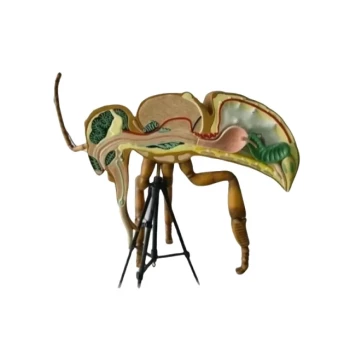
Professional stereo microscopes are the essential optical interface required for the successful extraction of honeybee queen reproductive organs. They provide the three-dimensional visual support and adjustable magnification necessary to navigate the complex anatomy of the queen's abdomen. This equipment allows researchers to completely isolate ovaries and ovarioles while preventing damage to delicate internal structures like the germarium or follicles.
The stereo microscope acts as the primary quality control filter for biological research, ensuring that the physical extraction of tissue preserves the original anatomical structure required for accurate histological analysis.
The Mechanics of Precision Dissection
To understand the role of the microscope, one must look at the specific challenges involved in dissecting a honeybee queen.
Three-Dimensional Visualization
The anatomy of a honeybee abdomen is not flat; it requires depth perception to navigate.
Stereo microscopes provide a 3D view, allowing the operator to manipulate tools within the abdominal cavity with spatial accuracy.
This depth perception is critical for separating organs without accidentally severing adjacent tissues.
Adjustable Magnification
Fixed magnification is often insufficient for the varying scales of reproductive anatomy.
Professional scopes allow for adjustable magnification, enabling the researcher to zoom out for a broad view of the abdomen and zoom in for detailed work on specific organs.
This flexibility is required to identify and isolate the ovaries and individual ovarioles effectively.
Ensuring Sample Integrity for Histology
The extraction process is not an end in itself; it is a prerequisite for downstream scientific analysis.
Protecting the Germarium and Follicles
The reproductive system contains highly fragile structures, specifically the germarium and follicles.
Without the visual clarity provided by professional optics, these internal structures are easily crushed or torn during extraction.
Preserving these structures is the only way to maintain the biological fidelity of the specimen.
A Prerequisite for Processing
High-quality dissection is the foundation for all subsequent histological processes.
Procedures such as fixation, embedding, and sectioning rely entirely on the condition of the excised tissue.
If the initial extraction is flawed due to poor visualization, the chemical and physical processing that follows will yield compromised data.
Understanding the Trade-offs
While stereo microscopes are powerful, they present specific operational challenges that users must navigate.
Magnification vs. Field of View
As you increase magnification to see the fine details of the ovarioles, your field of view decreases significantly.
This can make it difficult to maintain spatial awareness of the entire abdomen during the procedure.
Users must frequently toggle between magnification levels to balance detail with context.
The Limits of Visualization
Optical clarity does not replace manual dexterity.
The microscope improves visualization, but it cannot correct for unsteady hands or improper tool usage.
It highlights the anatomy, but the operator is still responsible for the mechanical act of preservation.
Making the Right Choice for Your Goal
The level of optical support you need depends largely on the intended use of the specimen.
- If your primary focus is General Anatomy: A standard stereo microscope with lower magnification ranges is sufficient for identifying major organs.
- If your primary focus is Histological Research: You require high-quality optics with adjustable zoom to ensure the germarium and follicles remain intact for sectioning.
The quality of your data is directly proportional to the precision of your initial dissection.
Summary Table:
| Feature | Role in Queen Dissection | Impact on Sample Integrity |
|---|---|---|
| 3D Visualization | Provides depth perception within the abdomen | Prevents accidental severing of adjacent tissues |
| Adjustable Zoom | Switches between broad abdominal view and fine detail | Enables precise isolation of ovaries and ovarioles |
| Optical Clarity | Highlights fragile germarium and follicles | Minimizes physical trauma to delicate internal structures |
| High Magnification | Focuses on microscopic histological features | Essential for high-quality fixation and sectioning |
Elevate Your Research with HONESTBEE Precision Equipment
At HONESTBEE, we specialize in empowering commercial apiaries and beekeeping distributors with the high-precision tools necessary for advanced apicultural science. Whether you are conducting detailed histological research or scaling up queen rearing operations, our comprehensive wholesale portfolio offers everything from specialized dissection aids to advanced hive-making and honey-filling machinery.
Our value to your business:
- Comprehensive Supply: One-stop sourcing for beekeeping tools, machinery, and industry consumables.
- Technical Excellence: Equipment designed to preserve biological fidelity and maximize operational efficiency.
- Global Distribution: Tailored solutions for large-scale distributors and honey-themed cultural enterprises.
Don't let subpar equipment compromise your biological data. Contact HONESTBEE today to discover how our professional beekeeping hardware can enhance your facility's capabilities!
References
- I. I. Dvylyuk, I. V. Dvyliuk. Features of functioning of the reproductive system of honey bees queen after feeding the silver and copper nanoparticles citrate-based. DOI: 10.15407/animbiol21.03.033
This article is also based on technical information from HonestBee Knowledge Base .
Related Products
- Heavy-Duty Ergonomic Grip Galvanized Pollen Shovel
- HONESTBEE AC Powered Wire Embedder with Alligator Clips
- Solar Beeswax Melter Easy Solar Wax Melter for Beeswax
- Professional Dual Action Queen Excluder Scraper for Beekeeping
- Premium Traditional Copper Bee Smoker with Bellows
People Also Ask
- For what reasons do beekeepers collect bee pollen? Boost Hive Health and Unlock New Revenue Streams
- Why should commercial apiaries focus on the collection of diversified bee products? Maximize Your Hive’s Profit Potential
- How do bee pollen collection tools affect the quality of bee pollen used in functional dairy ice cream production?
- How does a specialized pollen collector facilitate the harvesting of diverse bee products? Automate High-Value Yields
- What is the impact of pollen collectors and associated equipment on the cost structure of pollen production? Maximize ROI