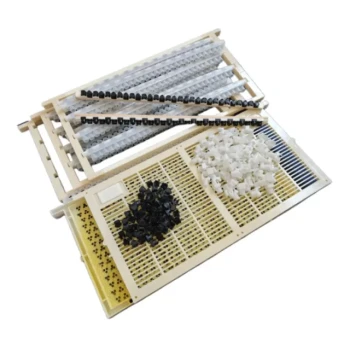
Specialized queen rearing tools and nucleus colony equipment act as the critical infrastructure for scaling superior honeybee genetics from the lab to the field. These technologies allow breeders to take a single colony identified by a selection index and mass-produce virgin queens, while nucleus colonies provide a controlled environment to confirm fertilization and stabilize traits before widespread distribution.
While genetic selection identifies the best bees, specialized equipment allows those genetics to be scaled. By standardizing the rearing environment, these tools ensure that superior traits are not just isolated anomalies, but reproducible assets for commercial apiaries.
The Mechanics of Mass Propagation
Scaling Through Queen Rearing
The primary function of queen rearing tools is to facilitate the mass production of virgin queens. Once a breeder colony is identified as superior based on specific performance indices, these tools allow apiarists to graft and raise significant numbers of daughter queens from that single genetic source. This process is the bottleneck of breeding; without efficient tools, superior genetics remain trapped in a single hive.
The Role of Nucleus Colonies
Nucleus colonies are small-scale, standardized hives designed to house approximately 600 newly emerged worker bees. They serve as the testing ground for the newly reared queens. In this compact environment, breeders can efficiently manage the mating process and confirm fertilization success before the queen is introduced to a full-sized commercial colony.
Ensuring Genetic Stability
The transition from a virgin queen to a productive layer is delicate. Nucleus equipment provides a semi-natural but highly controlled environment that protects the queen during this vulnerable phase. This ensures that the genetic potential identified in the breeder colony is successfully established in the next generation.
The Importance of Standardization
Removing Environmental Variables
To prove that a bee is genetically superior, you must rule out environmental advantages. Standardized hive-making machinery creates a uniform physical environment for all test colonies. This eliminates variables—such as hive volume or insulation differences—ensuring that observed performance is due to genetics, not equipment.
Precision Research and Dietary Control
Nucleus colonies allow for precise interventions that are impossible in full-sized hives. They facilitate specific dietary formulations of pollen or nectar to test metabolic responses. This standardization enables researchers to handle colonies uniformly for procedures like anesthesia or pesticide exposure testing.
Linking Genotype to Phenotype
Advanced breeding relies on correlating genetic markers (genotypes) with physical traits (phenotypes). By combining standardized equipment with automated management systems, researchers can accurately record data points like honey yield and wintering performance. This clear data allows for the accelerated validation of genomic selection models.
Understanding the Trade-offs
The Cost of Precision
Implementing standardized nucleus colonies and automated machinery requires a significant upfront capital investment. While these tools provide better data, they increase the overhead compared to traditional, low-tech breeding methods.
Complexity of Management
Managing hundreds of micro-colonies (nucleus hives) is distinct from managing full-sized commercial hives. It requires specialized labor and distinct handling protocols regarding population control and resource management. A failure to manage the specific needs of these small units can lead to high mortality rates, negating the benefits of the genetic program.
Making the Right Choice for Your Goals
To effectively utilize these tools, assess the scale and objective of your operation:
- If your primary focus is Commercial Propagation: Prioritize queen rearing tools that maximize the volume of viable virgin queens to rapidly disseminate superior genetics across your apiary.
- If your primary focus is Genetic Research: Invest in standardized nucleus equipment and automated monitoring to isolate environmental variables and accurately link genotypes to production traits.
Success in honeybee breeding lies in the ability to replicate excellence; these tools provide the consistency required to turn a genetic breakthrough into an industry standard.
Summary Table:
| Tool/Equipment Type | Core Function | Impact on Genetic Distribution |
|---|---|---|
| Queen Rearing Tools | Mass propagation of virgin queens | Scales elite genetics from a single breeder hive to thousands. |
| Nucleus Colonies | Controlled mating & fertilization | Confirms trait stability and fertilization before field deployment. |
| Standardized Hives | Environmental variable control | Ensures performance data is driven by genetics, not equipment. |
| Automated Monitoring | Phenotype data collection | Accelerates validation of genomic selection through precise metrics. |
Elevate Your Genetic Program with HONESTBEE
Turning a genetic breakthrough into a commercial standard requires more than just superior bees—it requires precision infrastructure. At HONESTBEE, we empower commercial apiaries and distributors with the specialized tools needed to scale excellence. From high-capacity queen rearing kits to precision hive-making and honey-filling machinery, our comprehensive wholesale catalog is designed for industrial-scale success.
Whether you are a researcher isolating environmental variables or a distributor supplying the next generation of beekeeping equipment, we provide the hardware and consumables to optimize your operation. Partner with HONESTBEE today to secure the equipment that turns genetic potential into measurable profit.
References
- Dennis van Engelsdorp, Gard W. Otis. Application of a Modified Selection Index for Honey Bees (Hymenoptera: Apidae). DOI: 10.1603/0022-0493-93.6.1606
This article is also based on technical information from HonestBee Knowledge Base .
Related Products
- No Grafting Queen Rearing Kit: System for Royal Jelly Production and Queen Rearing
- Retractable Chinese Queen Rearing Grafting Tools Equipment
- Stainless Steel Beekeeping Queen Grafting Tool for Honey Bee Rearing
- Plastic Chinese Queen Grafting Tool for Bee Queen Rearing
- Stainless Steel Queen Grafting Tool for Beekeeping and Bee Queen Grafting
People Also Ask
- What is the primary function of a queen rearing kit? Eliminate Manual Grafting for Superior Bee Breeding
- How do specialized queen rearing kits and queen management tools improve the success rate of bee colony expansion?
- What are some alternative methods to grafting for queen cell production? Discover Graft-Free Queen Rearing Systems
- Are queen rearing systems generally suitable for all honeybee species? Master Efficient Breeding Methods
- Are queen rearing systems suitable for all beekeepers? Modern Tools for Every Experience Level