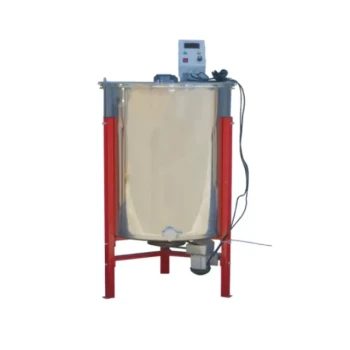
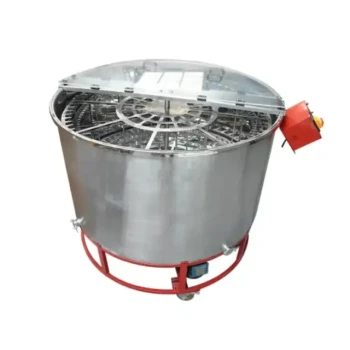
The industrial-grade centrifuge functions as the definitive clarification step in the production of propolis extracts. It employs high-speed centrifugal force to rapidly separate solid residues, such as insoluble beeswax and resins, from the liquid solvent containing the desired bioactive components.
While extraction methods release active compounds from raw propolis, the centrifuge is the tool responsible for isolation. It transforms a complex, cloudy mixture into a clear supernatant, which is a prerequisite for accurate chemical analysis and high-purity applications.
The Mechanics of Separation
Overcoming Material Complexity
Crude propolis is a complex substance composed of resins, beeswax, volatile oils, and bioactive compounds like flavonoids.
Standard extraction releases these components into a mixture, but they remain suspended with unwanted solids.
Leveraging Centrifugal Force
An industrial-grade centrifuge applies intense force to this mixture.
This force drives heavier, insoluble materials—specifically resins and beeswax—to the bottom of the vessel, effectively decoupling them from the liquid phase.
Achieving Rapid Isolation
Unlike passive filtration, which can be slow and prone to clogging, centrifugation offers rapid and complete separation.
This speed is essential for industrial scalability, preventing bottlenecks in the processing line following ultrasonic or microwave-assisted extraction.
Ensuring Quality and Clarity
Creating High Transparency
The primary output of this process is a liquid with high transparency.
By aggressively removing particulate matter and impurities, the centrifuge ensures the final product is visually clear and free of sediment.
Enabling Precise Analysis
A clear supernatant is critical for downstream quality control.
Chemical analysis requires a pure liquid sample; the centrifuge provides the clarity needed to accurately measure the concentration of pharmacologically active components without interference from suspended solids.
Understanding the Constraints
Equipment Precision and Maintenance
Industrial centrifuges operate at high speeds and generate significant mechanical stress.
To maintain the rapid separation capabilities described, these machines require rigorous maintenance schedules to ensure the rotor and drive systems remain balanced and safe.
The Limits of Separation
While effective at removing solids, a centrifuge does not chemically separate dissolved compounds.
It cannot isolate specific dissolved bioactives from one another (e.g., separating flavonoids from phenolic acids); it strictly separates the liquid phase from the solid phase.
Making the Right Choice for Your Goal
To determine how to best integrate centrifugation into your workflow, consider your specific end goals.
- If your primary focus is Chemical Analysis: Prioritize a centrifuge capable of higher G-forces to ensure the absolute removal of all micro-particulates for a pristine supernatant.
- If your primary focus is Production Efficiency: Focus on throughput capacity to ensure the centrifuge can keep pace with your ultrasonic or microwave extraction stages.
The industrial centrifuge is not merely a filter; it is the gateway between a raw extraction and a refined, analyzable product.
Summary Table:
| Feature | Benefit in Propolis Processing |
|---|---|
| High G-Force Separation | Rapidly removes insoluble beeswax, resins, and sediment. |
| Phase Isolation | Decouples bioactive liquids from solid waste for high transparency. |
| Industrial Scalability | Prevents production bottlenecks compared to passive filtration. |
| Clarity Enhancement | Provides a clear supernatant essential for precise chemical analysis. |
| Process Efficiency | Seamlessly integrates with ultrasonic or microwave-assisted extraction. |
Elevate Your Propolis Production with HONESTBEE
At HONESTBEE, we specialize in empowering commercial apiaries and distributors with the professional tools needed for high-purity processing. Whether you are looking to scale your production or ensure pharmaceutical-grade clarity for chemical analysis, our comprehensive wholesale offering has you covered.
From industrial-grade centrifuges and honey-filling machinery to specialized hive-making equipment, we provide the full spectrum of beekeeping hardware and essential consumables.
Ready to optimize your extraction workflow? Contact us today to discuss your equipment needs and discover how our industry-leading solutions can drive your business growth.
References
- Hatice Kalkan Yı̇ldırım. Assessment of Propolis Treated by Different Extraction Methods. DOI: 10.1590/1678-4324-2022210251
This article is also based on technical information from HonestBee Knowledge Base .
Related Products
- Manual Hand Crank 4 Frame Honey Extractor Centrifuge for Beekeeping
- electric honey extractor honey centrifuge 3 frame honey extractor stainless steel honey frame extractor
- Professional 4 Frame Self Reversing Electric Honey Extractor for Beekeeping
- HONESTBEE 72 Frame Industrial Electric Honey Extractor for Beekeeping
- Fully Automatic High Speed Centrifugal Bottle Unscrambler
People Also Ask
- What are some tips for achieving efficient honey extraction with a centrifuge extractor? Maximize Your Yield & Efficiency
- What is the proper procedure for maintaining a centrifuge honey extractor? Expert Tips for Longevity and Hygiene
- What are the advantages of using a centrifuge honey extractor? Maximize Yields and Protect Your Honeycombs
- Which type of honey extractor is generally more durable? Focus on Material & Build Quality for Longevity
- What is a manual honey extractor? The Essential Guide to Cost-Effective Beekeeping for Beginners