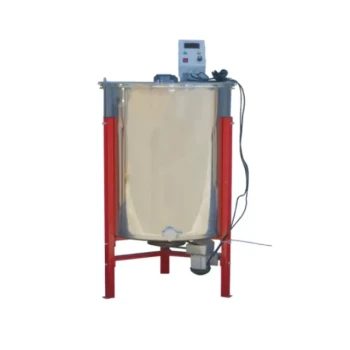
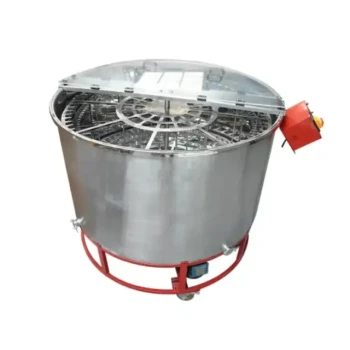
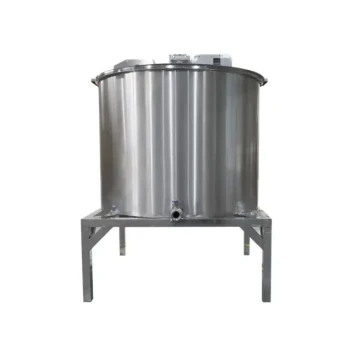
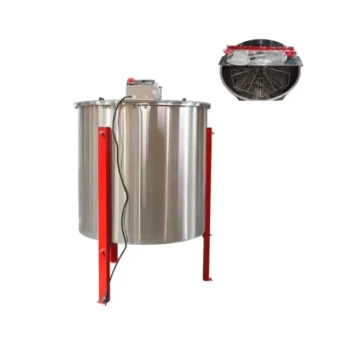
Industrial honey centrifuges are preferred over pressing methods primarily because they extract honey without destroying the honeycomb structure. While pressing crushes the comb to release the honey—often introducing wax impurities—centrifugation uses high-speed rotation to cleanly separate the liquid, preserving the comb for immediate reuse by the bee colony.
The Core Insight Centrifugation is not just about extraction speed; it is an energy-conservation strategy for the hive. By preserving the wax comb, producers allow bees to direct their energy toward making honey rather than rebuilding wax, significantly boosting overall yield and product purity.
The Economic Driver: Honeycomb Preservation
The most critical distinction between pressing and centrifugation lies in how they treat the wax comb. This single factor determines the efficiency of the entire apiary.
Protecting the Structural Integrity
Traditional pressing involves crushing the honeycomb to squeeze out the liquid. This destroys the wax structure, rendering it unusable.
Centrifugal extraction applies rotational force to pull honey out while leaving the delicate wax walls intact. This non-destructive process ensures the physical structure of the honeycomb remains undamaged.
Redirecting Bee Energy for Higher Yields
Bees consume a significant amount of energy and time to secrete wax and build new combs. When a producer uses pressing, the bees must rebuild from scratch.
By returning intact, empty combs to the hive, you eliminate the need for this reconstruction. This allows the colony to redirect its labor immediately toward foraging and honey production, directly increasing the harvest volume during the flowering season.
Elevating Product Quality and Hygiene
Beyond yield, the method of extraction fundamentally alters the chemical and physical quality of the final product.
Minimizing Impurities
Pressing exerts excessive pressure on the comb, which inevitably mixes wax particles, debris, and other water-insoluble impurities into the honey.
Centrifugation avoids this mechanical crushing. The process occurs in a sealed environment, ensuring a clean separation that drastically reduces the presence of impurities. This results in higher clarity and reduces the need for aggressive filtration later.
Preserving Flavor and Chemical Properties
Honey contains delicate volatile compounds that define its floral aroma and flavor.
The centrifugal method maximizes the preservation of these original physical and chemical properties. By avoiding the heat and friction often associated with heavy mechanical pressing, the honey retains its specific floral profile and meets higher sensory standards.
Meeting Food Safety Standards
Industrial centrifugal extractors typically utilize stainless steel materials within a closed system.
This design meets rigorous food safety and hygiene standards by preventing secondary contamination. It ensures the output is consistent, clean, and ready for premium markets.
Understanding the Trade-offs
While centrifugation is the industrial standard, it is important to recognize the operational requirements compared to simpler methods.
Equipment Complexity and Cost
Centrifuges are complex machines requiring motors, balanced rotors, and speed controls.
This represents a higher initial capital investment compared to simple mechanical presses. However, for commercial operations, the return on investment is realized through the increased honey yield mentioned above.
Maintenance Requirements
Because these machines operate at high speeds, they require regular maintenance to ensure safety and efficiency.
Operators must ensure the frames are balanced during loading to prevent vibration damage to the machine or the honeycombs.
Making the Right Choice for Your Goal
The choice of extraction method dictates your production capacity and product quality.
- If your primary focus is maximizing volume: Prioritize centrifugal extraction to recycle combs and minimize the "downtime" bees spend rebuilding wax.
- If your primary focus is product clarity: Use centrifugal extraction to prevent wax debris and physical impurities from contaminating the honey.
Centrifugation transforms honey extraction from a destructive harvest into a sustainable cycle that benefits both the producer and the colony.
Summary Table:
| Feature | Centrifugal Extraction | Pressing Method |
|---|---|---|
| Comb Condition | Intact & Reusable | Destroyed/Crushed |
| Honey Purity | High (Minimal impurities) | Lower (Wax & debris mix) |
| Production Yield | Maximized (Bees skip rebuilding) | Lower (Energy spent on wax) |
| Hygiene Standard | High (Stainless steel/Closed) | Variable (Often open/Manual) |
| Flavor Retention | Excellent (Preserves volatiles) | Moderate (Friction/Heat risk) |
Maximize Your Apiary's Output with HONESTBEE
Transitioning to professional centrifugation is the key to scaling your honey production. HONESTBEE specializes in supporting commercial apiaries and distributors with high-performance industrial honey extractors and filling machines.
Our comprehensive wholesale range covers everything from specialized hardware to essential industry consumables, ensuring your honey maintains premium clarity and flavor. Ready to upgrade your extraction efficiency? Contact our experts today to find the perfect equipment solution for your business!
References
- Asma Ghorab, M. Carmen Seijo. Sensorial, Melissopalynological and Physico-Chemical Characteristics of Honey from Babors Kabylia’s Region (Algeria). DOI: 10.3390/foods10020225
This article is also based on technical information from HonestBee Knowledge Base .
Related Products
- electric honey extractor honey centrifuge 3 frame honey extractor stainless steel honey frame extractor
- Manual Hand Crank 4 Frame Honey Extractor Centrifuge for Beekeeping
- Professional 4 Frame Self Reversing Electric Honey Extractor for Beekeeping
- HONESTBEE 72 Frame Industrial Electric Honey Extractor for Beekeeping
- Honey Concentrating and Filtering Dehumidifier Machine 2T Capacity for Honey
People Also Ask
- What are the characteristics of electric honey extractors? Boost Your Apiary Efficiency with Automated Technology
- What are the disadvantages of using an electric honey extractor? Weighing Cost, Power, and Comb Safety
- What are the advantages of an electric honey extractor? Boost Efficiency and Scale Your Honey Production
- What are the technical advantages of electric honey extractors? Maximize Yield and Protect Your Bee Colony
- How does an electric honey extractor affect the quality of honey? Preserve Flavor & Purity with Precision Extraction