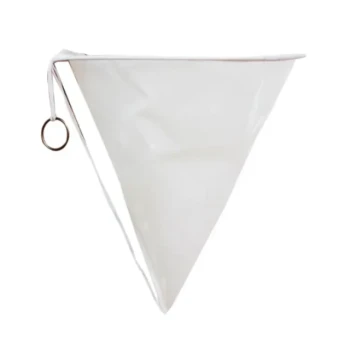
The primary technical advantage of a 0.2 mm aperture mesh filter is its capability to perform critical fine filtration. This specific mesh size acts as a precise mechanical barrier, effectively capturing and removing minute impurities such as wax fragments and bee body parts. Using this aperture ensures the final honey product attains the high levels of clarity and purity required to meet professional industry standards.
The 0.2 mm aperture defines the threshold for professional-grade purity. It eliminates fine particulates and dust to meet strict organic standards while preserving the honey’s essential natural components.
Achieving Industry-Standard Purity
Targeting Microscopic Contaminants
The 0.2 mm aperture is specifically calibrated to address contaminants that escape coarser filtration. It physically isolates wax fragments and bee body parts from the liquid honey. This removal is essential for preventing the degradation of the honey's visual and physical quality over time.
Enhancing Product Clarity
Beyond larger debris, this filtration level addresses fine dust and suspended particles. The result is a product with high transparency, which is a key indicator of quality for consumers. This level of clarity is often a prerequisite for certifying honey as a natural or organic product.
Operational Advantages Over Basic Methods
Superior Consistency
Professional filtration using a 0.2 mm mesh offers a distinct advantage over simple manual drainage or siphoning. It provides stable efficiency, ensuring that every batch meets the same rigorous specification. This eliminates the variability often found in non-mechanical processing methods.
Preserving Natural Integrity
While the filter is fine enough to remove impurities, it is designed to respect the product's composition. The process removes physical contaminants without damaging the natural components of the honey. This balance allows producers to deliver a clean product that retains its authentic character.
Understanding the Trade-offs
The Limitations of Manual Alternatives
It is important to recognize why professional mesh filtration is preferred over manual methods. Simple drainage or basic siphoning often fails to capture the fine dust that causes cloudiness. Relying on these older methods can result in lower product consistency, potentially failing to meet modern market requirements for transparency.
Making the Right Choice for Your Goal
To determine if this filtration level aligns with your processing needs, consider your end-product objectives:
- If your primary focus is Market Compliance: The 0.2 mm aperture is necessary to meet industry standards for "natural" and "organic" labeling by ensuring sufficient removal of biological debris.
- If your primary focus is Consumer Appeal: This specific mesh size provides the visual transparency and freedom from sediment that drives consumer confidence in high-quality honey.
By implementing 0.2 mm filtration, you transition from basic processing to professional-grade consistency and purity.
Summary Table:
| Feature | Technical Advantage | Impact on Honey Quality |
|---|---|---|
| Aperture Size | 0.2 mm Precise Mechanical Barrier | Removes fine wax fragments and bee body parts |
| Filtration Level | Microscopic Contaminant Targeting | Ensures high transparency and eliminates fine dust |
| Consistency | Stable Mechanical Efficiency | Provides uniform quality across all honey batches |
| Integrity | Non-Destructive Filtering | Preserves natural components and authentic character |
Elevate Your Honey Production with HONESTBEE
At HONESTBEE, we understand that professional-grade purity is the hallmark of a premium honey brand. As a dedicated partner to commercial apiaries and honey distributors, we provide more than just equipment—we provide the competitive edge you need in a demanding market.
From high-precision filtration mesh and specialized honey-filling machines to advanced hive-making technology, our comprehensive wholesale range is designed to optimize your workflow. Whether you are scaling up your processing line or sourcing essential industry consumables, HONESTBEE delivers the tools and machinery required to meet the strictest organic standards and consumer expectations.
Ready to refine your process? Contact our experts today to discover how our tailored equipment solutions can enhance your product clarity and operational efficiency.
References
- Ahmet Güler. The effects of the shook swarm technique on honey bee (<i>Apis mellifera L.</i>) colony productivity and honey quality. DOI: 10.1080/00218839.2008.11101420
This article is also based on technical information from HonestBee Knowledge Base .
Related Products
- Professional Stainless Steel Honey Filter with Support Handle
- Stainless Steel Triangle Support Honey Strainer and Filters
- Nylon Honey Strainer Square Filter Cloth for Honey Filters
- Conical Nylon Honey Strainer Filter Bag for Beekeeping and Honey Filtration
- Professional Cone-Shaped Honey Filter with Reinforced Steel Ring
People Also Ask
- Why are stainless steel filters essential during the initial purification phase of honey processing? Ensure Purity
- What are the benefits of using a high-quality honey filter? Elevate Purity and Preserve Natural Flavor
- What is the primary purpose of honey filters? Achieve Professional Clarity & Pure Honey Quality
- What micron filter should I use for honey? Choose the Right Filter for Sales or Competitions
- Why do people filter honey? For Clarity, Stability, and Consumer Appeal