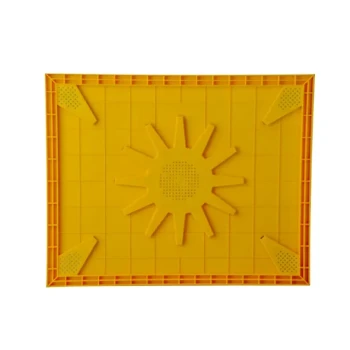
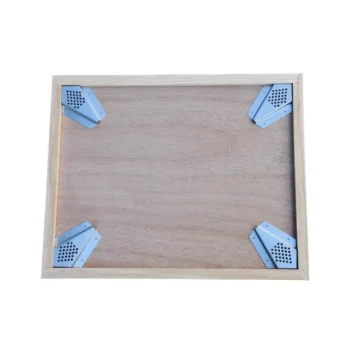
Painted front boards serve as the primary visual address system for bees in high-density apiaries. In environments where hive entrances are closely packed and structurally identical, these boards utilize distinct colors and patterns to guide bees accurately to their specific colony, preventing navigation errors.
In high-density settings, uniformity is a risk factor. Painted front boards break this visual monotony to significantly reduce "drifting," ensuring colony populations remain balanced and minimizing the spread of pathogens between hives.
The Challenge of High-Density Environments
The Risk of Visual Confusion
In a bee house, hive entrances are often stacked or lined up in close proximity. Without visual aids, these entrances appear identical to returning foragers.
This uniformity creates a complex navigation challenge for bees attempting to return home after a flight.
The Phenomenon of Drifting
When bees cannot distinguish their specific hive, they often enter a neighbor’s hive. This behavior is technically known as drifting.
Drifting is not merely a navigation error; it represents a breakdown in the structural integrity of the apiary's management.
How Front Boards mitigate Risk
Creating Distinct Visual Signatures
Painted front boards function by assigning unique visual identifiers to each entrance.
By applying distinct colors and patterns, apiary managers transform a uniform wall of hives into a navigable grid.
Ensuring Accurate Identification
These visual cues allow bees to lock onto their specific entrance before landing.
This creates a reliable guidance system that functions effectively even when hives are packed tightly together.
Critical Impacts on Colony Health
Preserving Colony Strength Balance
One of the primary dangers of drifting is the unintentional redistribution of the workforce.
Without visual markers, strong colonies often absorb bees from weaker neighbors, or vice versa. Painted boards ensure bees return to their origin, maintaining the intended balance of colony strength.
Preventing Disease Cross-Infection
Perhaps the most critical function of these boards is biosecurity.
When bees drift between hives, they become vectors for pathogens. By strictly limiting bees to their own hives via visual navigation, you significantly reduce the risk of cross-infection of diseases spreading throughout the bee house.
Understanding the Trade-offs
The Requirement for High Contrast
Simply painting boards is not enough; the differentiation must be clear.
If colors or patterns are too similar between adjacent hives, the navigation aid fails, and drifting will persist despite the effort.
Reliance on Visual Maintenance
The effectiveness of this system relies entirely on visibility.
Faded paint or obscured patterns reduce the bee's ability to navigate, meaning these components require regular monitoring to remain functional.
Optimizing Your Apiary Layout
For the system to work, the visual cues must be strategic and well-maintained.
- If your primary focus is Disease Control: Prioritize high-contrast patterns between immediate neighbors to create the strongest possible barrier against cross-infection.
- If your primary focus is Colony Management: Ensure every hive has a unique visual signature to guarantee accurate population data and strength retention.
Effective navigation is the first line of defense in maintaining a healthy, stable apiary.
Summary Table:
| Navigation Feature | Primary Function | Impact on Apiary Health |
|---|---|---|
| Unique Colors | Provides a visual address | Reduces navigation errors and bee drifting |
| Distinct Patterns | Breaks visual monotony | Ensures bees return to the correct colony origin |
| High Contrast | Maximizes visibility | Prevents cross-infection of pathogens between hives |
| Strategic Layout | Defines hive boundaries | Maintains balanced colony strength and workforce |
Scale Your Apiary Operations with HONESTBEE Precision Equipment
Effective navigation is just the first step in successful high-density beekeeping. At HONESTBEE, we empower commercial apiaries and global distributors with the professional-grade tools needed to thrive. From durable hive components to advanced hive-making and honey-filling machinery, our comprehensive wholesale catalog is designed to optimize your efficiency.
Partner with HONESTBEE to access:
- Professional Tools & Machinery: Full spectrum equipment for large-scale production.
- Essential Consumables: A wide array of industry-standard supplies for daily operations.
- Strategic Wholesale Solutions: Tailored offerings for commercial managers and distributors.
Ready to elevate your beekeeping business and safeguard your colony health? Contact our expert team today to explore our full range of hardware and honey-themed cultural merchandise.
References
- P. Kozmus, Aleš Gregorc. Slovenia: small country with great beekeeping experience. DOI: 10.1080/0005772x.2005.11417314
This article is also based on technical information from HonestBee Knowledge Base .
Related Products
- Langstroth Solid Bottom Board for Beekeeping
- Solid Bottom Board Australian Pine Wood Langstroth Bottom Board for Wholesale
- HONESTBEE AC Powered Wire Embedder with Alligator Clips
- Australian Pine Wood Langstroth Screen Bottom Board for Wholesale
- Solar Beeswax Melter Easy Solar Wax Melter for Beeswax
People Also Ask
- What are the functions of solid bottom boards for a beehive? Essential Thermal Protection and Winter Survival Tips
- What is the purpose of a solid bottom board for bee hives? Enhance Hive Health and Winter Survival
- How does climate influence the choice between a solid and screened bottom board? Optimize Your Hive for Local Weather
- What is the primary function of a bottom board in a modern modified beehive system? Essential Foundation Guide
- What are the characteristics of a solid bottom board for a beehive? Boost Colony Health and Thermal Insulation