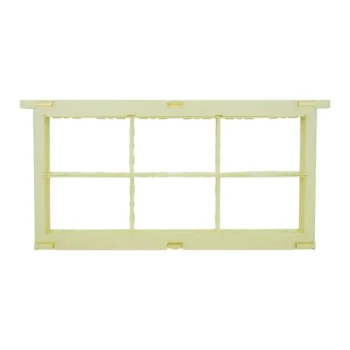
The 5cm x 5cm grid measuring frame is a precision instrument designed to objectively quantify the area of capped brood on a honeycomb. By overlaying this grid on a frame, technicians can determine the exact surface area occupied by developing bees, which serves as the raw data needed to calculate the queen bee's daily egg-laying rate. This metric is essential for scientifically evaluating a colony's reproductive potential and the speed of its recovery immediately following the winter season.
The grid measuring frame transforms subjective visual estimates into concrete biological data. It allows you to move beyond guessing a colony's strength to precisely calculating its growth trajectory based on reproductive output.
Deriving Biological Metrics from Physical Data
The primary purpose of the 5cm x 5cm grid is to convert the physical presence of brood into actionable biological statistics.
Calculating the Daily Egg-Laying Rate
The central metric derived from this tool is the queen’s daily egg-laying rate. Because the grid defines a specific area (25 square centimeters per cell), technicians can convert the total area of capped brood into a specific count of offspring.
Knowing the duration of the capped brood stage allows you to mathematically determine how many eggs the queen laid per day to generate that volume of brood.
Quantifying Post-Winter Recovery
Spring assessment is critical because it reveals how well a colony survived the winter. The grid frame provides a scientific evaluation of recovery speed.
By measuring the expansion of capped brood over time, you can determine if the colony is building momentum fast enough to exploit early nectar flows or if it is lagging behind due to a failing queen.
Assessing Reproductive Potential
Beyond current numbers, the grid assesses future potential. A high density of capped brood measured by the grid indicates a surge in the adult worker population is imminent.
This data point confirms the colony's reproductive potential, allowing you to predict population peaks and plan splits or supering accordingly.
Standardization and Health Analysis
Using a standardized 5cm x 5cm grid removes human error and provides indicators for colony health beyond simple population counts.
Eliminating Estimation Bias
Visual inspections are prone to "estimation errors." Two beekeepers might look at the same frame and guess different brood percentages.
The grid ensures precise statistical counting. Whether evaluating a single hive or comparing fifty, the measurement remains constant, providing objective data to support decisions.
Identifying Compensatory Behavior
Precise brood quantification is vital for calculating the bees-to-brood ratio.
If the grid reveals a massive volume of brood but the adult population is low, it may indicate "abnormal compensatory brood-rearing." This is often a sign that the colony is under disease pressure and trying to outbreed a pathogen, a distinct warning sign that visual estimates might miss.
Evaluating Feeding Strategies
The grid is also used to measure the efficacy of spring inputs. By measuring brood area before and after providing supplemental feeds (such as probiotics or protein patties), you can quantitatively evaluate how different feeding programs impact colony development.
Understanding the Trade-offs
While the grid frame offers precision, it requires a specific operational approach to ensure validity.
Precision vs. Speed
Using a grid frame is slower than a standard visual inspection. It requires removing frames, shaking off bees (often necessary for accurate grid placement), and counting. This extends the time the hive is open.
The Risk of Chilling
In early spring, temperature control is vital. The extended time required to measure frames with a grid can expose the brood to cold air. This method must be executed quickly to avoid damaging the very colony you are trying to assess.
Snapshot Limitations
The grid measures "capped brood," which is a lagging indicator of eggs laid days ago. It provides a snapshot of the colony's status from nearly two weeks prior, rather than the immediate egg-laying status of the current day.
Making the Right Choice for Your Goal
To maximize the value of the 5cm x 5cm grid, align its use with your specific management objectives.
- If your primary focus is Genetic Selection: Use the grid to calculate the exact daily egg-laying rate to identify and breed from queens with superior reproductive metrics.
- If your primary focus is Health Monitoring: Use the grid to monitor the bees-to-brood ratio to detect if a colony is struggling to maintain population against disease pressure.
- If your primary focus is Resource Management: Use the grid to measure the exact increase in brood area following supplemental feeding to determine the ROI of your nutritional program.
By replacing guesswork with grid-based measurement, you turn beekeeping into a data-driven science.
Summary Table:
| Metric Evaluated | Function of 5cm x 5cm Grid | Key Benefit |
|---|---|---|
| Reproductive Rate | Calculates queen's daily egg-laying volume | Identifies high-performance genetics |
| Colony Recovery | Measures capped brood area post-winter | Predicts population peaks for honey flows |
| Health Status | Determines bees-to-brood ratio | Detects disease pressure or abnormal compensation |
| Nutritional ROI | Quantifies brood expansion after feeding | Evaluates efficacy of protein and supplements |
| Data Accuracy | Eliminates visual estimation bias | Provides standardized, scientific metrics |
Transform Your Apiary Management with Data-Driven Tools
Precision is the key to scaling a successful commercial beekeeping operation. At HONESTBEE, we empower commercial apiaries and distributors with the high-quality tools needed to turn biological observations into actionable growth strategies.
Our comprehensive wholesale portfolio includes everything from specialized brood-measuring frames and hive-making machinery to honey-filling equipment and essential consumables. Whether you are looking to optimize your queen breeding program or upgrade your honey production line, we provide the industrial-grade solutions you need to succeed.
Ready to elevate your beekeeping business?
Contact HONESTBEE Today to explore our full spectrum of beekeeping machinery and wholesale equipment. Let us help you build a more productive and profitable future.
References
- Hanna Hrechka, Oleksandr Senchylo. WINTER HARDINESS OF UKRAINIAN BEES OF INTRABREED TYPE «GADYATSKY». DOI: 10.46913/beekeepingjournal.2022.8.02
This article is also based on technical information from HonestBee Knowledge Base .
Related Products
- Ergonomic Plastic Frame Spacer Tool for Rapid Hive Management Beekeeping
- Professional 500g Sectional Comb Honey Frame System for Beekeeping
- Durable Plastic Frame Spacer
- JZBZ Langstroth Queen Rearing Frame for Beekeeping
People Also Ask
- What specific challenges do beekeeping hive tools address during hive maintenance? Essential Solutions for Apiaries
- How do specialized beehive management tools assist in the routine maintenance of bee colonies? Boost Hive Efficiency
- How do specialized beehive management tools support high-purity honey production? Master Monofloral Isolation
- How do traditional harvesting tools like axes and machetes negatively affect bee colonies? Upgrade to Professional Gear
- What additional equipment might be useful for beekeeping? Boost Hive Health & Efficiency