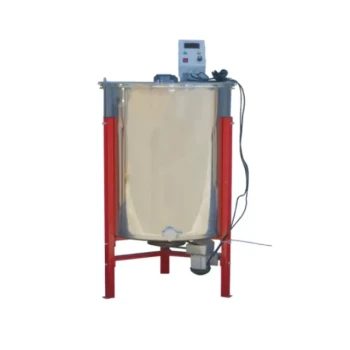
The primary necessity of a benchtop centrifuge in this context is to guarantee the purity required for precise instrumental analysis. By generating powerful centrifugal force at speeds around 3000 rpm, the device rapidly layers the sample, forcing insoluble impurities and protein precipitates to the bottom of the tube. This separates them from the clarified supernatant (the clear liquid) which contains the target antibiotics or analytes needed for testing.
Core Takeaway
While mechanical extractors are used to harvest honey from the comb, the benchtop centrifuge is a laboratory precision tool used during sample preparation. Its critical function is to remove particulate matter that interferes with sensitive testing equipment, ensuring accurate detection of antibiotics or other chemical residues.
Achieving Analytical Grade Purity
Generating Sufficient Force
A benchtop centrifuge operates at high rotational speeds, typically around 3000 rpm.
This speed generates the G-force necessary to overcome the viscosity of honey mixtures. Gravity alone is insufficient to settle fine particles within a reasonable timeframe.
Removal of Interfering Substances
The primary goal of this step is the removal of insoluble impurities and protein precipitates.
These solids are distinct from the honey matrix and the target analytes (such as antibiotics). If left in the solution, these proteins can clog delicate chromatography columns or scatter light in optical detectors, leading to erroneous results.
Creating a Clarified Supernatant
The process results in a clear stratification of the sample.
The target compounds remain dissolved in the top liquid layer, known as the clarified supernatant. This clean liquid can then be drawn off and injected directly into analytical instruments with minimal risk of contamination.
Distinguishing "Extraction" Contexts
Laboratory Extraction (Benchtop Centrifuge)
In the context of the primary reference, "extraction" refers to chemical isolation for quality control.
Here, the focus is on a small volume of sample (milliliters) undergoing solid-liquid separation to test for safety and purity. This ensures the sample meets regulatory standards for antibiotic residues.
Mechanical Harvesting (Honey Extractor)
It is important not to confuse the benchtop unit with the manual or commercial honey extractor.
As noted in supplementary references, mechanical extractors are large vessels used to fling bulk honey out of wax frames. Their goal is agricultural yield and preserving the drawn comb for reuse by the bees, not preparing samples for chemical analysis.
Understanding the Trade-offs
Sample Volume vs. Processing Speed
A benchtop centrifuge offers high speed and separation power but is limited to small sample volumes.
It cannot process bulk quantities of honey. Attempting to use this precision tool for bulk processing would be inefficient and operationally impossible.
Physical Stress on the Sample
While effective for separation, high-speed centrifugation applies physical stress.
Operators must ensure the speed (rpm) and duration are optimized. Excessive speed typically does not harm antibiotic targets, but in other contexts, shear forces can degrade sensitive biological structures.
Making the Right Choice for Your Goal
To ensure you are employing the correct equipment for your specific "extraction" needs:
- If your primary focus is Laboratory Analysis: Use a benchtop centrifuge to sediment proteins and particulates, ensuring your sample is clean enough for high-sensitivity instrumentation.
- If your primary focus is Honey Harvesting: Use a manual or radial extractor to remove honey from the frames while preserving the wax structure for the colony's future use.
Ultimately, the benchtop centrifuge is the gatekeeper of data accuracy, transforming a raw, turbid mixture into a clean analyte ready for validation.
Summary Table:
| Feature | Laboratory Benchtop Centrifuge | Commercial Honey Extractor |
|---|---|---|
| Primary Goal | Analytical purity for lab testing | Agricultural yield and bulk harvesting |
| Operating Speed | High (Approx. 3000+ RPM) | Moderate (Rotational force for frames) |
| Sample Volume | Small (Milliliters/Test tubes) | Large (Bulk frames/Gallons) |
| Target Output | Clarified supernatant (liquid) | Raw honey from wax combs |
| Key Benefit | Removes proteins and particulates | Preserves drawn comb for reuse |
Elevate Your Honey Quality Control with HONESTBEE
At HONESTBEE, we understand that global honey distributors and commercial apiaries require more than just harvesting tools—they need precision. Whether you are scaling up your production with our high-capacity honey-filling machines or ensuring batch safety through advanced laboratory preparation, we have you covered.
We provide a comprehensive wholesale range, including:
- Advanced Machinery: From hive-making to specialized processing equipment.
- Beekeeping Essentials: A full spectrum of professional tools and consumables.
- Quality Assurance Tools: Equipment designed to help you meet rigorous industry standards.
Ready to streamline your apiary operations and guarantee product excellence? Contact HONESTBEE today to explore our wholesale solutions and discover how our expertise can grow your business.
References
- Buket Er Demirhan, Burak Demirhan. Detection of Antibiotic Residues in Blossom Honeys from Different Regions in Turkey by LC-MS/MS Method. DOI: 10.3390/antibiotics11030357
This article is also based on technical information from HonestBee Knowledge Base .
Related Products
- electric honey extractor honey centrifuge 3 frame honey extractor stainless steel honey frame extractor
- Manual Hand Crank 4 Frame Honey Extractor Centrifuge for Beekeeping
- Professional 4 Frame Self Reversing Electric Honey Extractor for Beekeeping
People Also Ask
- What are the characteristics of electric honey extractors? Boost Your Apiary Efficiency with Automated Technology
- What are the disadvantages of using an electric honey extractor? Weighing Cost, Power, and Comb Safety
- What are the advantages of an electric honey extractor? Boost Efficiency and Scale Your Honey Production
- What are the technical advantages of electric honey extractors? Maximize Yield and Protect Your Bee Colony
- How does an electric honey extractor affect the quality of honey? Preserve Flavor & Purity with Precision Extraction