Precision is the primary driver for using a queen oviposition controller. This device restricts the queen bee to a specific, empty comb for a strictly limited window of time, typically around four hours. This confinement guarantees that all eggs laid—and the resulting larvae collected for sampling—are virtually identical in age.
The Core Utility
In microbial research, age ambiguity ruins data. By using an oviposition controller to force a synchronized laying window, researchers create a standardized cohort of larvae. This allows for the accurate mapping of rapid, day-to-day changes in gut microbiota that would otherwise be lost in a mixed-age population.
The Critical Role of Age Synchronization
To understand the necessity of this tool, one must look beyond the simple mechanics of egg-laying and look at the biological requirements of the study.
Eliminating Developmental Variables
In honeybee development, the difference of even 24 hours can be significant.
Without a controller, a queen lays eggs continuously across various cells. This results in a brood pattern where larvae of different ages are mixed together.
The controller forces a "batch" approach, ensuring every subject in the study begins its lifecycle at the same moment.
Tracking Microbiota Succession
The primary reference highlights that the honeybee gut microbiota undergoes a "dynamic succession."
This means the bacterial community composition changes rapidly as the bee progresses from a 1-day-old larva to a 6-day-old larva.
If a researcher cannot verify the exact age of the larva, they cannot correlate specific bacterial changes to specific developmental stages.
Standardizing the Sampling Window
The controller creates a predictable timeline for the researcher.
By restricting the queen to a broodless comb for 4 hours, the researcher establishes "Time Zero."
This allows for precise scheduling of sample collection, ensuring that a "3-day-old" sample is genuinely 72 hours old, plus or minus only that narrow 4-hour window.
Common Pitfalls to Avoid
While the queen oviposition controller is vital for experimental precision, it is distinct from other isolation tools used in apiary management.
Distinguishing Tools by Function
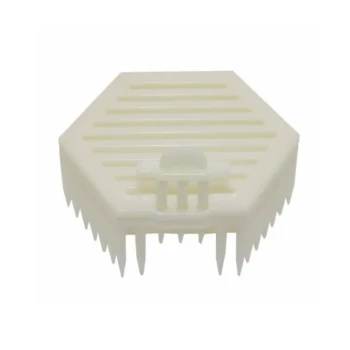
It is critical not to confuse an oviposition controller with a queen cell protector or emergence cage.
As noted in supplementary documentation, emergence cages are used to physically isolate mature queen cells to prevent lethal combat between newly emerged queens.
While both involve isolation, the oviposition controller is for biological timing and research data, whereas emergence cages are for physical safety and colony management. Using the wrong terminology or tool will compromise the specific goals of a microbial study.
Ensuring Data Integrity in Your Study
The decision to use an oviposition controller is ultimately a decision to prioritize data quality over convenience.
- If your primary focus is precise microbial mapping: You must use an oviposition controller to synchronize larval ages and track rapid bacterial succession accurately.
- If your primary focus is general colony management: You may be looking for emergence cages to protect queens from combat, rather than for controlling egg-laying timing.
By strictly controlling the input—the timing of the egg—you ensure the validity of your output: the microbial data.
Summary Table:
| Feature | Queen Oviposition Controller | Queen Emergence Cage |
|---|---|---|
| Primary Goal | Synchronize egg-laying for precise age cohorts | Protect emerging queens from physical combat |
| Research Use | Critical for mapping daily microbial succession | Primarily used for breeding and colony management |
| Timing Control | Limits laying to a ~4-hour "Time Zero" window | Used during the final stages of pupation |
| Data Impact | Eliminates developmental variables in sampling | Ensures survival of queen stock for distribution |
Elevate Your Research and Apiary Standards with HONESTBEE
At HONESTBEE, we understand that precision is the foundation of successful commercial beekeeping and advanced research. Whether you are a large-scale distributor or a commercial apiary, our comprehensive wholesale portfolio is designed to meet your exact specifications.
We provide everything from specialized research-grade tools like oviposition controllers to heavy-duty honey-filling machines and hive-making equipment. By partnering with us, you gain access to high-quality industry consumables and innovative hardware that drive efficiency and data accuracy.
Ready to scale your operations with premium beekeeping equipment? Contact us today to explore our wholesale offerings and let HONESTBEE empower your business growth.
References
- Zuzana Hroncová, V. Rada. Variation in Honey Bee Gut Microbial Diversity Affected by Ontogenetic Stage, Age and Geographic Location. DOI: 10.1371/journal.pone.0118707
This article is also based on technical information from HonestBee Knowledge Base .
Related Products
- Professional Bamboo Queen Isolation Cage
- Professional Queen Catcher and Introduction Queen Cage
- Premium Wood Framed Metal Wire Queen Bee Excluder
- Durable Galvanized Steel Spring Queen Bee Cage
- Professional Queen Cage with Sliding Gate and Feeder Plug
People Also Ask
- Why are specialized queen bee cages used for the banking of mated queen bees? Maximize Commercial Apiary Storage Efficiency
- What is the mechanism of action for using temporary queen bee cages? Master Successful Queen Introduction
- How does the side ventilation design of a queen bee cage impact the safety of the queen during long-distance transport?
- What should you do if the queen is still in the cage and the worker bees have not accepted her? Protect Your Colony from Queen Rejection
- What technical precaution must be taken regarding the mesh or grill side of a queen bee cage? Ensure Queen Survival