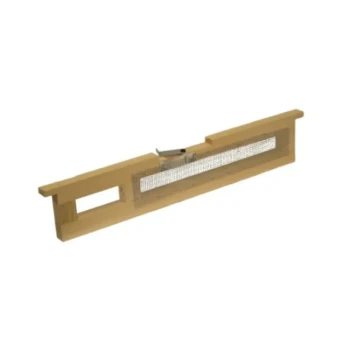
A screened wooden frame acts as a critical selective barrier within the hive. It is installed to physically separate the bee colony from the monitoring equipment below. This specific structure allows tiny debris and parasites, such as Varroa mites, to pass through its mesh while preventing honeybees from entering the area containing the sticky board.
The screen serves a dual purpose: it protects the colony from injury caused by the adhesive and prevents bees from removing fallen mites, ensuring your mortality data remains accurate and unaltered.
The Mechanics of Selective Filtration
Function of Pore Size
The screen is defined by a specific pore size. This mesh is engineered to be large enough for mites to fall through freely, but small enough to block the passage of a worker bee.
Separating Populations
By installing this frame, you create a distinct zone for monitoring that is inaccessible to the colony. This separation allows the natural "mite drop" to occur without the bees interacting with the collection surface.
Protecting Data Integrity
Preventing Hygienic Behavior
Honeybees are naturally hygienic and will actively clean debris from their hive. Without the screened frame, bees would access the sticky board to clear away fallen mites.
Ensuring Statistical Accuracy
If bees remove mites from the board, your count will be artificially low. The screen preserves the authenticity of mortality statistics by ensuring that once a mite falls, it remains on the board for you to count.
Ensuring Colony Safety
The Hazard of Sticky Boards
Sticky boards rely on strong adhesive substances to trap mites. If exposed directly to this adhesive, bees can become stuck, leading to injury or death.
The Physical Guard
The screened wooden frame acts as a shield. It prevents bees from accidental contact with the sticky surface, allowing you to monitor parasite loads without risking the health of your workforce.
Common Pitfalls to Avoid
Incorrect Mesh Sizing
If the screen's pore size is too small, mites may get caught in the mesh rather than falling to the board, skewing your data. Conversely, if the mesh is too large or damaged, bees may squeeze through and get trapped in the glue.
Improper Installation
The frame must be seated securely to ensure there are no gaps around the edges. Even a small gap can allow bees to bypass the screen and enter the monitoring chamber.
Making the Right Choice for Your Goal
When setting up your hive monitoring system, ensure your equipment aligns with your specific objectives:
- If your primary focus is Data Accuracy: Ensure the screen is intact and covers the entire area of the sticky board to prevent bees from altering the mite count.
- If your primary focus is Colony Health: Verify that the screen is positioned securely above the adhesive to eliminate any risk of bees coming into contact with the glue.
The screened frame is the linchpin of effective monitoring, balancing the safety of your bees with the reliability of your data.
Summary Table:
| Feature | Purpose | Benefit |
|---|---|---|
| Selective Mesh | Allows debris/mites to pass while blocking bees | Prevents bees from getting stuck in adhesive |
| Physical Separation | Creates an inaccessible zone for worker bees | Protects the colony from injury and death |
| Hygienic Barrier | Prevents bees from clearing away fallen mites | Ensures accurate and unaltered mortality data |
| Secure Seating | Eliminates gaps around the edges | Maintains monitoring integrity and colony safety |
Maximize Your Colony Productivity with HONESTBEE
Precise monitoring is the foundation of a healthy apiary. At HONESTBEE, we specialize in supporting commercial apiaries and distributors with high-quality, professional-grade beekeeping solutions. From precision-engineered hive components to advanced honey-filling machinery and specialized beekeeping tools, we provide everything you need to scale your operations.
Partner with HONESTBEE to access:
- Wholesale Excellence: Comprehensive inventory of beekeeping hardware and consumables.
- Industrial Solutions: Specialized hive-making and honey-processing machinery.
- Brand Growth: A wide array of honey-themed cultural merchandise to diversify your portfolio.
Ready to elevate your beekeeping business? Contact our expert team today to discuss how our wholesale offerings can drive your success.
References
- GHADA S. REFAEI. EVALUATION OF SOME NATURAL SUBSTANCES AGAINST VARROA DESTRUCTOR INFESTING HONEYBEE, APIS MELLIFERA IN EGYPT. DOI: 10.21608/ejar.2011.173973
This article is also based on technical information from HonestBee Knowledge Base .
Related Products
- Assembled Wooden Bee Frames with Plastic Foundation for Durability and Convenience by HONESTBEE
- Professional Wooden Requeening Frame for Beekeeping
- Assembled Wooden Bee Frames with Beeswax Foundation Ready to Use by HONESTBEE
- HONESTBEE Wired and Assembled Wooden Bee Frames Foundation for a Thriving Hive
- Wooden Bee Hive Frames for Beekeeping and Wholesale
People Also Ask
- When should frames with new foundation be given to colonies? Master Timing for a Thriving Hive
- What types of bee frames can be cleaned and returned to service? A Guide to Safe Apiary Refurbishment
- Can beekeepers switch between wooden and plastic frames? Optimize Your Hive's Performance
- How do you re-wax bee frames? A Simple Guide to Faster Comb Building
- Do you have to wire bee frames? Essential Guide to Frame Strength & Honey Harvesting