The Illusion of the "Best" Tool
In any craft, we are drawn to the idea of a single "best" tool. We search for the perfect hammer, the perfect keyboard, the perfect piece of software. It's a natural human tendency to seek a silver bullet.
But in a complex, living system like a beehive, the concept of "best" is a dangerous illusion. A beehive is not a static object; it's a dynamic entity governed by weather, population, and time.
Choosing a bee feeder is not a simple purchase. It is a strategic intervention. The right choice depends entirely on your goal, and every option comes with a set of predictable consequences.
The Four Philosophies of Feeding: A Tactical Breakdown
The four primary feeder types represent four distinct strategies for interacting with a colony. Understanding their underlying philosophy is key to making the right decision.
The Entrance Feeder: The Lure of Convenience
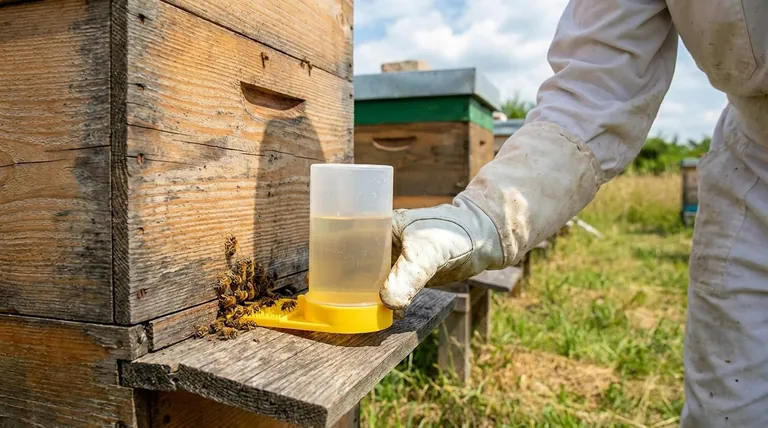
Imagine a new beekeeper on a sunny afternoon. They slide a tray into the hive entrance and place a fresh jar of syrup on it, proud they didn't have to "bother" the bees by opening the hive. The work is visible, and the effort is minimal.
This is the psychological appeal of the entrance feeder. It caters to our desire for low-friction, observable progress.
But this convenience comes at a severe cost: security. By placing a food source on the hive's doorstep, you are hanging a neon sign for every robber bee and wasp in a two-mile radius. That peaceful scene can turn into a frantic warzone, where a weaker colony is quickly overwhelmed and destroyed.
- Strategy: Provide a slow, steady stimulus.
- Best Use: Stimulating a small, new colony in a nectar-rich environment where robbing pressure is low.
- Critical Flaw: An open invitation to robbers that can decimate a weak hive.
The Top Feeder: The "Shock and Awe" Approach
Now picture a beekeeper in late fall. The goldenrod bloom has ended, the days are getting shorter, and the hive feels light. The first frost is a week away. This is not the time for a slow drip; it's time for a massive, rapid infusion of resources.
This is the domain of the high-capacity top feeder. It's the heavy artillery of feeding.
Its philosophy is "shock and awe"—deliver overwhelming volume with speed and efficiency. Placed inside the hive, under the cover, it dramatically reduces the risk of robbing. However, its design can create a new hazard. Open-style top feeders can become a sea of syrup where thousands of bees drown, a costly trade-off for a beekeeper who values every forager.
- Strategy: Deliver massive food stores quickly.
- Best Use: Rapidly building winter stores when time is short.
- Critical Flaw: High drowning risk in open-reservoir models without proper floats or guards.
The Frame Feeder: The Surgical Intervention
Consider an early spring cold snap. The colony has a small, tight cluster of bees, conserving every degree of warmth. They have food stores, but they are a few frames away—too far to travel without chilling the precious brood.
The frame feeder is the solution. It's a surgical tool.
By replacing a frame, it puts the food source directly adjacent to the cluster. It’s the equivalent of an IV drip, delivering essential nutrition exactly where it's needed with no wasted energy. This approach respects the internal thermodynamics of the hive. The cost? It occupies the space of a future brood or honey frame and requires opening the hive, which temporarily breaks its thermal seal.
- Strategy: Provide food directly to a small or cold-stressed cluster.
- Best Use: Emergency feeding for weak hives or new packages in poor weather.
- Critical Flaw: Consumes valuable hive space and requires colony disturbance to refill.
The Pail Feeder: The Elegant, Safe System
There is a certain romance to a simple, elegant engineering solution. A plastic pail, a tight lid, and a few tiny holes drilled in the center. That's it.
When inverted over the hive's inner cover, the vacuum pressure prevents the syrup from pouring out. Bees drink directly from the holes, taking only what they need. It's nearly impossible for them to drown.
The pail feeder is for the systems-thinker. It requires a bit more setup—an empty hive body to protect it—but it creates a stable, safe, and highly effective feeding system. It prioritizes risk mitigation above all else.
- Strategy: Deliver high volumes of food with maximum safety and security.
- Best Use: Safe and effective feeding for any strong colony, especially for building stores.
- Critical Flaw: Slower setup; requires a spare hive box for protection.
A Framework for Decision-Making
Your choice of feeder is a negotiation between competing priorities. To make a clear decision, consider the core trade-offs.
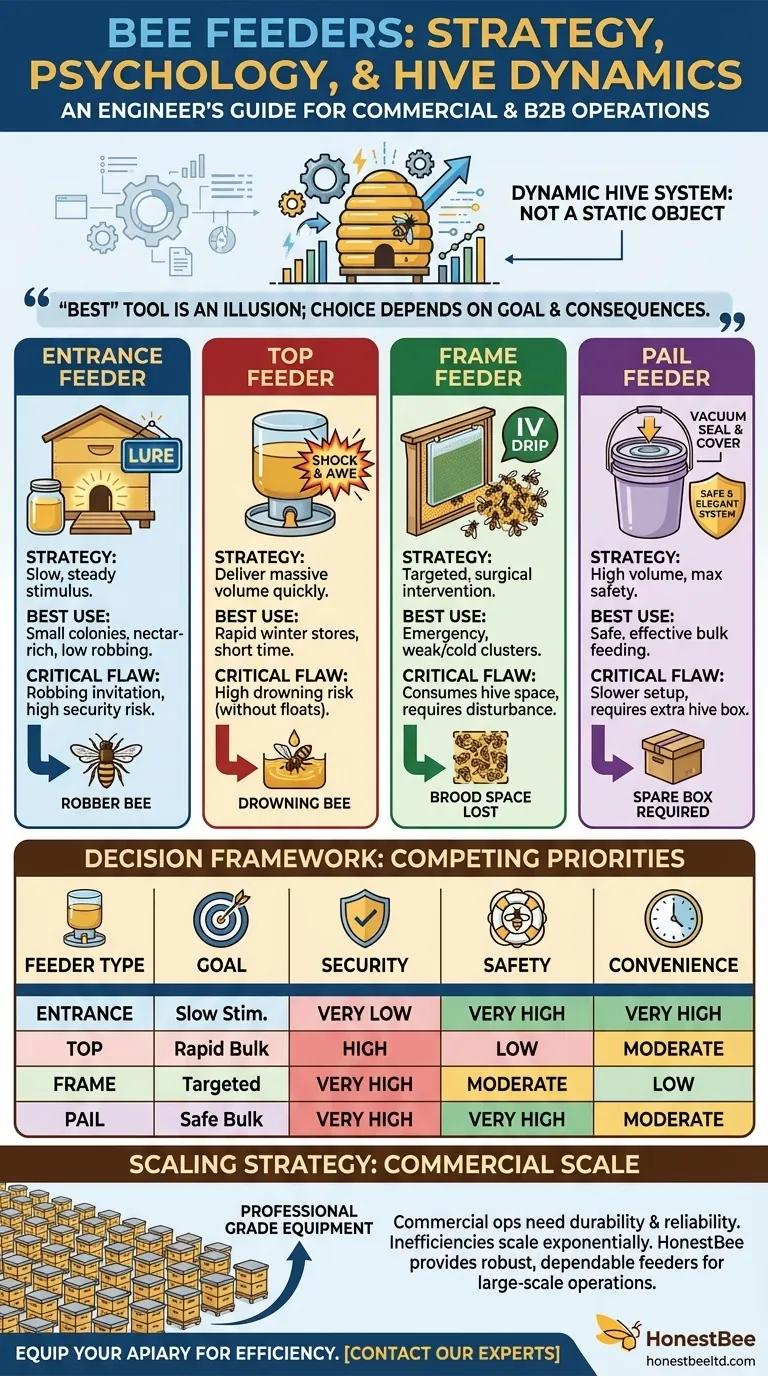
| Feeder Type | Primary Goal | Security (vs. Robbing) | Bee Safety (vs. Drowning) | Convenience |
|---|---|---|---|---|
| Entrance Feeder | Slow Stimulation | Very Low | Very High | Very High |
| Top Feeder | Rapid Bulk Feeding | High | Low (without floats) | Moderate |
| Frame Feeder | Targeted/Emergency Feeding | Very High | Moderate | Low |
| Pail Feeder | Safe Bulk Feeding | Very High | Very High | Moderate |
Scaling Strategy: From Hobbyist Gadget to Commercial Equipment
The psychology of a commercial beekeeper is fundamentally different. Their decisions are amplified across hundreds or thousands of hives.
At that scale, small inefficiencies become massive operational drags. A 1% drowning rate isn't a small loss; it's the loss of tens of thousands of foragers right before a honey flow. A single robbing incident can trigger a yard-wide frenzy, jeopardizing an entire apiary.
For commercial apiaries and equipment distributors, the focus shifts to durability, reliability, and efficiency at scale. A cheap feeder that cracks in the sun or leaks gallons of syrup is not a bargain; it's a liability that costs time, money, and colonies. This is why professionals invest in robust, high-performance equipment designed for the rigors of large-scale operations. As a wholesale-focused supplier, HONESTBEE provides the durable, dependable feeders that commercial operators rely on to protect their assets and maximize their productivity.
The right tool reflects a clear strategy. For those managing bees at scale, having a reliable supply of professional-grade equipment is the foundation of a successful operation. If you're ready to equip your apiary for efficiency and growth, Contact Our Experts.
Visual Guide
Related Products
- Rapid Bee Feeder White Plastic 2L Round Top Feeder for 8 or 10-Frame Bee Hives
- HONESTBEE Entrance Bee Feeder Professional Hive Nutrition Solution for Beekeeping
- White Plastic 0.5L Beekeeping Entrance Feeder for Bees
- HONESTBEE Entrance Bee Feeder Efficient Hive Front Liquid Feeding Solution for Beekeeping
- HONESTBEE Professional Entrance Bee Feeder Hive Nutrition Solution
Related Articles
- How to Choose Between Frame and Gravity Feeders for Healthy Honey Bee Colonies
- How to Choose the Right Bee Feeder for Your Hive’s Health and Efficiency
- Design, Drowning, and the Deceptively Simple Bee Feeder
- The Weight of Winter: A Systems Approach to Pre-Season Bee Feeding
- Beyond the Jar: The Hidden Engineering of Bee Feeder Safety