The Question of Trust in Every Hive
Every beekeeper faces a moment of calculation. You hold a frame, heavy with honey and bees, and consider its origin story. It began not with the bees, but with the foundation—the thin, patterned sheet of wax that serves as the colony's architectural blueprint.
The silent question is one of trust. Do you trust the source of your commercial foundation? Do you trust its purity, its cell size, its history? For a growing number of commercial apiaries, the answer is to take control. This isn't just about self-sufficiency; it's a strategic decision about the very biology of the hive.
The Blueprint of the Colony
A beehive is a marvel of engineering, but in modern beekeeping, it doesn't happen by accident. We provide a guide.
From Raw Wax to Ordered Architecture
Beeswax foundation is that guide. A sheet of wax imprinted with the hexagonal base of a honeycomb cell tells the bees where and how to build. It encourages them to draw straight, uniform combs within removable frames, making hive inspections and honey extraction predictable and efficient.
Without it, bees would build wild comb, beautiful but impractical for a managed apiary. The foundation is the schematic that channels their instinct into a productive, manageable system.
The Mechanical Heart of Control
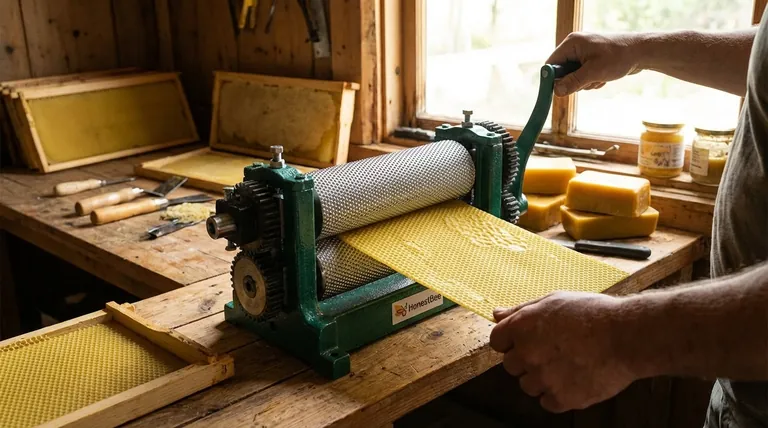
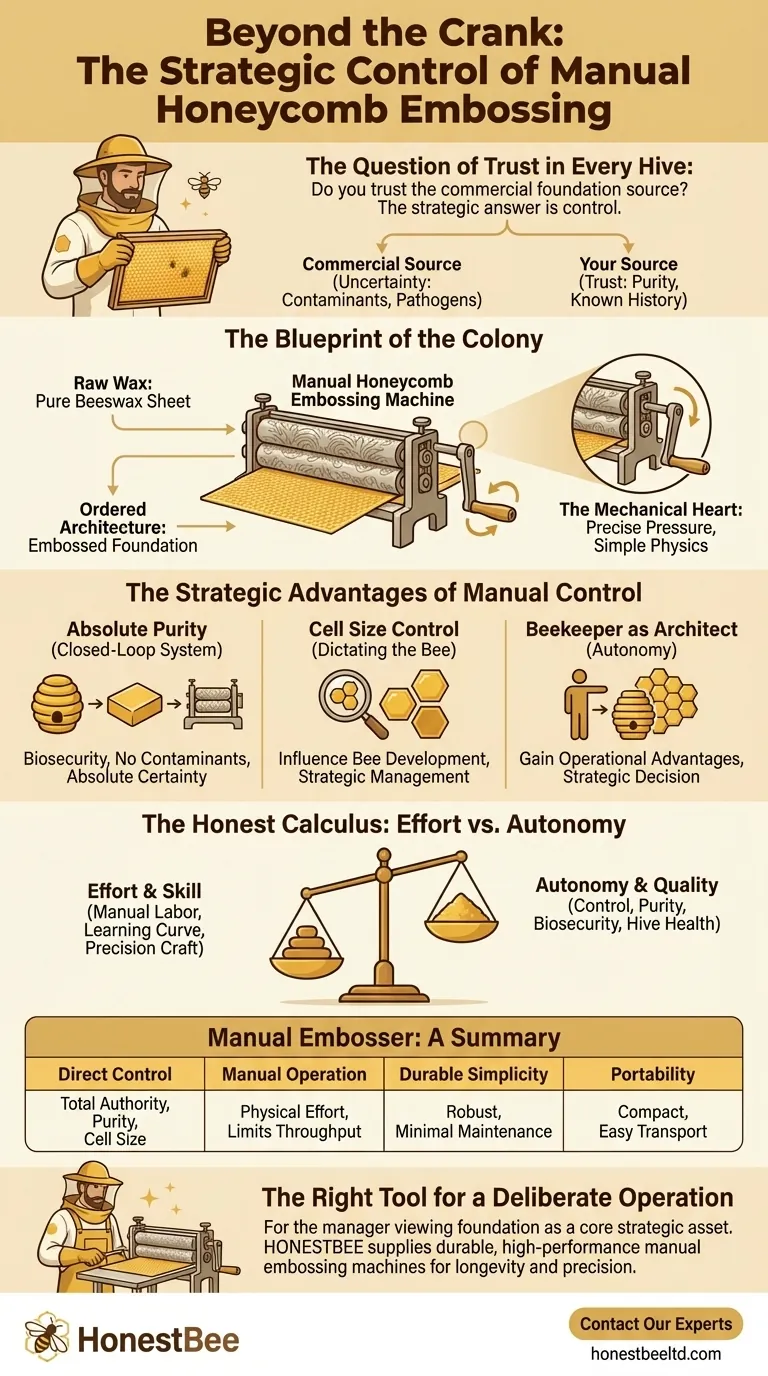
The manual honeycomb embossing machine is the tool that creates this schematic. Its operation is elegantly simple: a sheet of pure beeswax is fed between two intricately engraved rollers. As a hand crank is turned, the rollers exert precise pressure, embossing the perfect hexagonal pattern onto the wax.
There is a certain romance in this mechanical simplicity. It's a direct, tactile connection between the beekeeper's intention and the hive's foundational structure. There are no complex electronics, just the pure physics of pressure and pattern.
The Strategic Advantages of Manual Control
Choosing to produce your own foundation is less about saving money on supplies and more about gaining critical operational advantages. It’s a shift from being a consumer to being the architect.
The Pursuit of Absolute Purity
For a commercial apiary, biosecurity is paramount. Commercially sourced foundation can be a vector for contaminants—pesticide residues, adulterants, or even pathogens like American Foulbrood spores. These are risks that can devastate an operation.
By using wax harvested from your own healthy hives, you create a closed-loop system. You have absolute certainty about the purity of the foundation. This isn't just a feature; it's a powerful form of insurance against invisible threats.
Dictating the Cell, Guiding the Bee
The machine also grants you control over the dimensions of the honeycomb cells. Some management philosophies suggest that using foundation with slightly smaller or larger cells can influence the size of the bees raised within them.
While a subject of debate, the ability to experiment and implement this technique gives the beekeeper another lever to pull. It's a subtle but potentially powerful tool for influencing the colony's development according to a specific management strategy.
The Honest Calculus: Effort vs. Autonomy
A manual embosser is a tool of deliberation. Its strengths are also the source of its limitations, and understanding this trade-off is key.
The Physics of Production
The most significant factor is manual labor. Embossing wax requires physical effort. For a small batch of foundation, the work is satisfying. For hundreds or thousands of sheets, it becomes a serious physical task.
This is the trade-off: you exchange the convenience of automated, high-volume production for the absolute control and purity that manual embossing provides. It is designed for precision, not mass production.
The Artisan's Learning Curve
While mechanically simple, the machine requires skill. Achieving the perfect foundation sheet—free of tears or imperfections—is a craft. The beekeeper must learn the feel of it: the ideal wax temperature, the correct rolling speed, and the right amount of pressure.
This learning curve is not a flaw; it's an initiation. It ensures that the operator is intimately connected with the quality of the final product.
Manual Embosser: A Summary
| Attribute | Strategic Implication | Best For |
|---|---|---|
| Direct Control | Grants total authority over wax purity and cell size, enhancing biosecurity. | Operations prioritizing quality and hive health over sheer volume. |
| Manual Operation | Requires physical effort, limiting throughput for very large-scale needs. | Small-to-midsize commercial apiaries, queen breeders, and equipment distributors. |
| Durable Simplicity | Robust, reliable, and requires minimal maintenance, ensuring a long service life. | Beekeepers who value resilient, field-ready equipment. |
| Portability | Compact design allows for easy transport and storage in a workshop or apiary. | Mobile operations or those with limited dedicated space. |
The Right Tool for a Deliberate Operation
The manual honeycomb embosser is not for every beekeeper. It is for the manager who views foundation not as a consumable good, but as a core strategic asset. It is for the operation where purity, control, and biosecurity are the primary drivers of success.
For commercial apiaries and beekeeping suppliers who operate on this principle, the reliability of the tool itself is non-negotiable. At HONESTBEE, we supply durable, high-performance manual embossing machines engineered for longevity and precision. They are built to empower beekeepers who choose deliberate control over mass-produced convenience.
If you are ready to implement a strategy of foundational autonomy in your operation, we can provide the tools to make it a reality. Contact Our Experts
Visual Guide
Related Products
- Easy Use Manual Stainless Steel Honey Press for Honey Comb
- Manual Beeswax Comb Foundation Machine Wax Foundation Mill Embossing Machine
- Manual Honey Filling Machine Bottling Machine for Honey
- Professional Bent Tine Honey Uncapping Fork with Ergonomic Grip
- HONESTBEE 3-Frame Manual Acrylic Honey Extractor
Related Articles
- The Unseen System: Why a Honey Press is More Than Just a Tool
- Why a Honey Press is the Smart Choice for Small-Scale Beekeepers
- The Last Drop: Maximizing Yield and Purity with a Stainless Steel Honey Press
- Is Your Honey Press Underperforming? The Overlooked Secret to Maximizing Your Yield
- Are You Throwing Away Profit? Why Commercial Apiaries Need a Honey Press