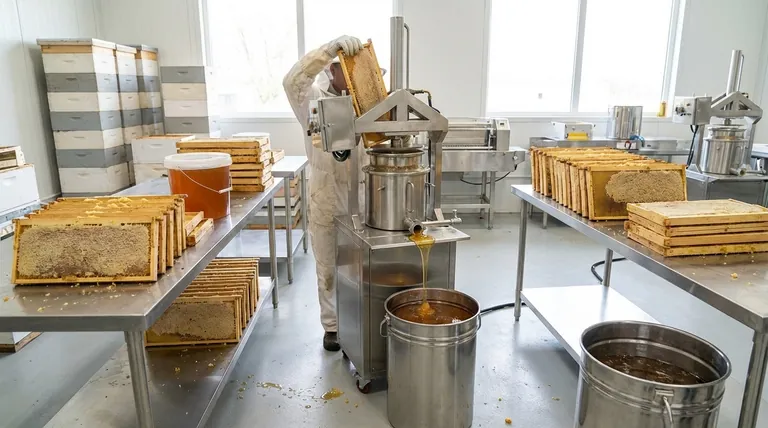
The Beekeeper's Dilemma: A Mountain of Cappings
Every commercial beekeeper knows the sight: a growing mountain of wax cappings, sticky and heavy with trapped honey. It represents both the success of a harvest and a frustrating operational bottleneck. This is where the real work begins.
The traditional centrifuge is a marvel of speed for standard frames, but it’s useless for these cappings, or for the broken, irregular comb that is an inevitable part of beekeeping. The honey locked within this wax is some of the finest, yet extracting it is often a messy, inefficient, multi-stage process.
This challenge isn't just about lost product; it's about the psychology of waste. Every drop of honey left behind feels like a betrayal of the bees' immense effort. The choice of extraction technology, therefore, is not merely technical. It's a statement about your operational philosophy.
A Unified System: The Logic of the Press
A honey press filter machine operates on a beautifully simple principle: crush and strain. But its true elegance lies in integrating two distinct processes—extraction and filtration—into a single, continuous workflow.
From Multiple Steps to One Motion
Instead of uncapping, spinning, then separately melting or pressing the cappings, the honey press takes the entire honeycomb (or cappings) and applies mechanical pressure.
The raw honey is forced out through an integrated filtering system, leaving behind a block of remarkably dry beeswax. This isn't just an improvement; it's a re-imagining of the workflow. It eliminates intermediate steps, reduces handling, and minimizes the opportunities for contamination or mess.
The Psychology of Maximum Yield
The deepest satisfaction of using a press comes from seeing the final puck of spent wax. It's light and almost perfectly dry. You know, with certainty, that you have recovered nearly every possible drop of honey.
For an operation where every ounce contributes to the bottom line, this addresses the deep-seated aversion to waste. It honors the resources and transforms a byproduct (cappings) into a primary revenue stream. This commitment to efficiency is the quiet romance of well-designed engineering.
The Critical Question of Scale
The term "honey press" can describe a small, hand-cranked device or a massive industrial machine. Its advantage is not universal; it is intensely specific to the scale and goals of your apiary.
The Artisan's Advantage: Quality and Resourcefulness
For small-scale or hobbyist beekeepers, a manual press is a tool of resourcefulness. It allows them to work with non-standard hives (like Warre or top-bar) and salvage every bit of honey from broken comb.
Furthermore, the gentle pressing action avoids the high-speed aeration that can occur in centrifugal extractors. Many feel this method better preserves the honey’s delicate volatile aromas and raw character, creating a premium product defined by minimal processing.
The Commercial Imperative: Throughput and Efficiency
For a commercial apiary, the industrial honey press filter is the solution to a critical bottleneck. The goal here is not just yield, but reliable, high-volume throughput.
When processing hundreds of supers, the cappings pile up fast. An industrial press turns this challenge into a streamlined part of the production line. It ensures that honey from cappings is processed as quickly and cleanly as honey from the main extraction line, readying it for bulk storage or bottling with minimal labor.
An Honest Accounting of Trade-Offs
No tool is without its compromises. The strategic power of the honey press is only realized when you understand what you are giving up.
The Irrecoverable Comb
The most significant trade-off is the comb itself. The crush-and-strain method completely destroys it.
Bees expend a tremendous amount of energy—consuming roughly 8 pounds of honey to produce 1 pound of wax—to draw out a comb. A centrifugal extractor preserves this investment, allowing bees to refill it immediately. A press is therefore ideal for wax that you do not plan to reuse.
The Calculus of Effort
While an industrial press is highly automated, smaller manual presses can be labor-intensive. Loading the comb, applying pressure, and clearing the spent wax takes time. For a beekeeper with hundreds of uniform, standard frames, the centrifuge is undeniably faster for the initial bulk extraction.
Press vs. Extractor: A Summary of Choices
| Feature | Honey Press Filter Machine | Centrifugal Extractor |
|---|---|---|
| Primary Function | Extracts & filters by crushing comb/cappings | Extracts by spinning honey out of intact comb |
| Best Use Case | Cappings, broken/non-standard comb, high-yield focus | Standard frames where comb reuse is the priority |
| Comb Impact | Destroys the wax comb | Preserves the wax comb for reuse by bees |
| Honey Yield | Maximizes recovery from wax, minimizing waste | Leaves residual honey in cappings |
| Operational Fit | Streamlines end-to-end processing for commercial scale | Maximizes speed for bulk frame extraction |
Your Philosophy Determines Your Machine
Ultimately, the choice between a press and an extractor is a reflection of your primary goal.
- To maximize speed and reuse comb: The centrifugal extractor is your workhorse.
- To maximize yield from cappings and waste wax: The honey press is your most profitable tool.
- To streamline a large-scale workflow into a single, efficient system: The industrial honey press filter is your strategic solution.
At HONESTBEE, we equip commercial apiaries and distributors with robust, high-yield honey press filter machines designed for operational excellence. We understand that the right equipment is a cornerstone of a profitable and sustainable beekeeping business.
If you're ready to turn your biggest bottleneck into your most efficient process, let's find the right solution for your scale. Contact Our Experts
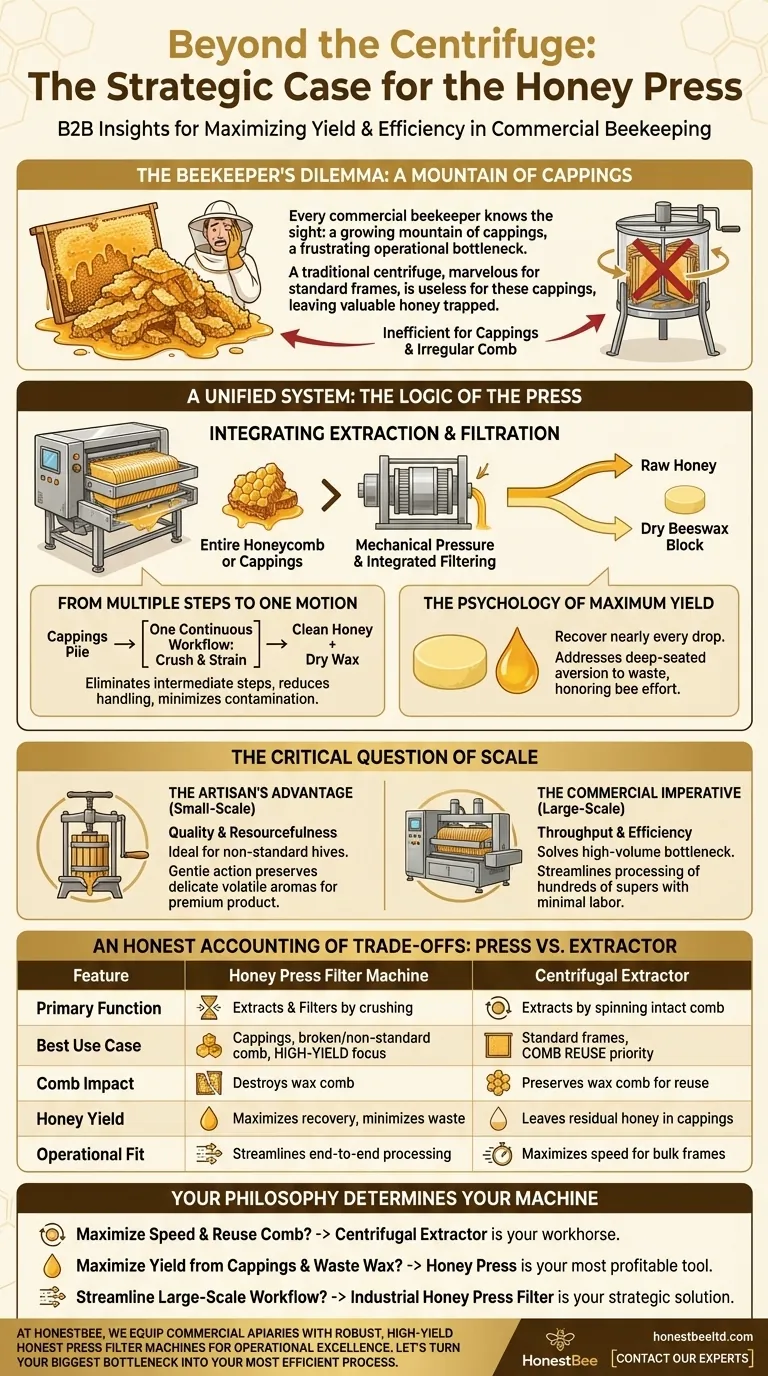
Visual Guide
Related Products
- Stainless Steel Manual Honey Press with Guard for Pressing Honey and Wax
- Stainless Steel Honey Press Wax Press with Tank
- Easy Use Manual Stainless Steel Honey Press for Honey Comb
- Electric Honey Press Machine for Squeezing Honey Comb Press Equipment
- 10L Stainless Steel Electric Honey Press Machine
Related Articles
- The Unseen System: Why a Honey Press is More Than Just a Tool
- Why a Honey Press is the Smart Choice for Small-Scale Beekeepers
- The Last Drop: Maximizing Yield and Purity with a Stainless Steel Honey Press
- Beyond Brute Force: Why Your Honey Press Is Costing You Quality and Yield
- Why Your Honey Press Is a Sticky, Contaminated Mess—And How to Fix It Permanently