The Allure of a Simple Number
Every beekeeper, from the novice to the seasoned commercial operator, has asked the question: "How many frames of brood should my hive have?"
We are wired to seek simple metrics. We want a single, clean number to tell us if things are "good" or "bad." It’s a cognitive shortcut that serves us well in many areas, but in the complex, living system of a beehive, it can be profoundly misleading.
A honeybee colony doesn't operate on a fixed target. It operates on a rhythm, an ancient seasonal clock that dictates its expansion and contraction. The true art of beekeeping isn't about hitting a specific frame count; it's about learning to read this rhythm.
The Brood Nest: A Colony's Dashboard
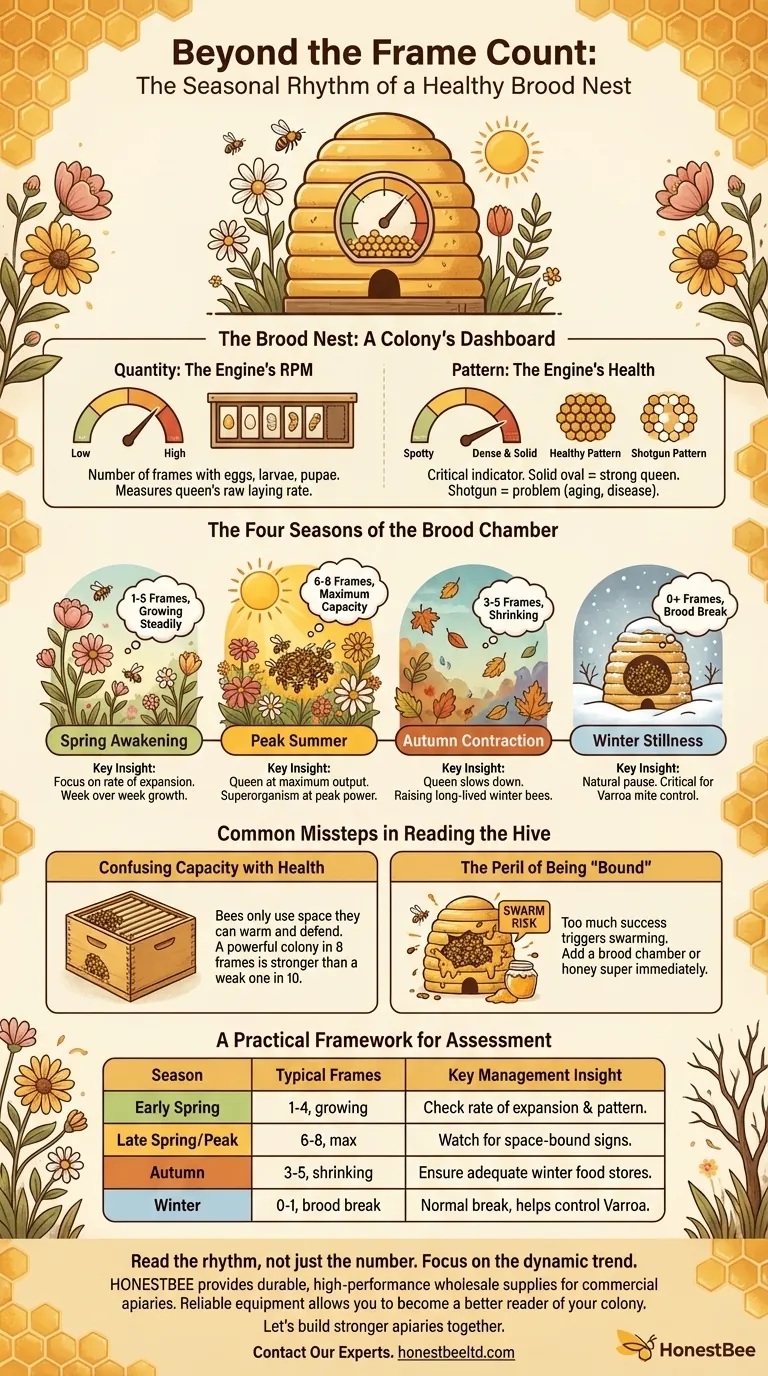
Think of the brood nest not as a fuel gauge, but as the central dashboard of your colony. It tells you a story about your queen's vitality, your hive's population dynamics, and its readiness for the challenges ahead. Two key readouts matter most.
Quantity: The Engine's RPM
The number of frames containing brood—eggs, larvae, and pupae—is a direct measure of the queen's laying rate. It tells you the raw output of your colony's engine. A larger brood area means more new bees are being produced, which is fundamental for growth and replacing the workforce.
Pattern: The Engine's Health
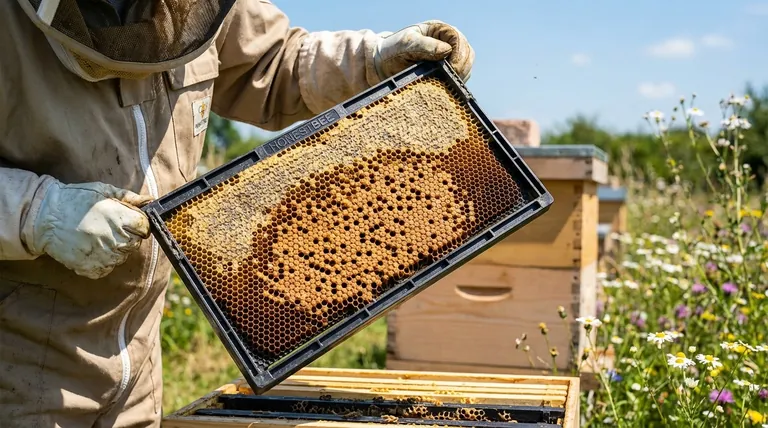
More critical than sheer quantity is the brood pattern. A strong, healthy queen lays her eggs in a dense, contiguous pattern, often forming a solid oval across the frame. You should see all stages of development—eggs, young larvae, and capped brood—clustered tightly together.
A spotty, "shotgun" pattern, with empty cells scattered randomly, is a serious warning light on your dashboard. It points to a systemic problem: an aging queen, poor genetics, or emerging disease. It’s the difference between a smoothly running engine and one that’s misfiring.
The Four Seasons of the Brood Chamber
A healthy hive is a master of resource management. It adjusts its population with remarkable precision throughout the year. Understanding this cycle is the key to accurate assessment.
The Spring Awakening (1-5 Frames)
As the first pollen arrives, the queen begins to lay. The brood nest starts small, perhaps the size of a fist on a single frame. The key indicator here is not the initial size, but the rate of expansion. Week over week, you should see it grow steadily as the colony builds its momentum for the season.
The Peak Summer (6-8 Frames)
This is the hive's explosive growth phase. In the weeks leading up to the main nectar flow, the queen is laying at maximum capacity. In a standard ten-frame Langstroth box, it's common to find six, seven, or even eight frames packed with brood. This is the superorganism at its peak power.
The Autumn Contraction (3-5 Frames)
As the days shorten, the colony's logic shifts from expansion to conservation. The queen's laying rate slows dramatically. The goal now is to raise smaller populations of long-lived "winter bees" designed to survive the cold months. The brood nest strategically shrinks.
The Winter Stillness (0+ Frames)
In colder climates, the colony enters a natural "brood break." The queen may stop laying entirely. Finding zero frames of brood in a mid-winter inspection is often not a sign of failure, but a sign of a healthy, intelligent system. This break is also critical for disrupting the life cycle of Varroa mites.
Common Missteps in Reading the Hive
Interpreting the brood nest is a skill, and two common cognitive traps can lead to poor management decisions.
Confusing Capacity with Health
A 10-frame box offers the capacity for a large brood nest, but the bees will only use the space they can effectively warm, defend, and maintain. A powerful colony in eight well-drawn frames is far stronger than a weak colony rattling around in ten. Your job is to provide robust, reliable equipment; the bees' job is to use it according to their needs.
The Peril of Being "Bound"
Conversely, a colony can be too successful for its own good. When nearly every frame is filled with brood, pollen, or honey, the hive becomes "brood bound" or "honey bound." This lack of space is a primary trigger for swarming. It is a sign of success that demands immediate action: adding another brood chamber or a honey super to provide room for expansion.
A Practical Framework for Assessment
Instead of focusing on one number, use this seasonal guide to interpret what you see.
| Season | Typical Brood Frames (10-Frame Box) | Key Management Insight |
|---|---|---|
| Early Spring | 1-4, steadily growing | Focus on the rate of expansion. Is the pattern solid? |
| Late Spring/Peak | 6-8 | Queen is at maximum output. Watch for signs of being space-bound. |
| Autumn | 3-5, shrinking | Colony is raising winter bees. Ensure they have adequate food stores. |
| Winter | 0-1 | A natural brood break is normal and helps control Varroa mites. |
Ultimately, reading the frames is about shifting your perspective from a static count to a dynamic trend. It's about understanding the story the bees are telling you.
At HONESTBEE, we build the durable, high-performance equipment that commercial apiaries rely on. Our wholesale supplies provide the stable foundation you need, so you can focus less on your hardware and more on the intricate biology of the hive. When your equipment is reliable, you are free to become a better reader of the colony's rhythm.
Let's build stronger apiaries together. Contact Our Experts
Visual Guide
Related Products
- Assembled Wooden Bee Frames with Plastic Foundation for Durability and Convenience by HONESTBEE
- Professional Galvanized Steel Frame Rest for Beehives
- Assembled Wooden Bee Frames with Beeswax Foundation Ready to Use by HONESTBEE
- JZBZ Langstroth Queen Rearing Frame for Beekeeping
- Wooden Bee Hive Frames for Beekeeping and Wholesale
Related Articles
- How to Clear Bees from Frames Without Compromising Honey Quality or Colony Health
- Beyond the Scrape: A Systemic Approach to Bee Frame Management
- The Pragmatic Hive: Engineering Resilience with Wood Frames and Plastic Foundation
- Why Wooden Beehive Frames Outperform Alternatives: Science, Sustainability, and Beekeeper Experiences
- Why Your Plastic Frames Are Warping—And Costing You More Than You Think