For honey producers weighing automation decisions, the choice between semi-automatic and automatic filling machines hinges on three critical factors: production scale, total cost of ownership, and long-term scalability. This guide breaks down the trade-offs to help commercial apiaries and distributors align equipment investments with operational goals.
Choosing Between Semi-Automatic and Automatic Honey Fillers
Production Scale and Output Targets
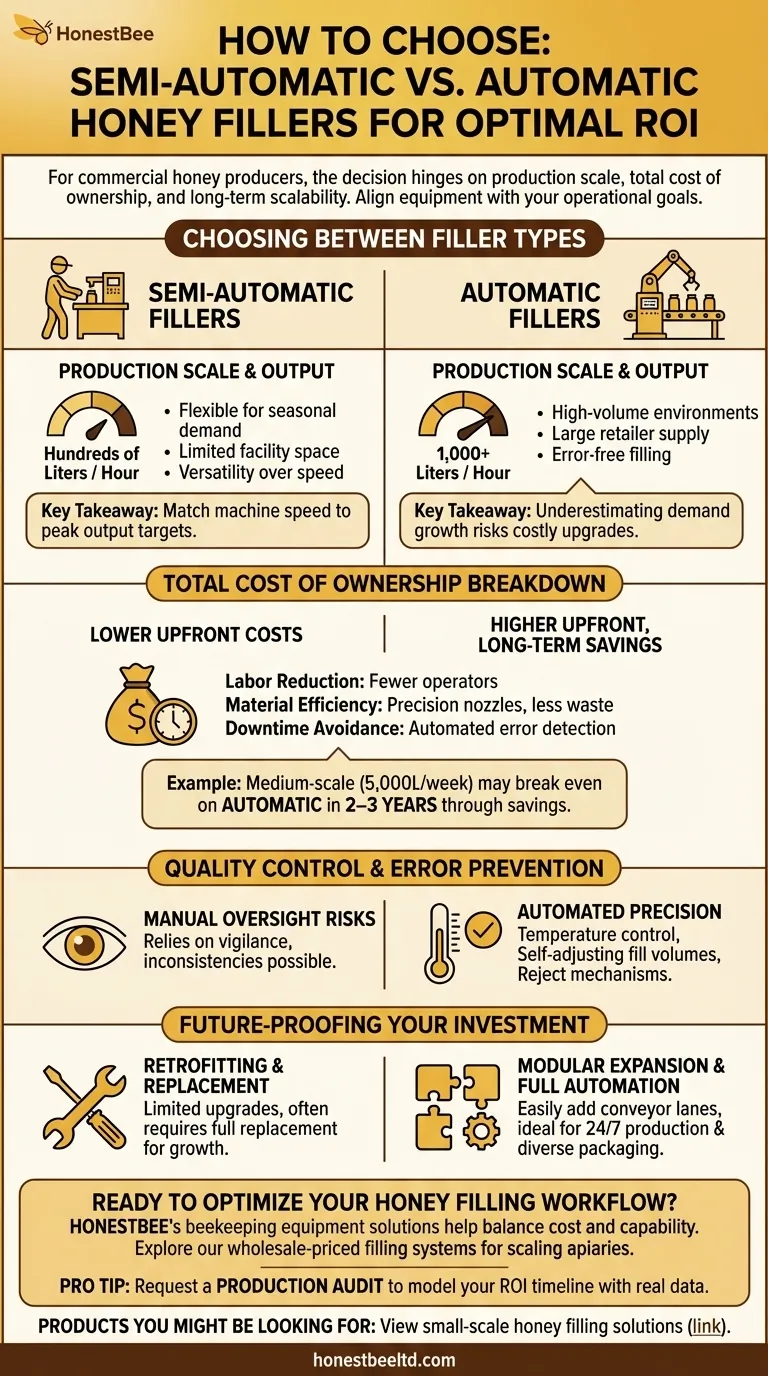
Semi-automatic fillers suit small to mid-sized operations with flexible production needs, typically processing hundreds of liters per hour with moderate manual oversight. They’re ideal for:
- Seasonal demand fluctuations
- Limited facility space
- Operations prioritizing versatility over speed
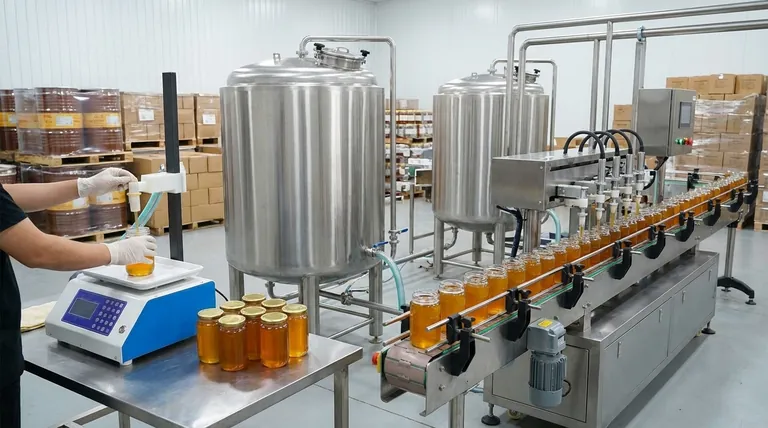
Automatic systems excel in high-volume environments (1,000+ liters/hour), leveraging PLC controls for consistent throughput. Consider them if:
- You supply large retailers or wholesalers
- Labor costs outweigh equipment expenses
- Error-free filling is non-negotiable
Key Takeaway: Match machine speed to your peak output targets. Underestimating demand growth may force costly upgrades later.
Total Cost of Ownership Breakdown
While semi-automatic fillers have lower upfront costs, automatic models deliver savings through:
- Labor reduction: Fewer operators needed per shift
- Material efficiency: Precision nozzles minimize honey waste
- Downtime avoidance: Automated error detection reduces stoppages
Example: A medium-scale apiary processing 5,000 liters weekly might break even on an automatic system within 2–3 years through labor and waste savings alone.
Quality Control and Error Prevention
Automatic fillers outperform in maintaining viscosity-sensitive honey quality via:
- Temperature-controlled reservoirs
- Self-adjusting fill volumes
- Reject mechanisms for under/overfilled containers
Semi-automatic models rely on operator vigilance, risking inconsistencies in high-humidity environments.
Future-Proofing Your Investment
Scalability Considerations
Automatic systems offer modular expansion (e.g., adding conveyor lanes), while semi-automatic units often require full replacements. Ask:
- Will your packaging formats diversify?
- Do you plan to certify for export markets (requiring tighter QC)?
Retrofitting vs. Full Automation
Retrofitting semi-automatic fillers with sensors can bridge gaps temporarily, but full automation is wiser for:
- Facilities with 24/7 production schedules
- Brands competing on shelf-appeal consistency
Ready to Optimize Your Honey Filling Workflow?
HONESTBEE’s beekeeping equipment solutions help commercial producers balance cost and capability. Explore our wholesale-priced filling systems designed for apiaries scaling toward automation—because every drop of efficiency translates to sweeter profits.
Pro Tip: Request a production audit to model your ROI timeline with real operational data.
Products You Might Be Looking For:
View small-scale honey filling solutions
Visual Guide
Related Products
- Precision Durable Efficient HONESTBEE Rotary Honey Filling Machine
- Semi Automatic Small Honey Bottle Filling Machine Honey Filler
- Automatic Honey Filling and Filtering Machine for Beekeeping Bottle Filling
- Economy Small Honey Filling Machine Honey Bottle Filler Packaging Machine
- Double Nozzle Small Honey Filling Machine Honey Sachet Packing Packaging Equipment
Related Articles
- How to Choose Between Semi-Automatic and Fully Automatic Honey Filling Machines
- The Bottleneck in a Bottle: Why Manual Honey Filling Limits Your Apiary's Growth
- The Viscosity Principle: How a Honey Filling Machine Masters More Than Just Honey
- The Sticky Truth: Why Your Honey Filling Fails and How to Fix It for Good
- The Mechanics of Trust: Why Your Honey Filling Process is Your Brand's First Handshake