The Illusion of Simplicity
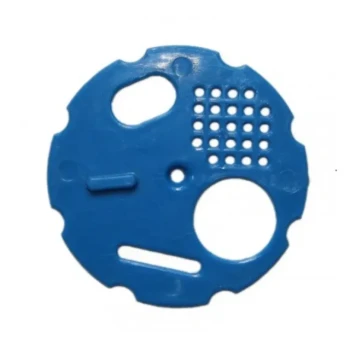
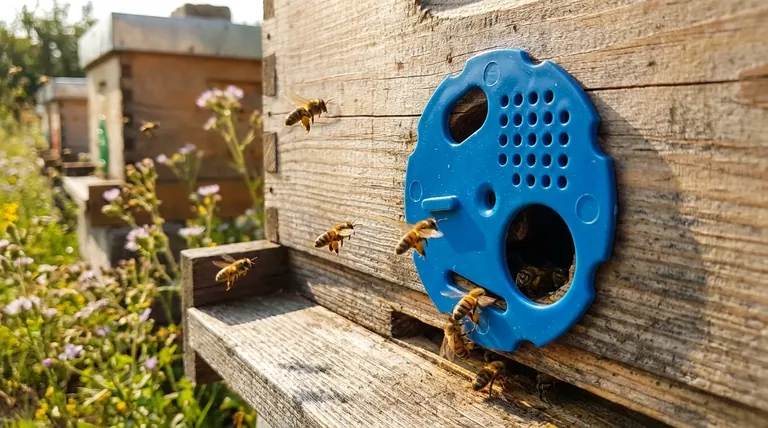
At first glance, the circular metal beehive entrance disc seems trivial. It's a small, simple rotating plate with a few holes of varying sizes. We have a cognitive bias for complexity; we often assume that impactful tools must look impressive.
But in beekeeping, as in so many complex systems, the most elegant solutions are often the simplest. This small disc is not merely a door; it is a control panel. It’s the primary interface through which a beekeeper regulates a hive's traffic, climate, security, and population dynamics in response to the constant flux of seasons, threats, and opportunities.
A Dial for Hive Operations: The Four Critical Settings
Understanding the entrance disc is to understand that you are not just opening or closing a hole. You are selecting a precise operational mode for the entire colony.
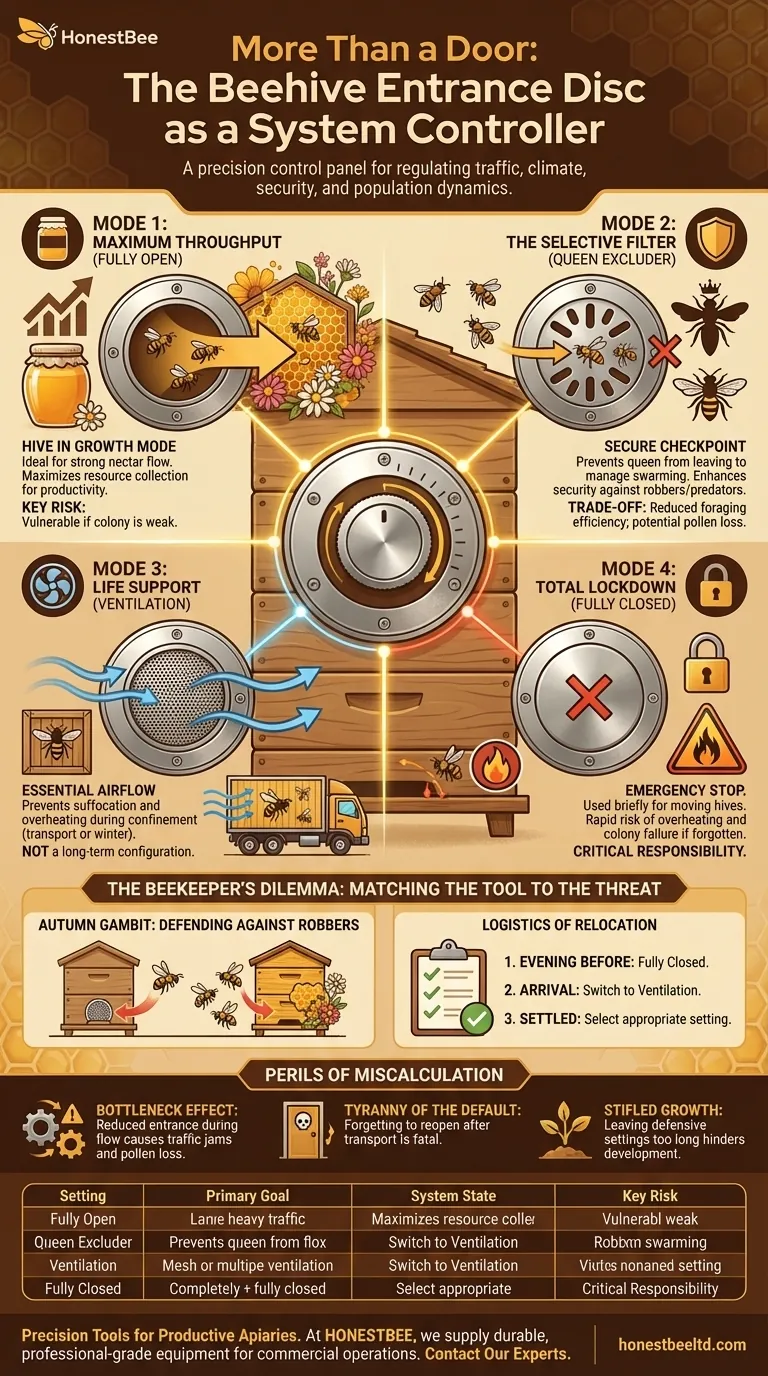
Mode 1: Maximum Throughput (Fully Open)
This is the hive in growth mode. During a strong nectar flow, the entrance is a bustling highway. Foragers arrive laden with resources while a new shift of workers departs.
Congestion here is more than an inconvenience; it's a direct tax on productivity. A bottleneck at the entrance means lost foraging time, wasted energy, and ultimately, a reduced honey harvest. The fully open setting is the default for a healthy colony precisely because it maximizes the flow of resources that fuels its success.
Mode 2: The Selective Filter (Queen Excluder)
This setting, with its smaller holes, transforms the entrance from an open highway into a secure checkpoint. It's large enough for worker bees but impassable for the larger queen and drones.
Here, the beekeeper imposes a critical rule: the queen cannot leave. This is a powerful intervention to manage the swarming impulse. But it's also a defensive strategy. It shrinks the doorway, making it far easier for guard bees to repel robbers or large predators like wasps. It's a deliberate trade-off: sacrificing maximum efficiency for enhanced security.
Mode 3: Life Support (Ventilation)
Picture a hive sealed and loaded onto a truck. Inside, thousands of bees generate immense heat. Without airflow, this confinement would quickly become a death sentence.
The ventilation setting is the colony's life support system in these high-stress moments. It decouples confinement from suffocation, allowing critical air exchange while keeping the bees securely inside. The same principle applies to managing the slow, silent threat of winter moisture, which can be just as deadly as heat.
Mode 4: Total Lockdown (Fully Closed)
This setting is absolute. It seals the hive completely. Its use is singular and brief: the physical act of moving the hive from one location to another.
This is the system's emergency stop. It ensures no bee is left behind. But it comes with immense responsibility. In this mode, the hive is a closed system rapidly approaching a critical failure point from overheating. It is the setting where a beekeeper's smallest mistake—a moment of forgetfulness—has the most catastrophic consequences.
The Beekeeper's Dilemma: Matching the Tool to the Threat
The power of the entrance disc lies not in its design, but in the beekeeper's judgment. The correct setting is always context-dependent.
The Autumn Gambit: Defending Against Robbers
In late summer, as nectar sources dwindle, the dynamics between hives change. The world becomes more competitive. A strong hive may attempt to rob a weaker neighbor.
For a young or small colony, the fully open entrance is a defensive liability. By switching to the queen excluder setting, the beekeeper fortifies the hive, creating a smaller, more defensible chokepoint. This strategic decision levels the playing field, giving the guard bees a fighting chance.
The Logistics of Relocation
Moving a hive is a precise operation that hinges on the correct sequence of settings:
- Evening Before: Wait for all foragers to return, then switch to Fully Closed.
- Upon Arrival: Immediately switch from closed to Ventilation. This allows the colony to regulate its temperature and calm down after the stressful journey.
- Final Step: Once the colony has settled, switch to a reduced opening (like the Queen Excluder) or the Fully Open setting, depending on the new environment.
The Perils of Miscalculation
Every powerful tool carries risk, and the entrance disc is no exception. The most common errors are not mechanical failures, but failures of judgment.
- The Bottleneck Effect: Using a reduced entrance during a peak nectar flow creates a costly traffic jam. Foragers may even have valuable pollen loads scraped from their legs as they squeeze through, robbing the colony of essential protein.
- The Tyranny of the Default Setting: The most dangerous mistake is human error. Forgetting to reopen a hive after a move is fatal. Leaving a defensive setting in place too long can stifle a colony's growth. The beekeeper must remain an active manager, constantly assessing if the current setting matches the colony's current needs.
| Setting | Primary Goal | System State | Key Risk of Misuse |
|---|---|---|---|
| Fully Open | Maximize Productivity | Growth | Vulnerable to robbers if colony is weak |
| Queen Excluder | Enhance Security / Swarm Control | Defense / Control | Reduced foraging efficiency; pollen loss |
| Ventilation | Ensure Survival in Transit | Life Support | Not a long-term living configuration |
| Fully Closed | Secure for Transport | Emergency Lockdown | Rapid overheating; colony death if forgotten |
Precision Tools for Productive Apiaries
For commercial apiaries and beekeeping equipment distributors, where the health and productivity of every hive directly impacts the bottom line, operational efficiency and risk management are paramount. The reliability of every component, no matter how small, is non-negotiable.
A well-engineered entrance disc isn't just a piece of metal; it’s a precision instrument for hive management. At HONESTBEE, we supply durable, professional-grade beekeeping equipment designed for the high stakes of commercial operations. Our products are built to provide the control and reliability you need to protect your investment and maximize your apiary's potential.
To ensure your hives are equipped with the best control systems on the market, Contact Our Experts.
Visual Guide
Related Products
- Multi-Functional Rotary Hive Entrance Disc for Beekeeping
- Beehive Entrance Discs Plastic Bee Entrance Disc for Bee Hives
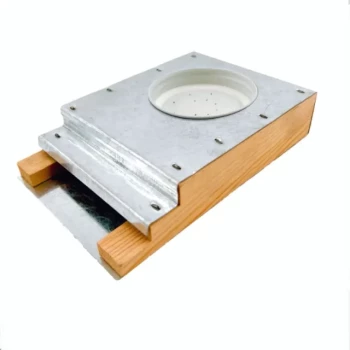
- Steel Round Disc Entrance Reducer for Flexzion Bee Hive Nuc Box Gate
- Professional Reversible Beehive Hive Entrance
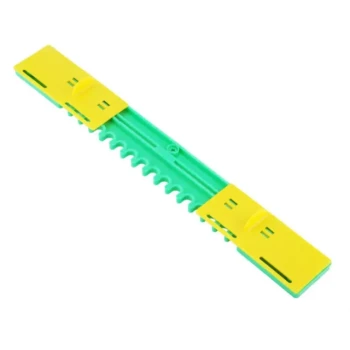
- Multi-Functional Sliding Hive Entrance for Beekeeping
Related Articles
- The Four-Way Gate: Mastering the Deceptive Simplicity of the Hive Entrance Disc
- The Four States of the Hive Entrance: A Gateway or a Fortress?
- How Hive Entrance Size Shapes Bee Health: Balancing Ventilation and Security
- Optimizing Beehive Entrance Discs: When Freedom Boosts Hive Performance
- Calibrating the Gateway: The Critical Engineering of the Hive Entrance