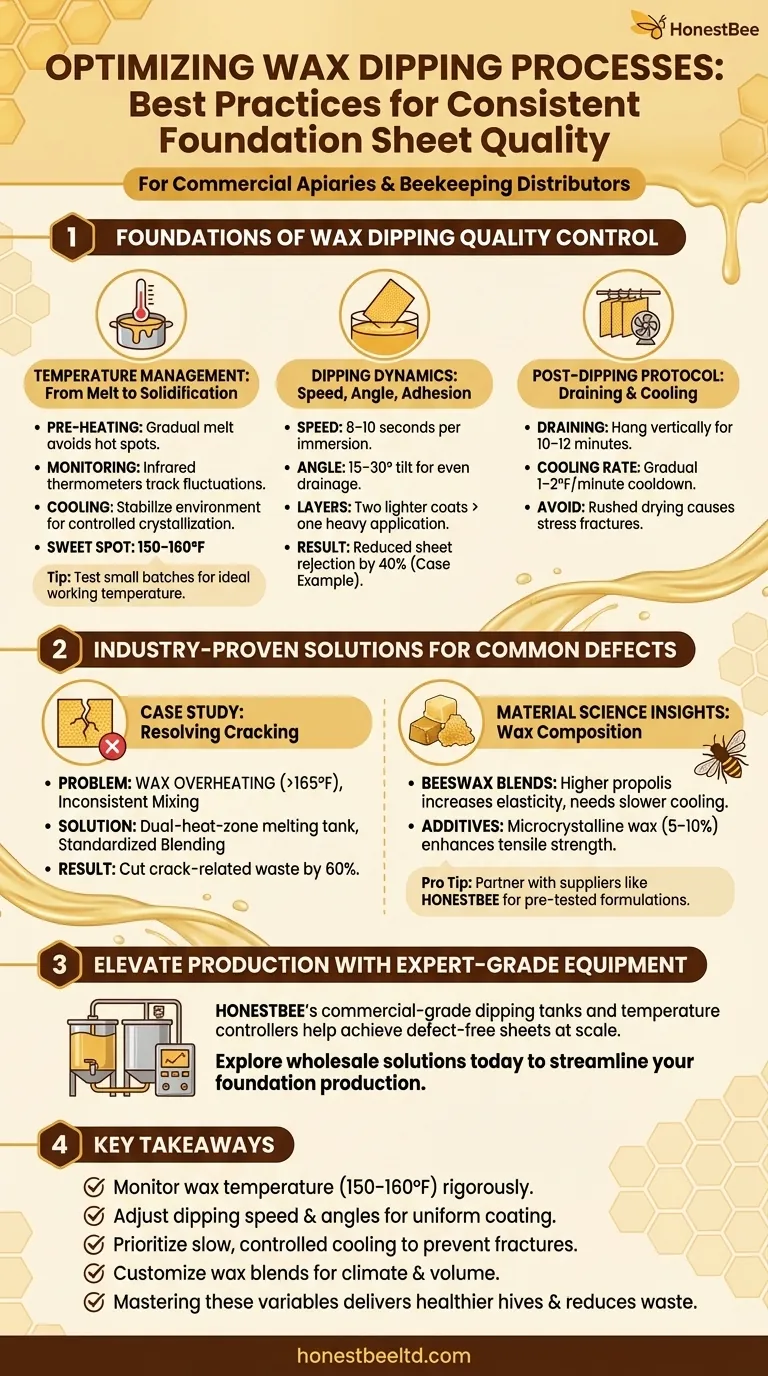
For commercial apiaries and beekeeping equipment distributors, maintaining flawless foundation sheets is critical to hive productivity. Wax dipping—a core manufacturing step—directly impacts structural integrity, bee acceptance, and long-term durability. This guide reveals actionable strategies to refine temperature control, dipping mechanics, and post-processing protocols, addressing the root causes of defects like cracking or warping.
Foundations of Wax Dipping Quality Control
Temperature Management: From Melt to Solidification
Precise thermal regulation ensures uniform wax viscosity and adhesion. Research shows that maintaining wax temperatures within a narrow range (typically between 150–160°F) prevents premature solidification or excessive thinning. Key considerations:
- Pre-heating phase: Gradually melt wax to avoid localized hot spots that degrade quality.
- Monitoring tools: Infrared thermometers help track real-time temperature fluctuations.
- Cooling environment: Stabilize ambient conditions to control crystallization speed—rapid cooling often causes brittleness.
Practical tip: Test small batches to identify your wax’s ideal working temperature before full-scale production.
Dipping Dynamics: Speed, Angle, and Adhesion Mechanics
The mechanical process of dipping foundation sheets influences wax distribution:
- Immersion speed: Too fast introduces air bubbles; too slow creates uneven layers.
- Sheet angle: A 15–30° tilt during extraction promotes even drainage.
- Multiple dips: Two lighter coats outperform one heavy application for defect prevention.
Case example: A Midwest apiary reduced sheet rejection rates by 40% after calibrating dip cycles to 8–10 seconds per immersion.
Post-Dipping Protocol: Draining Postures and Cooling Rate Control
Post-dip handling determines final sheet quality:
- Draining position: Hang sheets vertically for 10–12 minutes to minimize pooling.
- Controlled cooling: Use fans or climate-controlled rooms to achieve a gradual 1–2°F/minute cooldown.
Why it matters: Rushed drying leads to stress fractures, especially in high-humidity environments.
Industry-Proven Solutions for Common Defects
Case Study: Resolving Cracking in High-Volume Production
A commercial beekeeping supplier traced recurrent cracks to:
- Wax overheating (beyond 165°F), which weakened polymer bonds.
- Inconsistent batch mixing, causing uneven material properties.
Solution: Implemented a dual-heat-zone melting tank and standardized blending ratios, cutting crack-related waste by 60%.
Material Science Insights: How Wax Composition Affects Process Stability
Not all waxes behave identically during dipping:
- Beeswax blends: Higher propolis content increases elasticity but requires slower cooling.
- Additives: Microcrystalline wax (up to 5–10%) enhances tensile strength for large-format sheets.
Pro tip: Partner with suppliers like HONESTBEE to source pre-tested wax formulations tailored for foundation sheets.
Elevate Your Production with Expert-Grade Equipment
Optimizing wax dipping isn’t just about technique—it’s about leveraging the right tools. HONESTBEE’s commercial-grade dipping tanks and temperature controllers help distributors and apiaries achieve defect-free sheets at scale. Explore our wholesale solutions today to streamline your foundation production.
Key Takeaways:
- Monitor wax temperature rigorously; 150–160°F is the sweet spot.
- Adjust dipping speed and angles to eliminate air pockets and uneven coating.
- Prioritize slow, controlled cooling to prevent stress fractures.
- Customize wax blends for your climate and production volume.
By mastering these variables, manufacturers can deliver foundation sheets that support healthier hives and reduce operational waste.
Visual Guide
Related Products
- Beeswax Machine Press Embosser Wax Foundation Mold Printer Bee Hive Equipment Making Sheet
- Fully Automatic Beeswax Embossing Machine Foundation Mill
- Electric Flatting and Embossing Machine with Tray for Beekeeping
- Electric Beeswax Foundation Machine With Operating Tray and Wax Foundation Roller
- Manual Beeswax Comb Foundation Machine Wax Foundation Mill Embossing Machine
Related Articles
- Why Your In-House Beeswax Foundation is Failing Your Business—And How to Fix It
- Beyond the Embosser: The Systems Thinking Behind Perfect Beeswax Foundation
- How Beeswax Foundation Machines and Smart Equipment Transform Beekeeping Efficiency
- How Beeswax Foundation Machines Transform Beekeeping Efficiency
- Why Your Beeswax Foundation Fails: The Hidden Physics Behind Embossing