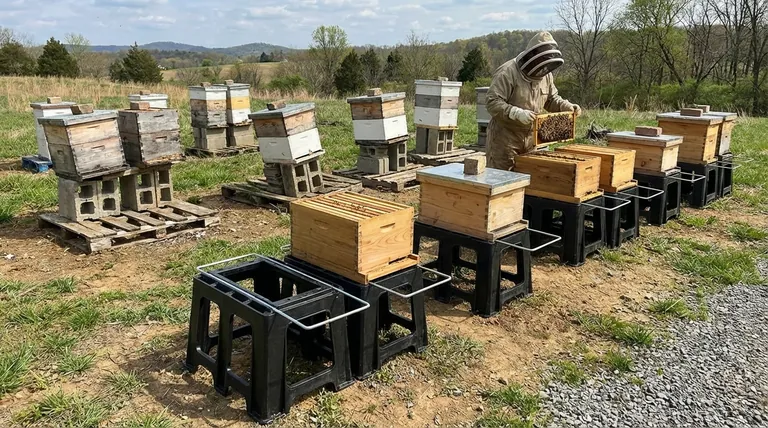
It’s a familiar sight in many commercial yards: a sea of beehives perched on a motley collection of supports. Some rest on weathered cinder blocks, others on old, splintering pallets, and a few on DIY wooden frames of varying heights. It seems like a minor detail—a practical, cost-saving measure. But what if this seemingly insignificant choice is quietly creating a cascade of problems that undermine your entire operation?
If you’ve ever struggled with inconsistent colony health, high hive component replacement rates, or a crew slowed by physical strain, you've experienced the symptoms. The root cause, however, might not be disease or poor management, but something far more fundamental: your foundation.
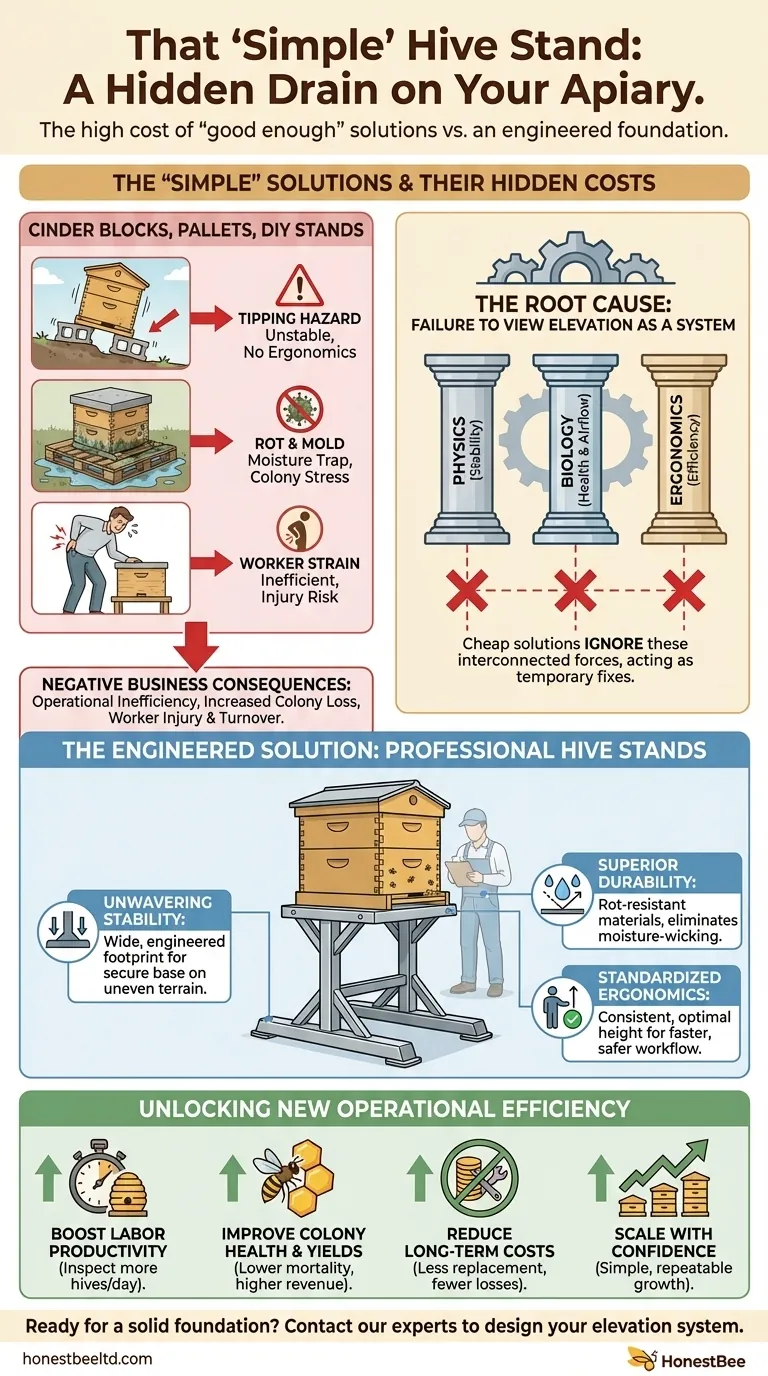
The High Cost of 'Good Enough': Why Cinder Blocks and Pallets Fail at Scale
When faced with setting up or expanding a yard of 50, 100, or 500+ hives, the immediate goal is to get them off the ground. The default solutions are often what’s cheap and available.
Many operators resort to:
- Cinder Blocks: They’re inexpensive but notoriously unstable on anything but perfectly level concrete. Their fixed height offers no ergonomic flexibility.
- Wooden Pallets: Often free, but they are a perfect sponge for ground moisture. They rot quickly, promoting mold and mildew that can stress a colony and degrade your expensive woodenware.
- Scrap Lumber DIY Stands: While economical, they rarely offer the consistency, stability, or durability required for a professional operation.
Initially, these seem like savvy ways to cut costs. But over time, they introduce hidden expenses that eat directly into your profits.
The negative business consequences are significant:
- Operational Inefficiency: Inconsistent working heights force your team to constantly bend, stoop, and lift awkwardly. This slows down routine inspections and honey harvesting, increasing labor costs per hive.
- Increased Colony Loss: Hives on moisture-trapping pallets or too close to the ground are more susceptible to rot, disease, and persistent pest pressure from animals like skunks. A seemingly small 5% increase in annual colony loss is a substantial financial hit across a large apiary.
- Worker Injury and Turnover: Repetitive back strain is a leading cause of injury in physically demanding jobs. An ergonomic setup isn't a luxury; it's a critical factor in retaining skilled beekeepers and avoiding workers' compensation claims.
Treating the hive stand as an afterthought means you are constantly fighting symptoms instead of solving the core problem.
The Real Culprit: It’s Not Just Height, It’s the Lack of a System
Here is the turning point: the problem isn’t just about finding the "perfect" 18-inch height. The root cause is the failure to view hive elevation as a standardized, engineered system.
The "common solutions" fail because they ignore the underlying principles required for a successful commercial apiary:
- Physics of Stability: A hive full of honey can weigh hundreds of pounds and become incredibly top-heavy. On a wobbly cinder block or uneven ground, it's a tipping hazard. A single tipped hive is a loss; a systemic instability risk is a potential catastrophe in a high wind event.
- Biology of Health: Lifting a hive off the ground isn't just about avoiding damp soil; it's about guaranteeing consistent airflow. A standardized elevation across the yard ensures every colony gets the same protection from moisture, reducing the risk of widespread chalkbrood or other mold-related ailments.
- Ergonomics of Efficiency: A uniform, waist-level working height transforms beekeeping from a series of disjointed, strenuous tasks into a streamlined workflow. It allows your crew to move faster, work safer, and focus on the bees, not their aching backs.
The cheap, improvised solutions fail because they are not designed to address these interconnected forces. They are temporary fixes for a permanent operational need.
Engineered for a Better Apiary: The Role of a Professional Hive Stand
To truly solve this problem, you need a tool designed with a systemic understanding of the apiary environment. You need a hive stand that provides stability, durability, and uniformity by design.
This is precisely why a professional-grade hive stand is not an expense, but an investment in your operational infrastructure. Rather than being a simple accessory, it is a product engineered to solve the core issues that limit efficiency and profitability.
Our hive stands directly address the root causes of failure:
- Unwavering Stability: With a wide, engineered footprint, they provide a secure base on uneven terrain, protecting your valuable colonies and honey from tipping.
- Superior Durability: Constructed from materials chosen to resist rot and withstand years of harsh weather, they eliminate the moisture-wicking problem of pallets and protect your investment in wooden hive bodies.
- Standardized Ergonomics: By providing a consistent, optimal working height across every hive, they create a safer, faster, and more efficient environment for your entire team.
This isn't just a better hive stand; it's a better system for running your business.
From Surviving to Thriving: Unlocking New Operational Efficiency
When you stop patching problems and instead implement a proper foundation, you unlock new potential for your business. With a stable, uniform, and durable hive stand system across your apiary, you can:
- Boost Labor Productivity: Your crews can inspect and manage more hives per day, lowering your cost per colony and increasing your operational capacity.
- Improve Colony Health & Yields: Lower mortality rates and healthier bees mean stronger pollination units and higher honey yields, directly impacting your revenue.
- Reduce Long-Term Costs: You'll spend less on replacing rotted hive components and lose fewer colonies to preventable, environment-related issues.
- Scale Your Operation with Confidence: Adding another 50 or 100 hives becomes a simple, repeatable process, not an exercise in improvisation. You can grow your business on a foundation built for success.
Investing in the right equipment is about more than just protecting your bees; it's about protecting your bottom line and building a more resilient, profitable, and scalable apiary. Your operation's success is built from the ground up, and it's time to ensure that foundation is solid.
Ready to move beyond the hidden costs of an unstable apiary? Our team of experts can help you assess your current setup and design an elevation system that improves efficiency and protects your investment for years to come. To discuss the specific challenges and goals of your operation, we encourage you to Contact Our Experts.
Visual Guide
Related Products
- Metal Hive Feet Bee Hive Stand for Ant Protection
- Plastic Bee Hive Stand for Beekeeping
- Metal Bee Hive Stand Bee Box Stand for Beekeeping
- Professional Ant-Proof Beehive Stand with Integrated Moat for Beekeeping
- Plastic Bee Frame Beekeeping Hive Frames for Wholesale
Related Articles
- How to Stabilize Beehive Stands in Wet Soil: Proven Techniques for Beekeepers
- How to Choose and Install a Beehive Stand for Pest Control and Colony Health
- The Unseen Foundation: Why a Beehive Stand Dictates Your Apiary's Success
- Beyond the Box: How a Simple Stand Prevents Compounding Failures in Beekeeping
- The Unseen Architecture of a Productive Apiary: Why Your Beehive Stand Height is a System Design Choice