The Most Important Decision You'll Make Twice
A new beekeeper’s first season is defined by tangible things: the smell of fresh pine from new hive bodies, the weight of a frame heavy with bees, the first taste of honey. The beehive stand, in contrast, feels like an afterthought—a simple platform to get the colony off the ground.
But this decision is not simple. And you don't just make it once. You reaffirm it with every inspection, every lift, and every season that adds wear to your lower back.
The height of a beehive stand is less a measurement and more a philosophy. It is the physical interface between the beekeeper and the colony. Getting it wrong introduces friction that compounds over time, leading to physical strain and inefficient work. Getting it right creates a seamless, sustainable system for years to come.
A Battle Against Two Forces: Entropy and Gravity
At its core, a beehive stand is a tool designed to solve two fundamental problems that constantly work against an apiary.
Defending the Colony from Ground-Level Entropy
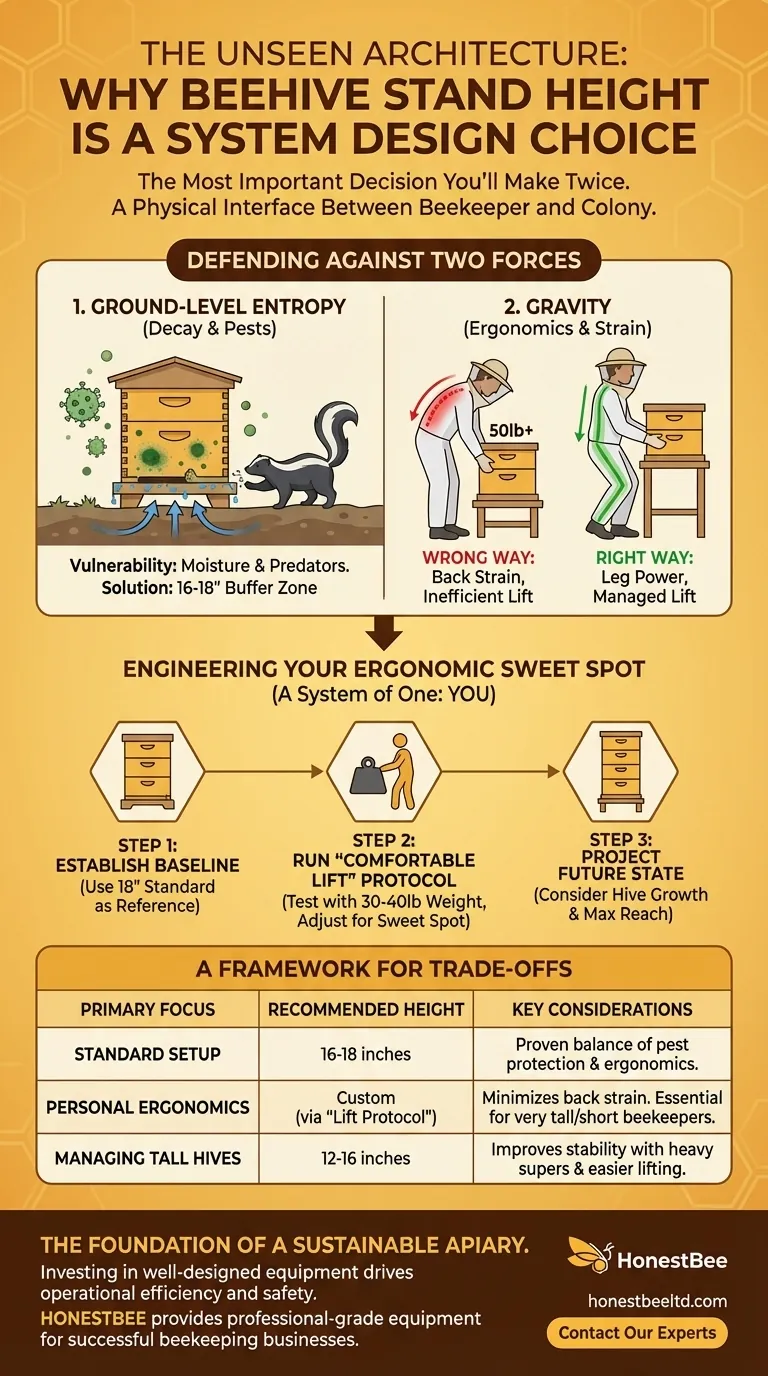
A hive placed directly on the ground is vulnerable. It is a constant battle against the forces of decay and predation.
- Moisture: Ground moisture seeps into the wood, fostering mold and mildew and creating a damp, unhealthy environment for the colony.
- Pests: The hive entrance becomes an easy target for skunks and other predators who can harass the colony nightly, stressing the guard bees and depleting the workforce.
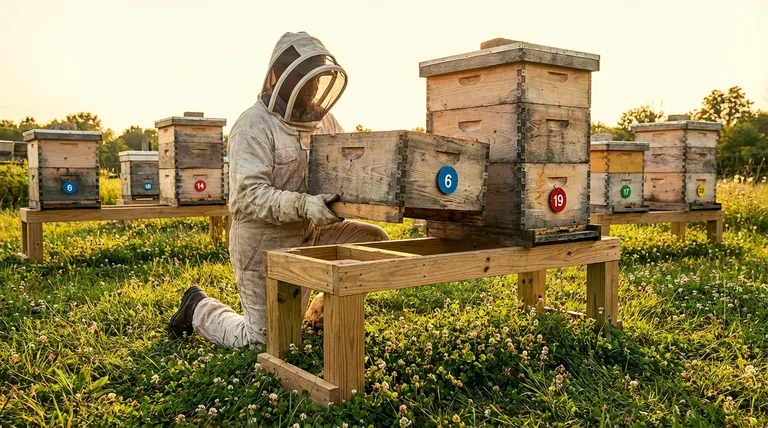
Elevating the hive by just 16 to 18 inches creates a crucial buffer zone. It promotes airflow, keeps the bottom board dry, and lifts the entrance out of the easy reach of most ground-level threats. It is the first line of defense.
Defending the Beekeeper from Gravity
Beekeeping is an act of working against gravity. A deep honey super can easily weigh over 50 pounds. Lifting that weight from a dead stop is a biomechanical challenge.
A stand that is too low forces you to bend at the waist, placing the entire load on your lower back. It’s an unnatural, inefficient lift that your body was not designed to perform repeatedly.
A stand at the correct ergonomic height transforms the lift. It allows you to bend your knees, keep your back straight, and engage your legs—the strongest muscles in your body. It turns a dangerous task into a manageable one.
Deconstructing the 18-Inch Dogma
The common recommendation of a 16 to 18-inch stand is not wrong; it is simply incomplete. It’s a good average for a person of average height managing a hive of average size.
The psychological trap is anchoring to this number as a rule rather than a guideline. We see a recommendation and adopt it without asking the most important question: Is this optimized for my body, my environment, and my management style?
A six-foot-five beekeeper will have a vastly different experience working on an 18-inch stand than a five-foot-four beekeeper. The "right" height is not a universal constant; it's a personal measurement.
Engineering Your Ergonomic Sweet Spot
Finding your ideal stand height is a simple design process. You are engineering a solution for a system of one: you.
Step 1: Establish Your Baseline
Start with the 18-inch industry standard as your reference point. Stack empty hive bodies or crates to this height to create a mock-up.
Step 2: Run the "Comfortable Lift" Protocol
Place a 30-40 pound weight on your mock stand—a bag of feed, a full bucket, or a cinder block will do. Perform a test lift.
- Is your back straight?
- Are you lifting with your legs?
- Do you feel any strain in your lower back?
Adjust the height up or down in small increments and repeat the lift. You are searching for the "sweet spot" where the movement feels most natural and least strenuous. This is your personal ergonomic height.
Step 3: Project for Future State
A hive is not a static object; it grows vertically. A stand that feels perfect for a single brood box in April may become awkward when the hive is five boxes tall in July.
You must be able to inspect and manipulate the top boxes without reaching far above your shoulders. A hive that becomes too tall is unstable and difficult to manage safely. Consider this maximum height when choosing your base height.
A Framework for Trade-offs
Choosing a stand height involves balancing competing priorities. Your primary focus will guide your final decision.
| Primary Focus | Recommended Stand Height | Key Considerations |
|---|---|---|
| Standard Setup | 16-18 inches | A proven industry default. Offers a great balance of pest protection and ergonomics. |
| Personal Ergonomics | Custom (via "Lift Protocol") | Minimizes back strain. Essential for very tall/short beekeepers or those with back issues. |
| Managing Tall Hives | 12-16 inches | Improves hive stability with heavy supers and makes lifting them more manageable. |
The Foundation of a Sustainable Apiary
The beehive stand is the literal and figurative foundation of your beekeeping operation. Choosing its height is an act of foresight—an investment in your own physical longevity and the long-term health of your colonies.
This principle of investing in a well-designed system extends to all your equipment. For commercial apiaries and distributors, standardizing on durable, high-quality, and ergonomic supplies is not a cost but a critical driver of operational efficiency and safety. At HONESTBEE, we provide the professional-grade equipment that forms the backbone of successful beekeeping businesses.
Build a more comfortable and productive apiary from the ground up. Contact Our Experts
Visual Guide
Related Products
- Metal Hive Feet Bee Hive Stand for Ant Protection
- Metal Bee Hive Stand Bee Box Stand for Beekeeping
- Plastic Bee Hive Stand for Beekeeping
- Professional Ant-Proof Beehive Stand with Integrated Moat for Beekeeping
- Wooden Bee Hive Frames for Beekeeping and Wholesale
Related Articles
- How to Stabilize Beehive Stands in Wet Soil: Proven Techniques for Beekeepers
- The Unseen Foundation: Why a Beehive Stand Dictates Your Apiary's Success
- Beyond the Box: How a Simple Stand Prevents Compounding Failures in Beekeeping
- How to Choose and Install a Beehive Stand for Pest Control and Colony Health
- How to Determine the Optimal Beehive Stand Height for Comfort and Efficiency