The Illusion of Simplicity
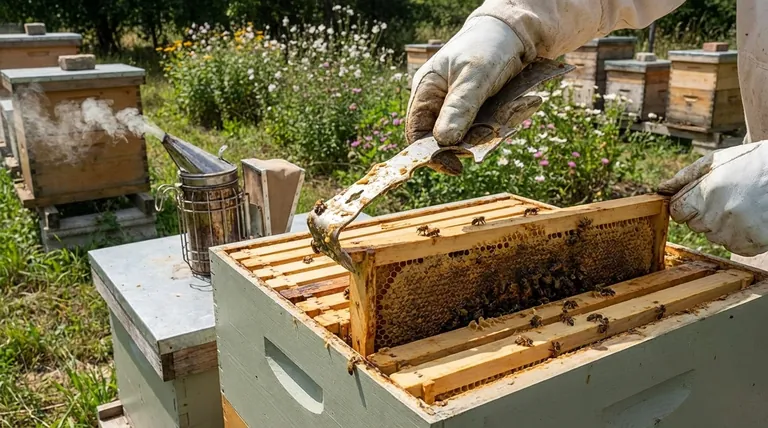
A beekeeper approaching a hive appears to be performing a simple act. They puff a little smoke, pry open a box, and lift a frame. It looks methodical, almost rustic.
But this calmness is deceptive. The beekeeper is not just opening a box; they are interfacing with a superorganism of fifty thousand individuals, a complex biological system governed by chemical signals, environmental triggers, and collective behavior.
The tools in their hands are not mere implements. They are the critical levers for managing that complexity. Their quality and design dictate whether the interaction is a smooth, productive inspection or a chaotic, system-wide failure.
The Smoker: Managing Chaos, Not Just Bees
The most iconic tool, the bee smoker, is fundamentally an instrument of information control.
Beyond a Calming Puff
The smoke doesn't sedate the bees. It masks their primary alarm pheromone, isopropyl acetate. When a bee stings or feels threatened, it releases this signal, which can incite a chain reaction of defensive behavior from the rest of the colony.
A few puffs of cool, white smoke effectively jam this communication channel. It prevents a localized incident from escalating into a full-blown colony defense, allowing the beekeeper to work without triggering systemic panic.
The High Cost of a Low-Quality Smoker
For a commercial operator managing dozens or hundreds of hives, a smoker that fails to stay lit is not an annoyance; it is a critical point of failure.
Imagine this: midway through an inspection of a strong, populous colony, your smoker goes out. The alarm pheromones, once suppressed, are now broadcasting freely. The colony's posture shifts from calm to defensive in seconds. Your inspection is cut short, you may miss the subtle signs of a new disease, and the risk of stings to you and your team skyrockets.
This is how a $20 tool decision can jeopardize hundreds of dollars in colony health and productivity. Reliability isn't a luxury; it's a prerequisite for predictable, safe operations.
The Hive Tool: The System's Scalpel
Bees are master builders, using a potent resin called propolis to seal every crack, reinforcing their home against weather and intruders. This makes the hive a fortress. The hive tool is the key to that fortress.
An Extension of the Beekeeper's Will
A well-designed hive tool is more than a simple pry bar. It is an extension of the beekeeper's hand, designed for precise, deliberate movements. Its heft, angle, and edge are engineered to break propolis seals with minimal vibration and impact.
The goal is to perform surgery on the hive, not demolition. A clumsy, poorly-made tool can crack frames, jolt bees, and needlessly agitate the colony, turning a routine check into a disruptive event.
Friction, Fatigue, and Focus
Consider the psychological impact of your tools. Over the course of a day inspecting 50 hives, small points of friction compound. A tool that doesn't feel right in your gloved hand, that requires too much force, or whose edge is too thick, creates physical and mental fatigue.
This fatigue erodes focus. A great hive tool reduces this cognitive load. It allows the beekeeper to concentrate entirely on the bees—the brood pattern, the honey stores, the queen's health—rather than on the struggle of manipulating the equipment. It makes expertise, not brute force, the primary input.
From Brush to Box: The Unseen Architecture
Beyond the primary hand tools, the entire hive structure functions as a tool for managing the colony's growth and productivity.
| Component | Hobbyist View | Commercial View |
|---|---|---|
| Bee Brush | A tool to move bees | A way to protect the workforce; minimizing bee loss |
| Hive Stand | Keeps the box dry | A foundation for stability; reducing colony stress |
| Hive Boxes | Containers for bees | A modular system for managing space and honey flow |
| Frames | Structures for comb | The production units; requiring precision for extraction |
Every element, from the soft bristles of a bee brush that protect individual workers to the perfectly level hive stand that ensures colony stability, contributes to the system's overall efficiency.
The Psychology of Professional Equipment
The transition from hobbyist to commercial beekeeper is marked by a fundamental shift in how one evaluates equipment. The focus moves from immediate function to long-term reliability.
- The hobbyist asks: "Does this tool work for opening one hive?"
- The professional asks: "Will this tool work reliably across 100 hives, every week, for the next five years?"
This professional mindset recognizes that equipment is not a cost center, but an investment in operational efficiency and risk management. For commercial apiaries and distributors, sourcing equipment is about building a fleet of reliable, durable tools that empower beekeepers to work at their best.
HONESTBEE understands this distinction. We focus on supplying professional-grade beekeeping equipment through wholesale operations, ensuring that commercial apiaries have access to tools built for the rigors of large-scale management. Our equipment is designed to be the reliable interface between the beekeeper and the colony.
When managing an apiary as a system, every component matters. To ensure your equipment meets the demands of a professional operation, Contact Our Experts.
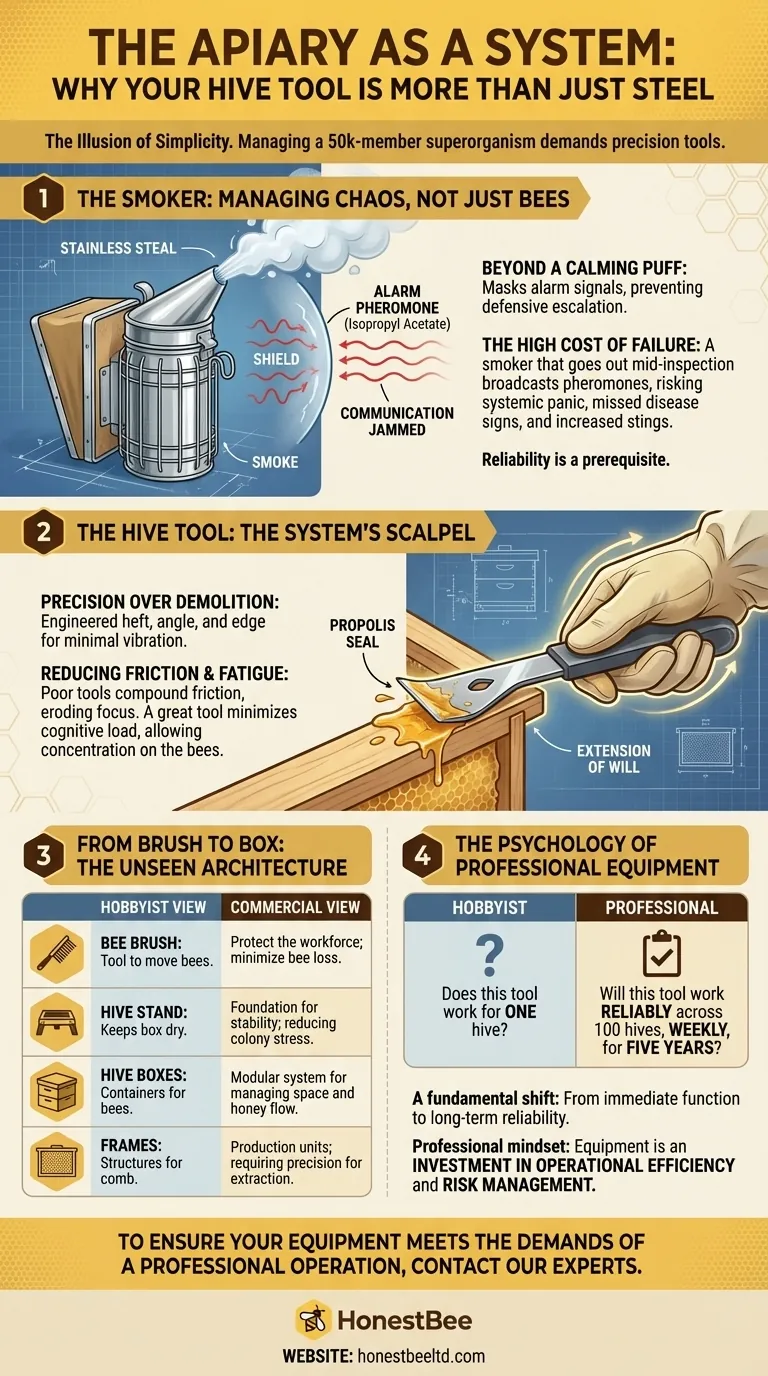
Visual Guide
Related Products
- Professional Multi-Function Stainless Steel Hive Tool
- Professional Stainless Steel Pry-Bar Hive Tool
- HONESTBEE Professional Long Handled Hive Tool with Precision Cutting Blade
- HONESTBEE Premium Italian Style Hive Tool with Hardwood Handle
- Ergonomic Plastic Frame Spacer Tool for Rapid Hive Management Beekeeping
Related Articles
- The Physics of Flow: How a Single Hive Tool Redefines the Beekeeper's Workflow
- The Essential Guide to Hive Tools in Modern Beekeeping
- The Beekeeper's Scalpel: How a Simple Hive Tool Governs Apiary Health
- How to Choose Hive Tools That Match Your Beekeeping Workflow
- Leverage and Finesse: The Unseen Physics of a Simple Hive Tool



















