The Anatomy of an Apiary Failure
Imagine this: you inspect Hive #12, a powerhouse colony buzzing with activity. You scrape a bit of burr comb, check a few frames, and see a healthy queen. Satisfied, you move to Hive #4, a colony that's been struggling.
You wipe your hive tool on your pants—it looks clean. But on its steel surface, invisible to the human eye, are microscopic spores of American Foulbrood (AFB).
This is how an apiary collapses. Not with a sudden disaster, but with a single, unsterilized scrape.
The Cognitive Trap of "Clean"
Our brains are wired for efficiency. We trust what we see. A hive tool free of visible wax and propolis feels safe to use. This is a dangerous cognitive trap.
There is a fundamental difference between cleaning and sterilizing.
- Cleaning is the physical removal of visible debris.
- Sterilizing is the chemical or thermal destruction of microscopic pathogens.
You cannot sterilize a dirty tool. Pathogens hide under the thinnest layer of propolis, shielded from heat and chemicals. Effective biosecurity is always a two-step process. One step without the other is a job half-done.
A Protocol for Biosecurity: The Two-Step Process
A protocol isn't a suggestion; it's a system designed to produce a reliable outcome. For beekeepers, that outcome is a healthy, productive apiary free from preventable disease.
Step 1: The Foundation - Aggressive Physical Cleaning
This first step is about removing the enemy's cover. It’s non-negotiable.
- Scrape: Use the sharp edge of another tool or a dedicated scraper to remove all caked-on wax and propolis.
- Scrub: Vigorously scrub the entire tool with an abrasive cleanser and steel wool. The goal is to remove the sticky resin films that water alone cannot touch.
- Rinse: Wash the tool in clean water to remove all loosened debris and cleansing agents. You should be left with a bare, physically clean surface.
Only now is your tool ready for sterilization.
Step 2: The Kill - Eliminating the Invisible Threat
With hiding places removed, you can now effectively eliminate the pathogens. Your choice of method depends on your context and risk level.
The Gold Standard: Trial by Fire
Heat is the most reliable and efficient way to destroy resilient spores like AFB.
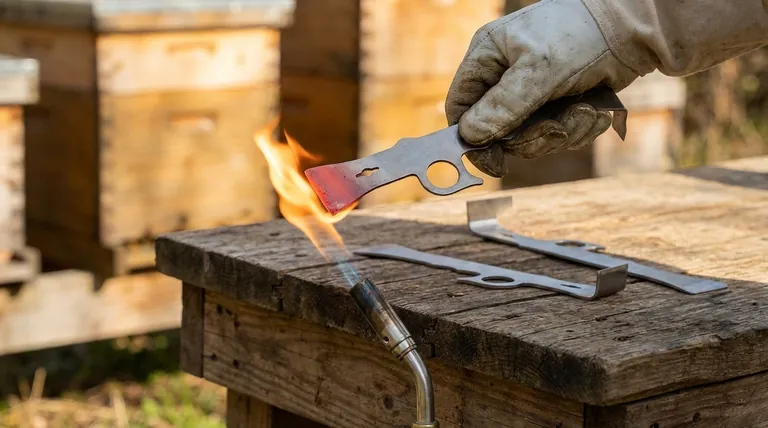
- Blowtorch: Heat the entire surface of the hive tool for at least 30 seconds, or until the metal just begins to glow. This provides a fast, definitive kill.
- Hot Smoker: For a field-expedient solution, place the tool directly in the hot firebox of your lit smoker. A few pumps of the bellows will bring it to sterilizing temperature.
The Practical Alternative: Chemical Immersion
When open flame is impractical, chemical soaks are a strong second option.
- Isopropyl Alcohol: Submerge the cleaned tool in a container of rubbing alcohol. This is a great method for keeping a tool sterile between inspections within the same yard.
- Diluted Bleach: A bleach solution is also effective, but it is corrosive. The tool must be rinsed thoroughly with clean water after soaking to prevent harming the bees.
Developing Your Hygiene Cadence
The right protocol is one that adapts to the situation. A rigid, one-size-fits-all approach is inefficient and often fails.
Routine Inspections: The "Clean Break"
- Context: Moving between healthy hives in a single apiary.
- Protocol: Thoroughly scrape the tool clean between each hive. Follow with a quick pass of a blowtorch or a wipe with an alcohol-soaked rag.
High-Alert Scenarios: The "Full Decontamination"
- Context: Inspecting a weak, dead, or potentially diseased hive.
- Protocol: Do not move to another hive. Perform a full two-step clean and sterilization using a blowtorch before touching any other equipment. This is your firewall against catastrophic spread.
Seasonal Reset: The "System Overhaul"
- Context: End-of-season deep cleaning and storage.
- Protocol: A thorough scrub followed by a dishwasher cycle or a prolonged soak in rubbing alcohol prepares your tools for storage, ensuring they are inert and ready for the next season.
The Right Tool Makes the Protocol Possible
A protocol is only as strong as its weakest link. For a commercial beekeeper, that link is often the equipment itself. A poorly designed tool with unnecessary crevices and low-quality materials is difficult to clean and impossible to reliably sterilize. It actively works against your biosecurity efforts.
For commercial apiaries, where a single biosecurity failure can have devastating financial consequences, equipment quality is non-negotiable. HONESTBEE supplies durable, easy-to-clean beekeeping tools designed for the rigors of professional use. Our wholesale operations ensure that distributors and large-scale apiaries have access to reliable equipment that forms the backbone of a successful biosecurity protocol.
Protecting your investment starts with understanding that the most significant threats are often the ones you can't see. By adopting a disciplined, two-step hygiene protocol, you move from simply looking at your hives to truly seeing their interconnected health.
To equip your operation with tools built for biosecurity and durability, Contact Our Experts.
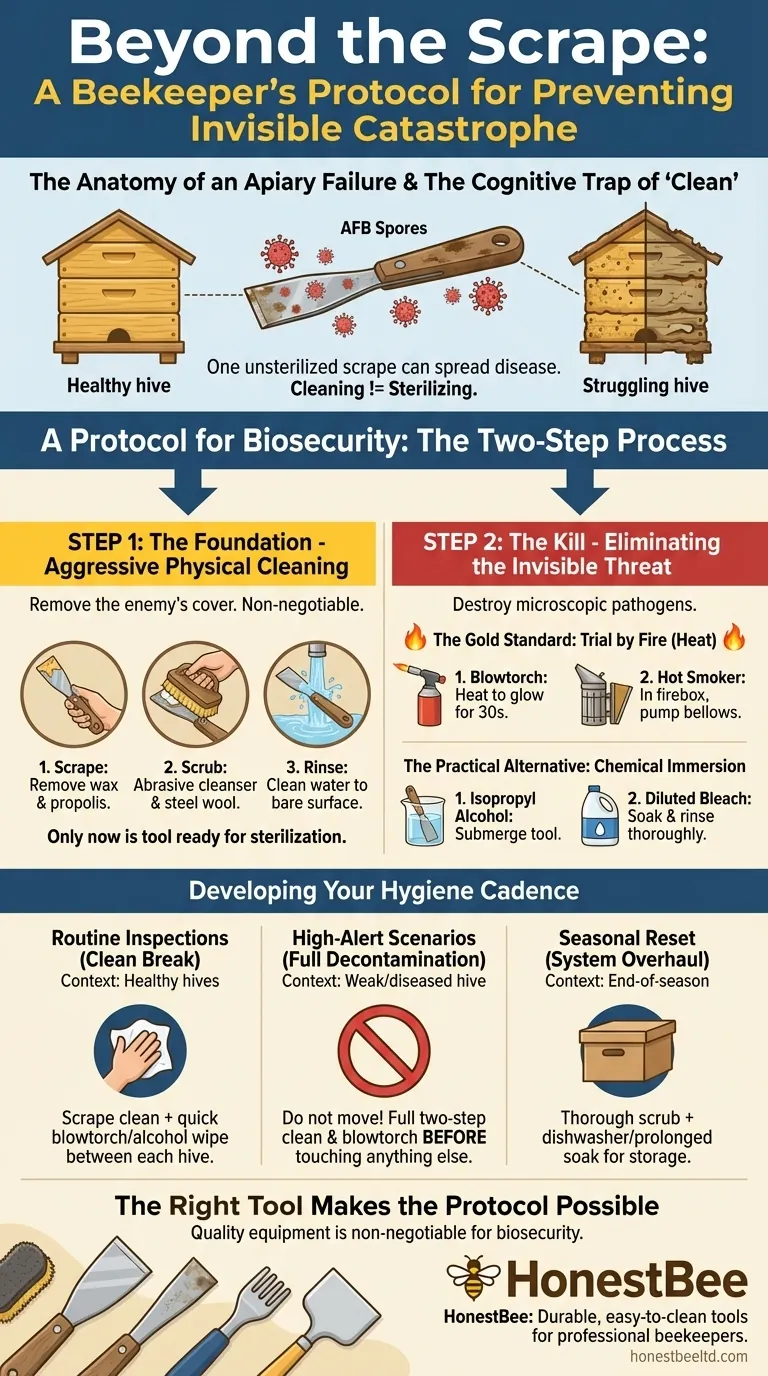
Visual Guide
Related Products
- HONESTBEE Professional Long Handled Hive Tool with Precision Cutting Blade
- Professional Multi-Function Stainless Steel Hive Tool
- HONESTBEE Premium Italian Style Hive Tool with Hardwood Handle
- Ergonomic Plastic Frame Spacer Tool for Rapid Hive Management Beekeeping
- Professional Grade Foldable Beehive Handles
Related Articles
- Force and Finesse: The Hive Tool as the Beekeeper's Critical Interface
- The Essential Guide to Hive Tools in Modern Beekeeping
- The Apiary as a System: Why Your Hive Tool is More Than Just Steel
- How to Choose Hive Tools That Match Your Beekeeping Workflow
- The Beekeeper's Scalpel: How a Simple Hive Tool Governs Apiary Health


















