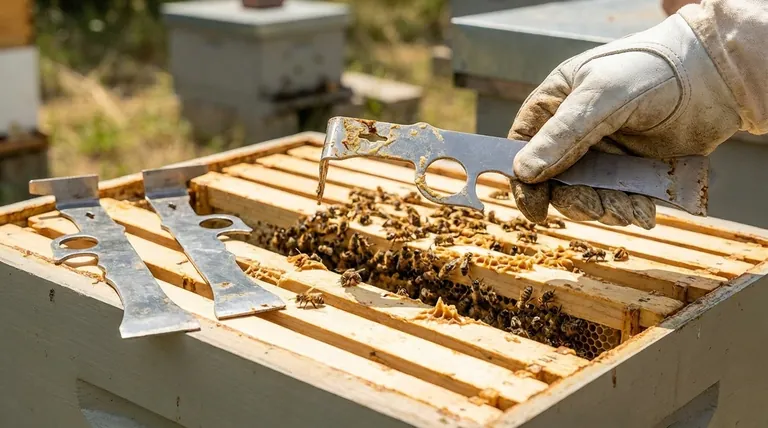
A Single Point of Failure
Picture a commercial beekeeper, dozens of hives to inspect before noon. The sun is climbing. At hive seventeen, a frame is sealed tight with propolis. The hive tool, caked with wax and sticky residue from the last sixteen, slips. A little extra force, a jagged movement, and the comb cracks. Honey begins to weep.
This small, frustrating moment isn't a failure of strength. It's a failure of a system, and the single point of failure is a simple piece of steel.
The maintenance of a hive tool is often treated as a trivial chore. But in systems thinking, there are no trivial components. This tool is the primary interface between the beekeeper and the colony. It is an extension of the beekeeper's will, but it is also a potential vector for inefficiency, stress, and—most critically—disease.
The Physics of Degradation
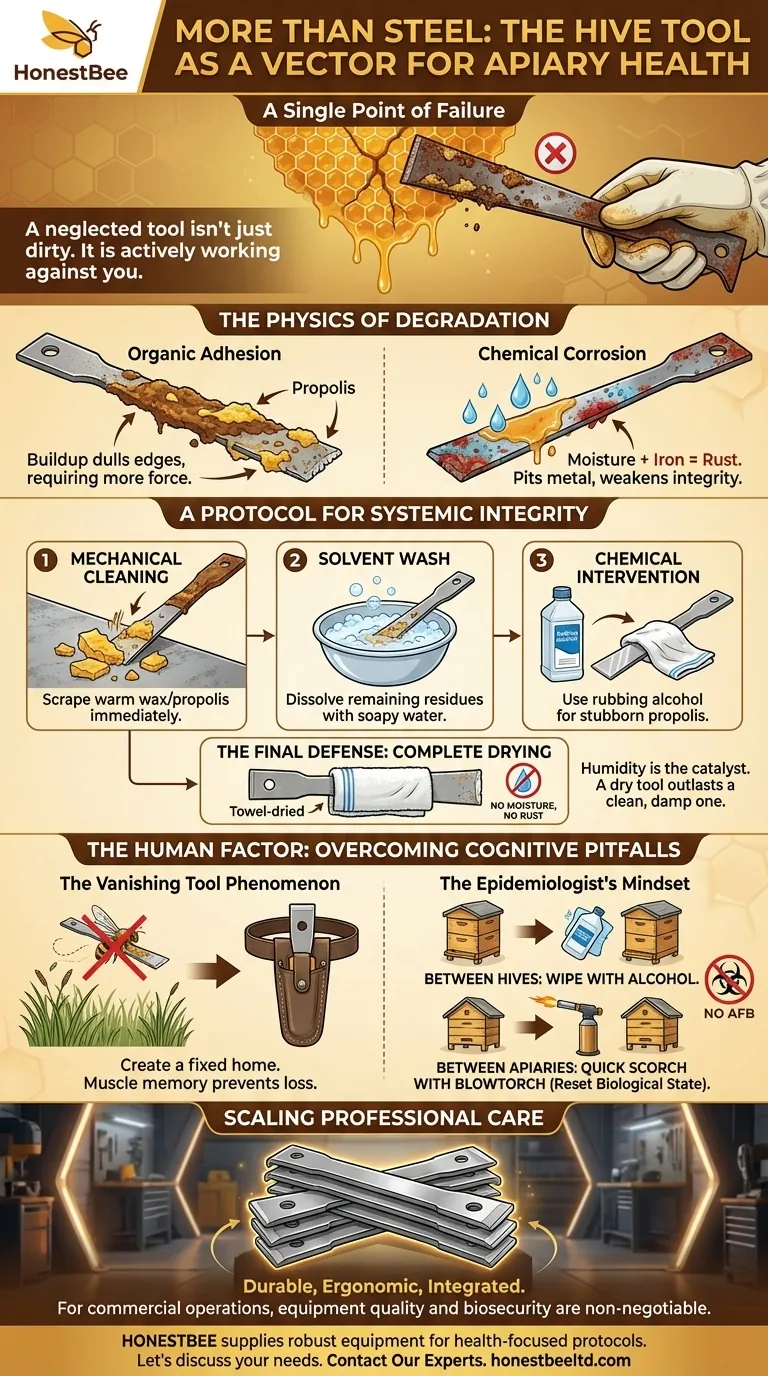
The forces that degrade a hive tool are simple and relentless. Understanding them is the first step toward negating them.
- Organic Adhesion: Propolis and wax, sticky and malleable when warm, harden into a stubborn laminate. This buildup dulls edges and makes the tool clumsy, requiring more force for simple tasks. More force increases the risk of damaging comb and angering bees.
- Chemical Corrosion: Honey residue attracts moisture from the air. That moisture, combined with the iron in steel, is the simple formula for rust. Rust is not just a cosmetic issue; it pits the metal, creating microscopic havens for pathogens and weakening the tool's structural integrity.
A neglected tool isn't just dirty. It is actively working against you.
A Protocol for Systemic Integrity
Treating tool maintenance as a protocol, rather than a task, changes the psychological frame. It’s a non-negotiable part of the workflow, like a surgeon sterilizing a scalpel.
The Post-Inspection Reset
Immediately after an inspection, the protocol begins.
- Mechanical Cleaning: Scrape the tool against itself or a hard surface to remove the large deposits of wax and propolis. Doing this while the material is still warm and pliable saves immense effort later.
- Solvent Wash: Use warm, soapy water to dissolve the remaining honey and water-soluble residues. This eliminates the stickiness that attracts pests to your equipment and moisture to the tool's surface.
- Chemical Intervention: For the stubborn, glue-like propolis, rubbing alcohol is the great equalizer. It acts as a solvent, breaking down the complex resins that water cannot touch. A wipe with an alcohol-soaked rag restores the tool to its bare metal state.
The Final Defense
The most crucial step is the last one. The tool must be dried completely. Humidity is the catalyst for rust. A towel-dried tool stored in a dry place will outlast a clean but damp tool by years. This isn't about cleanliness; it's about material preservation.
The Human Factor: Overcoming Cognitive Pitfalls
The biggest threats to the protocol are not physical, but psychological.
The Vanishing Tool Phenomenon
Beekeepers lose hive tools constantly. They are set on a hive cover, dropped in the tall grass, and forgotten. The cost is not just the price of a new tool, but the disruption to workflow.
The solution is behavioral. Create a fixed location for the tool—a specific pocket, a magnetic belt clip. The habit of always returning the tool to its home removes the cognitive load of remembering where you put it. It becomes muscle memory.
The Epidemiologist's Mindset
A simple cleaning routine is good. A biosecurity protocol is professional.
A dirty hive tool can carry American Foulbrood (AFB) spores from a single infected hive to every other hive in the apiary. It is a silent, devastating vector. For commercial operations or beekeepers managing multiple yards, sterilization isn't optional.
- Between Hives: A wipe-down with rubbing alcohol.
- Between Apiaries: A quick scorch with a blowtorch. The flame incinerates any potential pathogens, effectively resetting the tool's biological state to zero.
This mindset shifts the beekeeper's role from honey producer to disease manager. The hive tool is their primary instrument in this effort.
Scaling Professional Care
For a hobbyist, a lapse in tool maintenance is an inconvenience. For a commercial apiary, it's a financial risk that threatens the viability of the entire operation. Efficiency, hive health, and biosecurity are not ideals; they are metrics that directly impact the bottom line.
This is why professional-grade equipment is a non-negotiable part of the system. Tools must be durable enough to withstand repeated scraping, cleaning, and flame sterilization without degrading. They must be ergonomic enough to support the habit-forming behaviors that prevent loss and inefficiency.
At HONESTBEE, we supply the robust beekeeping equipment that commercial apiaries and distributors depend on. Our tools are designed not just for function, but for integration into the rigorous, health-focused protocols of professional beekeeping. They are built to be the reliable constant in a complex biological system.
To ensure your operation is built on a foundation of quality and biosecurity, let's discuss your equipment needs. Contact Our Experts
Visual Guide
Related Products
- HONESTBEE Professional Long Handled Hive Tool with Precision Cutting Blade
- Professional Multi-Function Stainless Steel Hive Tool
- HONESTBEE Premium Italian Style Hive Tool with Hardwood Handle
- Ergonomic Plastic Frame Spacer Tool for Rapid Hive Management Beekeeping
- Professional Grade Foldable Beehive Handles
Related Articles
- Force and Finesse: The Hive Tool as the Beekeeper's Critical Interface
- The Essential Guide to Hive Tools in Modern Beekeeping
- The Apiary as a System: Why Your Hive Tool is More Than Just Steel
- How to Choose Hive Tools That Match Your Beekeeping Workflow
- The Beekeeper's Scalpel: How a Simple Hive Tool Governs Apiary Health


















