The Paradox of Success
A thriving honey bee colony is a marvel of efficiency and growth. But its greatest strength is also the source of its most profound vulnerability.
Success breeds expansion. Expansion leads to congestion. And congestion triggers the swarm—the colony’s natural, explosive, and often costly method of reproduction.
For the beekeeper, a swarm isn't a sign of failure; it's a sign of success left unmanaged. It's the moment a valuable asset literally flies away.
The Hive's Internal Logic
To prevent a swarm, you must first understand the colony’s internal calculus. The decision to swarm is not random; it's a logical response to a specific set of environmental triggers.
It’s a solution to a problem. The problem is overcrowding.
The Tipping Point of Congestion
The single most powerful trigger for swarming is a lack of space. When the hive becomes packed, a cascade of problems begins.
The queen runs out of cells to lay eggs, curtailing the colony's growth engine. Workers run out of space to store incoming nectar and pollen, choking the supply chain. This physical limit sends a clear signal: this territory is maxed out. It's time to divide and conquer new ground.
The Fading Signal of the Queen
In a balanced hive, the queen's pheromones flow freely, acting as a chemical message of unity and stability. "I am here, I am healthy, all is well."
In a congested hive, this vital signal becomes diluted. It can't reach the furthest corners of the bustling population. To the workers on the periphery, the message is weak, as if the queen is failing. The logical conclusion? It is time to raise a new one. They begin building swarm cells, the first definitive step toward division.
An Elegant Intervention: The Controlled Fracture
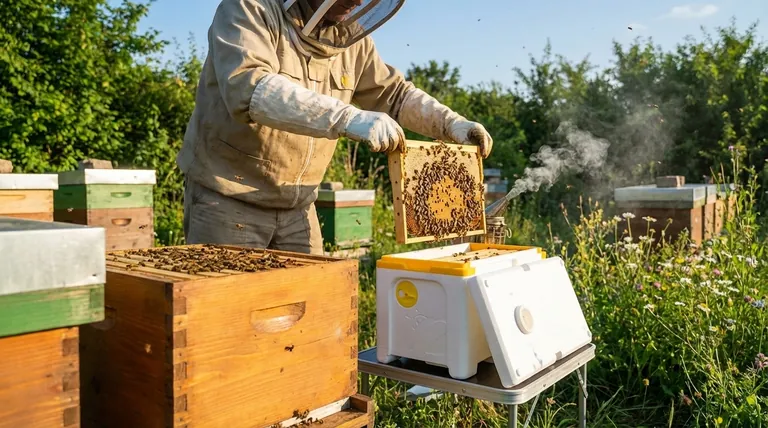
Making a nucleus colony, or "nuc," is the beekeeper's most elegant intervention. It doesn't fight the swarm impulse; it co-opts it.
You are not preventing reproduction. You are guiding it. By splitting the colony, you satisfy its biological urge to divide but on your own terms, transforming a potential loss into a definite gain.
Decompressing the Present
The most immediate effect of pulling a nuc is relief. By removing several frames of bees, brood, and resources, you instantly alleviate the population pressure within the parent hive.
You create space. The bees can breathe. The system can function again without the crushing pressure of overcrowding.
Defusing the Future
The true genius of the nuc lies not just in removing adult bees, but in exporting the next generation.
When you remove frames of capped brood, you are removing thousands of bees that are days away from emerging. You are solving not only today’s congestion problem but also the one that was scheduled to arrive next week. It's proactive, not reactive.
A Shift in Collective Purpose
The split forces both colonies to reset their priorities. The "swarm fever" breaks.
- The Parent Hive: Now with more space and fewer bees, its focus shifts from swarming back to building up its workforce. If you moved the old queen, it focuses on raising a new one.
- The New Nuc: Its entire existence is dedicated to one goal: establishing itself as a viable, self-sufficient colony.
The collective energy is redirected from division to development.
The Tyranny of the Calendar
This intervention is powerful, but its effectiveness is dictated entirely by timing. Acting at the right moment is the difference between management and emergency rescue.
The ideal window is four to six weeks before the main nectar flow. This is the period of explosive population growth, just before the massive influx of nectar compounds the space problem. A split during this time preempts the swarm impulse before it becomes irreversible.
Wait until you see sealed queen cells, and you are already behind. The colony has made its decision. A split at this point is a last-ditch effort to catch the bees before they leave, not a strategic move to prevent them from wanting to.
The Beekeeper's Calculus: Yield vs. Resilience
There is an unavoidable trade-off. Splitting your strongest colony will temporarily reduce its foraging workforce, likely lowering its peak honey production for the season.
But this isn't a simple loss. It's a strategic choice.
| Choice | Pro | Con |
|---|---|---|
| Don't Split | Potentially highest honey yield from a single hive. | High risk of losing half your bees to a swarm. |
| Split Proactively | Prevents swarm loss, creates a new colony, maintains genetic stock. | Lower honey yield from the original hive. |
This choice requires an investment, not just in strategy, but in physical resources. Executing a timely split requires having high-quality nuc boxes, frames, and feeders ready to go. Professional management demands professional equipment.
At HONESTBEE, we equip commercial apiaries and distributors with the durable, reliable beekeeping supplies necessary for this kind of proactive, strategic management. To work with a bee's nature, you need tools you can trust.
If you’re ready to grow your operation by working smarter, not just harder, we can help you get the equipment you need. Contact Our Experts
Visual Guide

Related Products
- Styrofoam Mini Mating Nuc Box with Frames Feeder Styrofoam Bee Hives 3 Frame Nuc Box
- 5 Frame Langstroth Poly Nuc Corrugated Plastic Nuc Boxes
- 4 Frame Plastic Nuc Boxes for Beekeeping Bee Nuc Box
- 5 Frame Wooden Nuc Box for Beekeeping
Related Articles
- Architecting Royalty: The Nuc Box as a Queen's Crucible
- The Thermodynamics of a New Colony: Why a Smaller Nuc Box Is a Stronger Start
- How Smaller Nuc Box Frames Improve Brood Health Through Thermal Regulation
- The Nuc Box Is Not a Home, It's a Tool: A Strategic Guide to Apiary Fleet Management
- Designing for Instinct: Why the Nuc Box is the Perfect Swarm Trap


