The Anxious Guardian's Dilemma
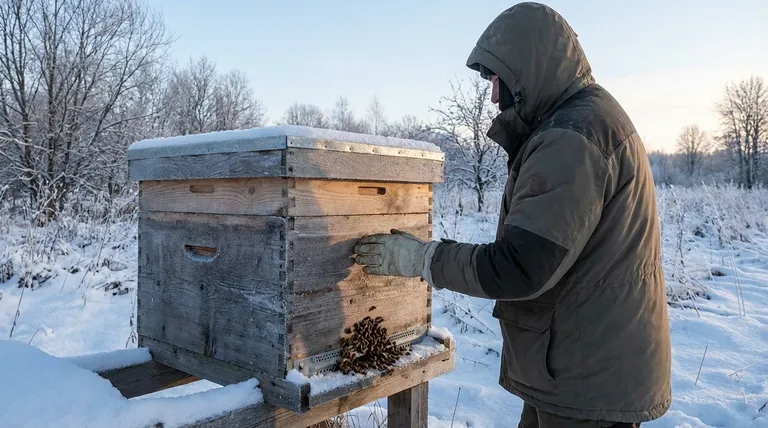
Every beekeeper feels it. A cold snap descends, and a nagging question arises: "Are they okay in there?" The urge to lift the lid for a quick peek is a powerful one, born from a sense of responsibility.
But this well-intentioned impulse often conflicts with a hard-won beekeeping principle: in winter, the most helpful action is usually no action at all.
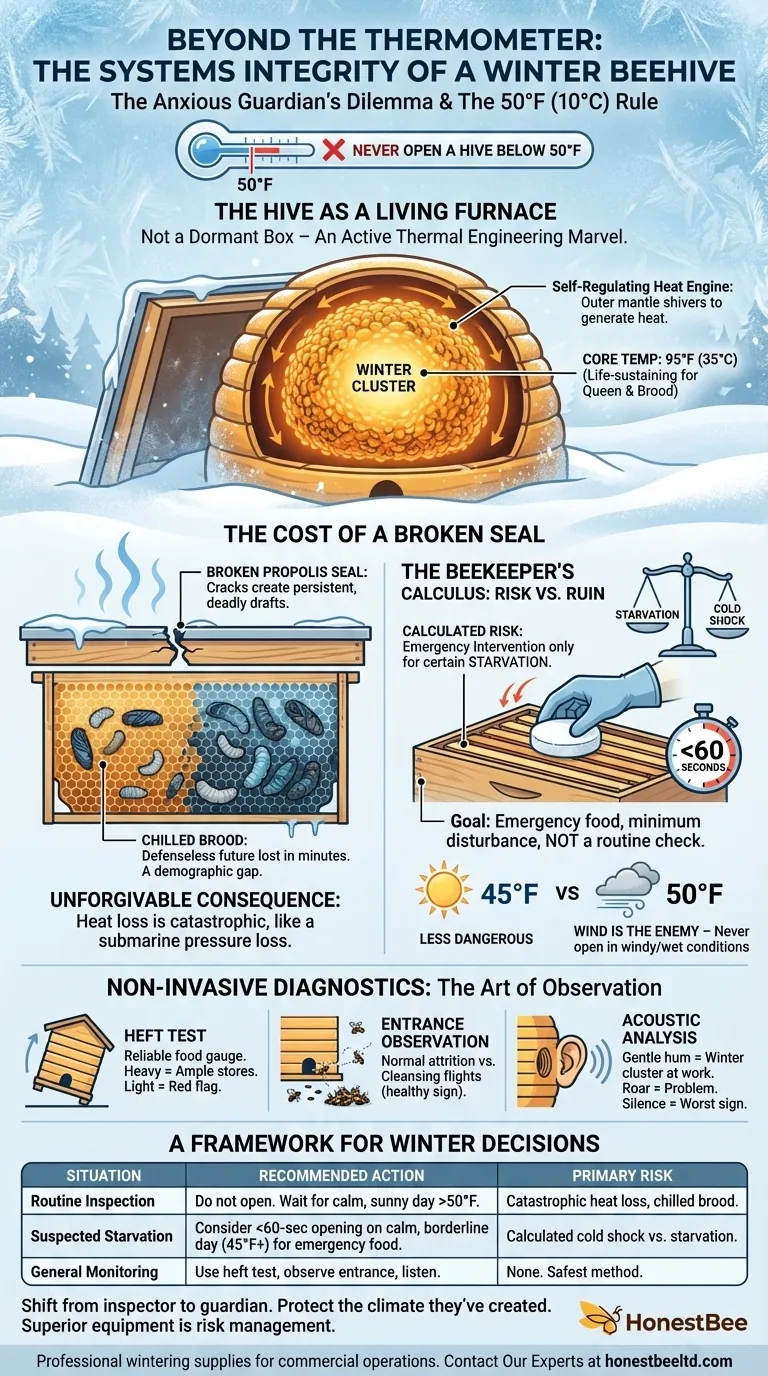
The widely cited rule—never open a hive below 50°F (10°C)—isn't arbitrary. It’s a simple guideline that protects a complex, fragile system. To ignore it is to misunderstand the fundamental physics and biology of a wintering honeybee colony.
The Hive as a Living Furnace
A beehive in winter is not a dormant box. It is a marvel of thermal engineering, actively fighting the cold. Opening it is not like opening a window in a house; it's like triggering a catastrophic pressure loss in a submarine.
The Winter Cluster: A Marvel of Collective Engineering
Honeybees don't hibernate. They form a tight sphere known as the winter cluster. This is not a random huddle; it's a highly organized, self-regulating heat engine.
Bees on the outer layer form a dense, insulating mantle, shivering their flight muscles to generate heat. Inside this living shield, the core temperature around the queen and any brood is maintained at a life-sustaining 95°F (35°C), even as snow falls outside.
Prying open the lid shatters this structure. The insulating mantle is broken, and the precious, hard-won heat vents into the atmosphere in seconds. The bees must burn through critical honey stores to recover—fuel they may not be able to spare.
The Cost of a Broken Seal
Throughout the year, bees meticulously seal every crack and seam of their home with propolis, a potent, anti-microbial resin. This turns their hive into a nearly airtight, draft-free cavity.
When you crack open a hive body in the cold, this brittle propolis seal shatters. The bees, clustered for survival, cannot easily repair the breach. A new, persistent draft can become a death sentence, silently bleeding heat from the colony day after day.
The Unforgivable Consequence: Chilled Brood
The most vulnerable residents of the hive are the brood—the eggs, larvae, and pupae. They are the colony's future, its promise of a vibrant spring workforce.
They are also completely defenseless against the cold. If their temperature drops, even for a few minutes, they die. Losing a generation of bees can fatally weaken the colony, creating a demographic gap it may never recover from.
The Beekeeper's Calculus: Risk vs. Ruin
While the 50°F rule is paramount, beekeeping is an exercise in calculated risk. The only threat more immediate than cold is starvation. This is where a beekeeper must weigh a bad option against a catastrophic one.
When Starvation is the Greater Threat
If you have strong reason to believe your bees are out of food (for instance, the hive feels dangerously light), the certainty of starvation may outweigh the risk of a brief intervention. This is an emergency procedure, not a routine check.
Defining the Emergency Intervention
A "quick look" is not a frame-by-frame inspection. It is a 30- to 60-second operation with a single purpose: to provide emergency food. This usually means placing a sugar patty or fondant directly on top of the frames, right above the cluster. The goal is to get in and get out with absolute minimum disturbance.
Reading the Weather, Not Just the Thermometer
A calm, sunny 45°F day is far less dangerous than a windy, overcast 50°F day. Wind is the true enemy, as it acts as a convective thief, stripping heat from the hive exponentially faster than still air. Never open a hive in windy or wet conditions, no matter what the thermometer says.
The Art of Non-Invasive Diagnostics
An experienced beekeeper can learn almost everything they need to know about a winter colony without ever breaking the propolis seal.
- The Heft Test: This is your most reliable food gauge. Gently tilt the hive from the back. A heavy, hard-to-lift hive has ample honey stores. A light hive is a red flag for potential starvation.
- Entrance Observation: Check the landing board. A small pile of dead bees is normal winter attrition. On a sunny, warmer day, a few bees taking brief "cleansing flights" is a sign of a healthy, active colony inside.
- Acoustic Analysis: On a quiet day, press your ear to the side of the hive. You should hear a gentle, constant hum—the sound of the winter cluster at work. A loud roar can signal a problem, while silence is the worst sign of all.
A Framework for Winter Decisions
Your choice to intervene must be guided by a clear and necessary purpose.
| Situation | Recommended Action | Primary Risk of Intervention |
|---|---|---|
| Routine Inspection | Do not open. Rely on external checks. Wait for a calm, sunny day above 50°F (10°C). | Catastrophic heat loss, chilled brood. |
| Suspected Starvation | On a calm, borderline day (45°F+), consider a <60-second opening to add emergency food directly over the cluster. | Calculated cold shock vs. starvation. |
| General Monitoring | Use the "heft test," observe the entrance, and listen to the hive. | None. This is the safest method. |
Ultimately, a beekeeper's winter role shifts from inspector to guardian. The goal is to protect the climate the bees have so painstakingly created. This work begins long before the first frost—by ensuring hives are heavy with honey, protected from wind, and equipped with the right gear.
For commercial apiaries, where each colony represents a significant investment, superior equipment is not a luxury; it's a critical part of risk management. At HONESTBEE, we provide the durable, high-quality wintering supplies—from insulated wraps to specialized feeders—that professional operations rely on to protect their assets through the harshest months.
Don't leave your colony's survival to chance. Contact Our Experts
Visual Guide
Related Products
- Professional Insulated Winter Hive Wrap for Beekeeping
- Stainless Steel Round Beehive Air Vents for Ventilation
- High Security Emlock Strap System
- Inner Beehive Cover for Beekeeping Bee Hive Inner Cover
- Professional Insulated Plastic Bee Hives
Related Articles
- The Cold Deception: Why Beehive Wintering is About Moisture, Not Warmth
- Beyond Warmth: The Physics of Beehive Survival in Winter
- How to Secure Beehive Covers: Weatherproof Strategies for Every Hive Type
- Beyond the Cold: The Physics of a Winter Beehive and Why Our Instincts Fail Us
- How to Time Hive Insulation for Maximum Winter Bee Survival