The Anatomy of a Purchase Decision
Picture a customer standing in a grocery store aisle, faced with a wall of honey. Ten, maybe fifteen different brands. They can't taste the honey. They can't meet the beekeeper.
So, how do they choose?
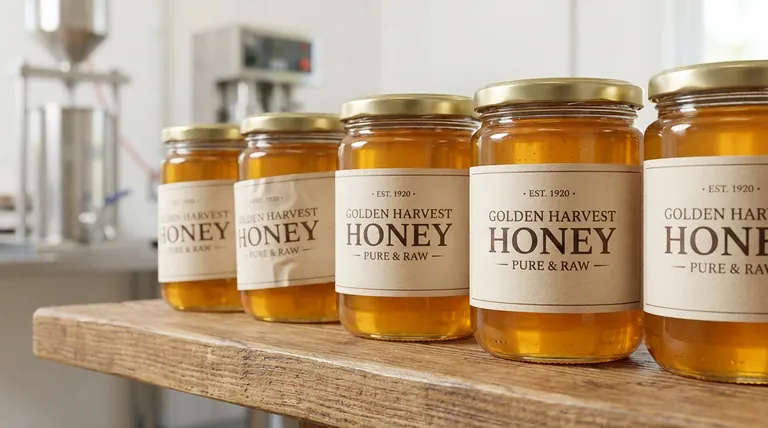
They judge the book by its cover. The decision hinges on a series of silent signals: the clarity of the jar, the color of the honey, and most importantly, the label. A perfectly centered, crisp, and professional label acts as a proxy for the quality within. It’s a handshake. It communicates care, precision, and trust.
A crooked, bubbled, or inconsistently placed label, however well-intentioned, silently asks a troubling question: if they can't get this simple detail right, can I trust the product inside?
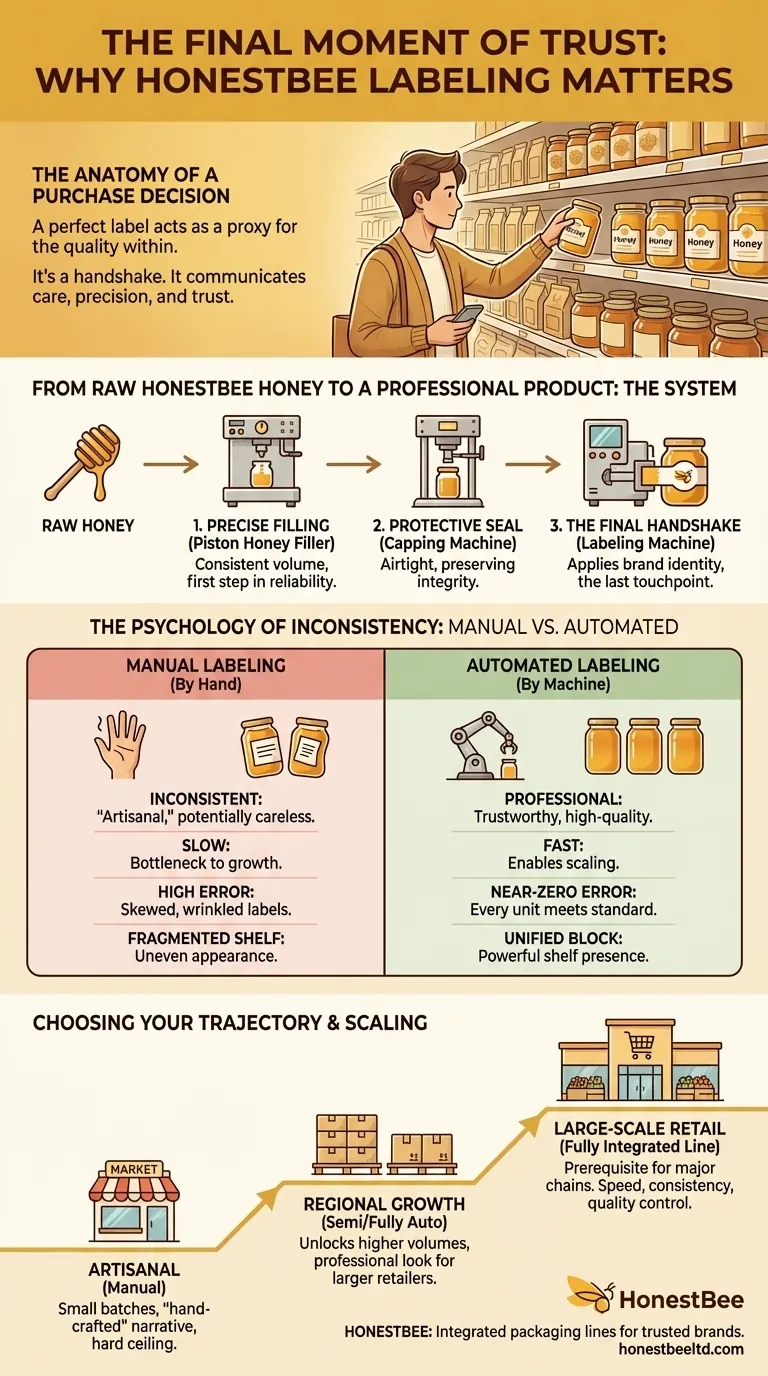
From Raw Honey to a Professional Product: The System
That final, decisive moment on the shelf is the culmination of a precise, mechanical symphony. A labeling machine isn't an isolated tool; it's the finale of an integrated system designed to transform a raw agricultural product into a polished, retail-ready item.
The Precise Measure: Filling
The process begins with a clean container and a promise of consistency. For a viscous product like honey, a piston honey filling machine is the instrument of choice. It uses a calibrated piston to dispense the exact same volume of honey, jar after jar. This isn't just about fairness to the customer; it's the first step in building a reputation for reliability.
The Protective Seal: Capping
Once filled, the jar moves to a capping machine. This quick, mechanical twist does more than prevent spills. It creates an airtight seal, preserving the honey's integrity and assuring the customer that they are the first to open it. It’s a simple, crucial guarantee of quality.
The Final Handshake: Labeling
Only after the product is measured and sealed does it arrive at the final station. The labeling machine applies the brand's identity. This is where the sum of all prior efforts—the beekeeping, the harvesting, the careful processing—is represented in a single, clean application. It’s the last touchpoint of the production process and the first touchpoint for the consumer.
The Psychology of Inconsistency
Manual labeling, especially for a growing operation, is a battle against entropy. Every jar is a slight variable. Over a full production run, these minor deviations create a visual noise on the shelf that undermines a premium brand.
Automation removes this variability. It replaces the "human touch," with its inherent inconsistencies, with machine precision. The result is a powerful psychological trigger for consumers.
| Aspect | Manual Labeling (By Hand) | Automated Labeling (By Machine) |
|---|---|---|
| Brand Perception | Inconsistent, artisanal, potentially careless. | Professional, trustworthy, high-quality. |
| Operational Speed | Slow, labor-intensive, a bottleneck to growth. | Fast, efficient, enables scaling. |
| Error Rate | High (skewed, wrinkled, misplaced labels). | Near-zero, ensuring every unit meets a quality standard. |
| Shelf Impact | A fragmented, uneven appearance across multiple units. | A unified, powerful block of branding. |
The human brain is wired to recognize patterns. A perfectly uniform product line signals order, control, and quality. It tells the consumer that the producer cares about every detail.
The Scaling Dilemma: Crossing the Automation Chasm
For a growing apiary, the decision to automate is often a significant psychological and financial hurdle. The upfront cost of machinery feels tangible and risky, while the hidden costs of manual labor—inefficiency, inconsistent quality, and capped production—are diffuse and harder to quantify.
Yet, you can't build a regional or national brand one crooked label at a time.
This is the chasm that separates a hobbyist from a commercial operation. Crossing it requires recognizing that equipment isn't just an expense; it's an investment in the brand's future potential. For commercial apiaries and distributors, sourcing the right integrated system is critical. A robust piston filler, a reliable capper, and a precision labeler working in concert are the engine of scalable growth.
Choosing Your Trajectory
Your approach to labeling should be a direct reflection of your business ambition.
The Artisanal Path
If your goal is to sell small batches at a local farmer's market, meticulous manual labeling can work. It reinforces the "hand-crafted" narrative, but it creates a hard ceiling on growth.
The Growth Engine for Regional Distribution
To move from a few cases to a few pallets, automation is non-negotiable. A semi-automatic or fully automatic labeling machine is the key that unlocks higher volumes and access to larger retailers, ensuring your product looks as professional as established brands.
The Mandate for Large-Scale Retail
For major grocery chains, a fully integrated packaging line is a prerequisite. Speed, consistency, and quality control are not optional. The system, from filler to labeler, must perform flawlessly to meet demand and maintain shelf presence.
Ultimately, the journey from hive to shelf is one of meticulous care. The final step should reflect that same commitment. At HONESTBEE, we supply commercial apiaries and equipment distributors with the robust, integrated packaging lines—from piston fillers to precision labelers—that turn a great product into a trusted brand.
To ensure your product’s quality is perfectly represented on the shelf, Contact Our Experts.
Visual Guide
Related Products
- Fully Automatic Honey Filling Packaging Machine for Processing Line
- Precision Automated Packaging Turntable Honey Spoon Filling Sealing Packing Machine
- Automatic Single-Dose Snap & Squeeze Honey Sachets Packing Machine
- Honey Stick Filler Vertical Paste Sachet Packing Machine for Honey Sachets
- Double Nozzle Small Honey Filling Machine Honey Sachet Packing Packaging Equipment
Related Articles
- The Bottleneck and the Bottom Line: A Systems Approach to Choosing Your Honey Filling Machine
- Are Manual Honey Filling Methods Bottlenecking Your Apiary's Growth?
- The Unseen Cost of Manual Honey Filling: A Case for Automation
- The Bottleneck and the Balance Sheet: A Strategic Guide to Honey Filling Machines
- The Bottleneck in a Bottle: Why Manual Honey Filling Limits Your Apiary's Growth