A Question of Trust, Not a Schedule
Imagine a commercial beekeeper standing in the extracting room. The air is thick with the scent of beeswax and warm honey. An entire season’s work—thousands of hours of labor from both human and bee—sits in gleaming stainless steel tanks.
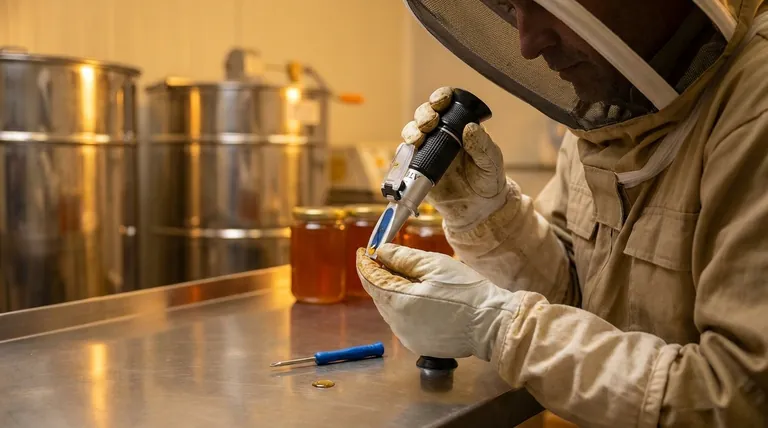
The final quality check rests on a single, small instrument: a honey refractometer. The number it displays will determine the fate of the harvest. But the real question isn't "What is the reading?" It's "Can I trust the reading?"
This is the central dilemma. Calibrating a refractometer isn't about ticking a box on a checklist. It's a foundational act of building trust in the tool that guards your product's integrity.
The Physics of Failure
Honey is a remarkably stable product, but its stability hinges on one critical variable: water content.
The 18.6% Threshold
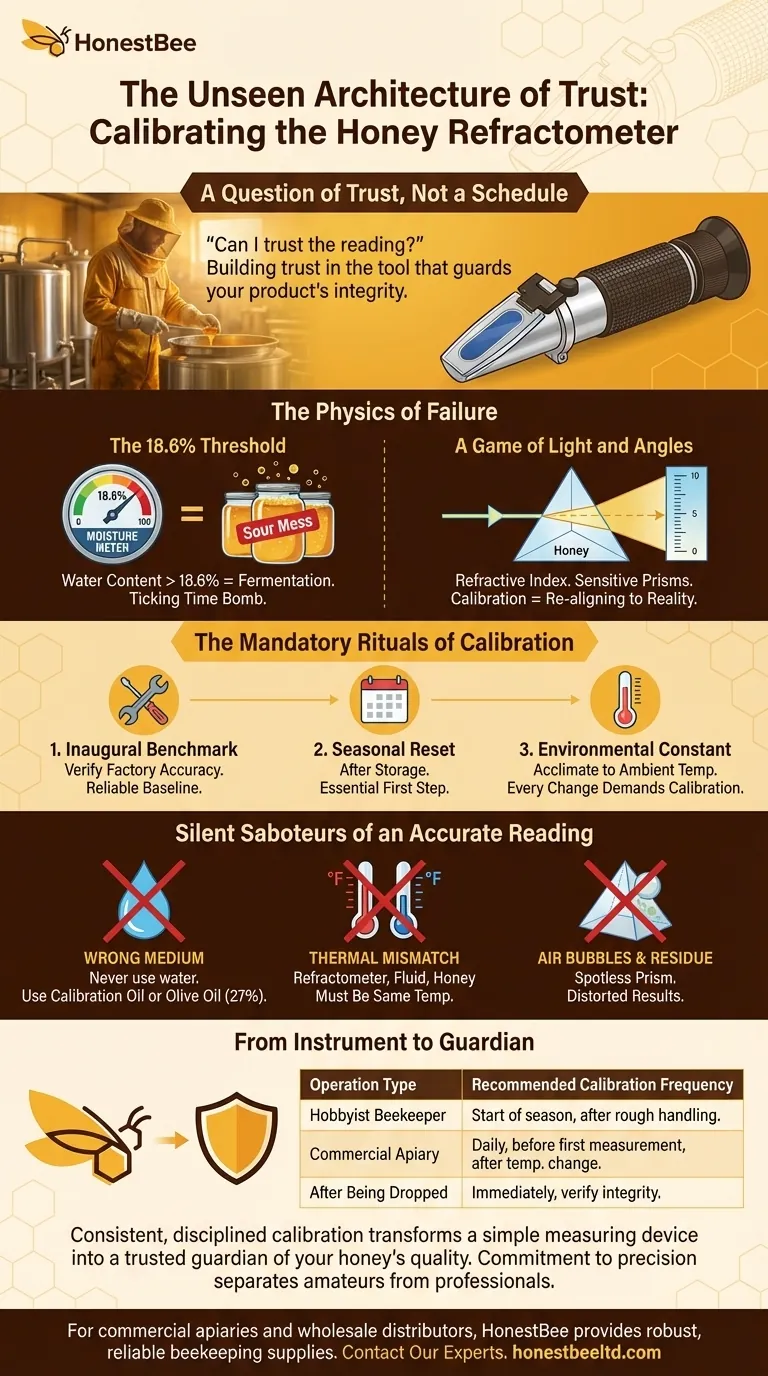
Once the moisture content of honey climbs above 18.6%, the dormant osmophilic yeasts present can awaken. Fermentation begins, turning a premium product into an unsellable, sour mess.
An inaccurate refractometer, off by just one or two percentage points, can give you a false sense of security. It can lead you to bottle honey that is, scientifically speaking, a ticking time bomb.
A Game of Light and Angles
A refractometer is an elegant piece of optical engineering. It works by measuring the degree to which a beam of light bends—its refractive index—as it passes through a thin layer of honey. This angle correlates directly to the concentration of dissolved solids, and thus, the water content.
The internal prisms that perform this measurement are sensitive. A sharp knock, a sudden temperature change, or even the subtle shifts of long-term storage can alter their alignment. Calibration is the act of re-aligning this delicate system to reality.
The Mandatory Rituals of Calibration
Think of calibration not as a chore, but as a series of non-negotiable checkpoints. These are the moments when you re-establish your instrument's connection to the truth.
1. The Inaugural Benchmark
A new refractometer is an unknown quantity. It has traveled through various temperatures and handling conditions to reach you. Calibrating it straight out of the box is the only way to confirm its factory accuracy and establish a reliable baseline for its entire service life.
2. The Seasonal Reset
After months in storage, your refractometer's accuracy is not guaranteed. Temperature and humidity shifts in the storage environment can cause microscopic changes. Calibrating at the start of a new honey season is the essential first step to ensuring every reading that follows is sound.
3. The Environmental Constant
Consider this scenario: You bring your refractometer from a cool, air-conditioned office into a hot, humid extracting room. The metal and glass of the instrument contract or expand at different rates. This thermal shock is the single most common cause of inaccurate readings.
You must allow the tool to acclimate to the ambient temperature of your working environment and then recalibrate it. Every significant temperature change demands a new calibration.
Silent Saboteurs of an Accurate Reading
Beyond the timing, simple procedural errors can completely invalidate your results. These are the silent saboteurs of accuracy.
- The Wrong Medium: Never use water to calibrate a honey refractometer. Its refractive index is outside the instrument's readable scale. Use the specific calibration oil provided, or in its absence, pure olive oil. Olive oil should produce a consistent reading of 27% on the moisture scale.
- Thermal Mismatch: For a valid reading, the refractometer, the calibration fluid, and the honey sample must all be at the same temperature. Testing cold honey with a warm refractometer will always produce a false reading.
- Air Bubbles and Residue: Tiny air bubbles trapped in the honey sample will bend light incorrectly, distorting the result. Likewise, dried honey residue from a previous test will contaminate the new sample. The prism must be spotless for every single measurement.
From Instrument to Guardian
The frequency of your calibration should reflect the stakes of your operation.
| Operation Type | Recommended Calibration Frequency |
|---|---|
| Hobbyist Beekeeper | At the start of each season and after any suspected rough handling. |
| Commercial Apiary | Daily, before the first measurement, and after any temperature change. |
| After Being Dropped | Immediately, to verify the integrity of the optical system. |
Consistent, disciplined calibration transforms a simple measuring device into a trusted guardian of your honey's quality. This commitment to precision is what separates an amateur from a professional.
For commercial apiaries and wholesale distributors, this discipline must extend to the quality of the tools themselves. A professional-grade instrument is more stable, more durable, and ultimately, more trustworthy. HONESTBEE provides the robust, reliable beekeeping supplies and equipment that form the foundation of a quality-focused operation. When your entire harvest is on the line, the integrity of your tools is paramount.
To ensure your measurements are always true, start with equipment built for the demands of the profession. Contact Our Experts
Visual Guide
Related Products
- Digital Honey Refractometer for Precision Measurement of Optimal Honey Quality
- Precision Honey Refractometer Instrument for Quality Assessment
- Premium Heat-Resistant Glass Honey Dipper
- Modern Stainless Steel Honey Dipper Stirrer
- Heavy Duty 304 Stainless Steel Honey Dipper
Related Articles
- The Physics of Perfection: Why a Single Number Determines Your Honey's Fate
- How to Accurately Test Honey Readiness: Science-Backed Methods for Beekeepers
- How to Perfect Honey Moisture Levels: A Beekeeper’s Guide to Refractometer Mastery
- From Ambiguity to Certainty: The Practical Case for Digital Honey Refractometers
- Precision in a Drop: Why Your Honey Refractometer Might Be Lying to You