The Moment of Truth in Beekeeping
Imagine standing in your honey house. The air is thick with the sweet smell of a season's hard work. In front of you are frames of honey, ready for extraction. But a critical question hangs in the air: is the moisture content low enough?
Harvest too soon, and the honey could ferment in the jar, ruining your product and your reputation. Wait too long, and you risk losing valuable production time.
This single decision rests on one number. For decades, getting that number involved squinting through an eyepiece, interpreting a blurry line, and making a judgment call. It was a process riddled with ambiguity, doubt, and the potential for human error.
The Core Flaw of Analog Measurement: Our Own Eyes
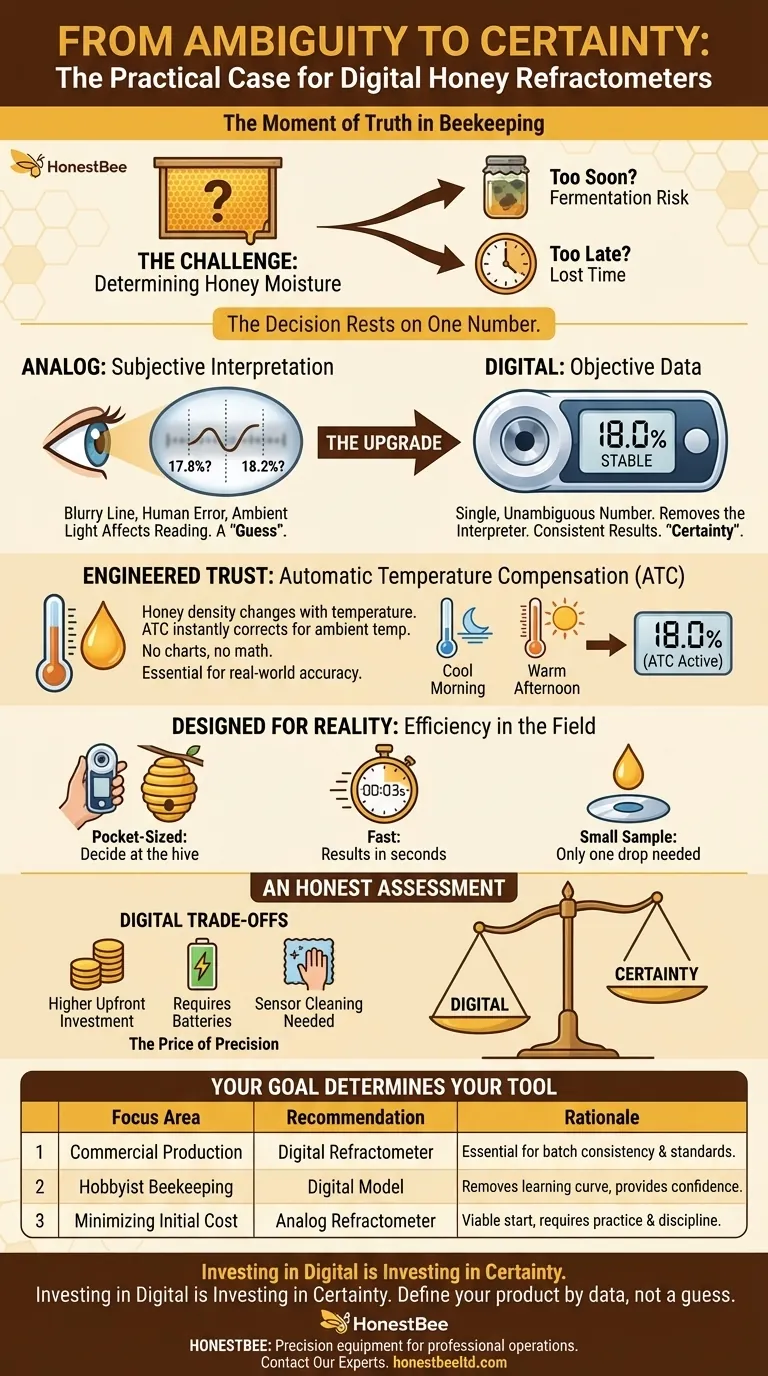
The most significant upgrade from an analog to a digital refractometer isn't just the screen; it's the removal of subjective interpretation. It addresses a fundamental psychological bias: we see what we want to see.
Interpretation vs. Data
A traditional analog refractometer forces your brain to act as a processor. You must account for the ambient light, the angle of your eye, and the clarity of the scale. Is that line on 17.8% or 18.2%? In poor light, the difference is a guess.
A digital refractometer removes the interpreter. It provides a single, unambiguous number. This shift from subjective interpretation to objective data is the foundation of any serious quality control process. It ensures the measurement taken by you today is identical to the one taken by your assistant tomorrow.
Engineering Trust: The Unseen Force of Temperature
Honey's density, and therefore its refractive index, changes with temperature. A reading taken in a cool morning is fundamentally different from one taken on a warm afternoon, even if the honey's moisture content is identical.
This is where the quiet genius of Automatic Temperature Compensation (ATC) comes in.
The best digital refractometers have ATC built-in. It’s an invisible partner, instantly correcting the reading for the ambient temperature. You don't have to consult a conversion chart or perform mental math. The device simply gives you the correct number, every time. This isn't a luxury; it's essential for achieving trustworthy data in the real-world conditions of a farm or apiary.
Designed for the Reality of the Harvest
Professional tools are not just accurate; they fit seamlessly into a demanding workflow. During the busiest parts of the season, efficiency is everything.
Data at the Source
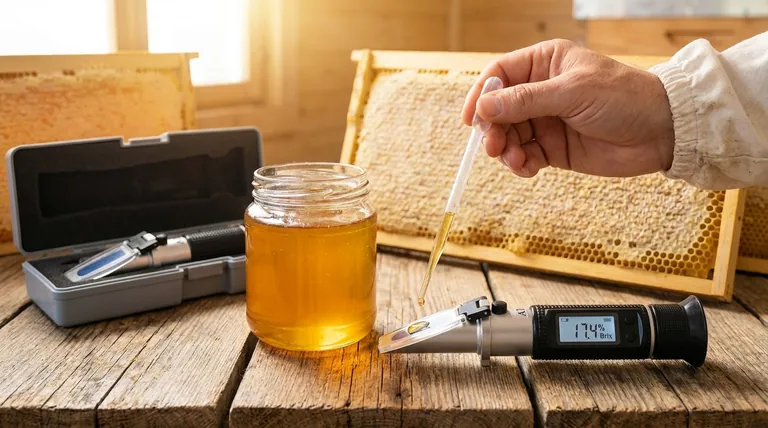
The pocket-sized design means you can make critical decisions on the spot. Walk out to your hives, take a tiny sample from a frame, and know in seconds if that super is ready to be pulled. This eliminates the guesswork and inefficiency of pulling a frame, carrying it back to the honey house, and only then discovering it's not yet cured.
The Economy of Speed and Samples
Testing takes seconds, not minutes. When you need to check dozens of supers or multiple batches from the extractor, this speed is invaluable. Furthermore, it requires only a single drop of honey. You get the critical data you need without wasting the very product you've worked so hard to create.
An Honest Assessment of the Trade-offs
No tool is perfect. A digital refractometer represents a higher upfront investment than its analog counterpart. The cost reflects the precision electronics, the digital display, and the internal processor that delivers its accuracy.
It also requires batteries. Unlike a purely optical tool, it can't function without power. This simply means that, like any professional, you must care for your tools. Keeping spare batteries on hand is no different than keeping a blade sharp. The sensor also requires careful cleaning to maintain its accuracy—a small price to pay for certainty.
Your Goal Determines Your Tool
Ultimately, the choice comes down to your operational priorities.
| Focus Area | Recommendation & Rationale |
|---|---|
| Commercial Production | A digital refractometer is an essential investment. It ensures batch consistency, meets industry standards, and protects your bottom line from spoilage. |
| Hobbyist Beekeeping | A digital model removes the learning curve and provides confidence, making the crucial step of moisture testing simple and reliable. |
| Minimizing Initial Cost | An analog refractometer is a viable starting point, but requires practice and discipline to achieve consistent, accurate readings. |
Investing in a digital refractometer is an investment in certainty. It's a declaration that your final product will be defined by data, not by a guess. For commercial apiaries and equipment distributors who understand this distinction, having a reliable supply of professional-grade tools is paramount.
At HONESTBEE, we supply the precision equipment—including digital honey refractometers—that empowers professional beekeeping operations to guarantee quality and operate with confidence. Contact Our Experts
Visual Guide
Related Products
- Digital Honey Refractometer for Precision Measurement of Optimal Honey Quality
- Precision Honey Refractometer Instrument for Quality Assessment
- Digital Display Electric Honey Uncapping Knife for Beekeeping and Decapping
- Professional Electric Honey Uncapping Knife with Heated Digital Temperature Control for Beekeeping
- Premium Heat-Resistant Glass Honey Dipper
Related Articles
- The Physics of Perfection: Why a Single Number Determines Your Honey's Fate
- How to Accurately Test Honey Readiness: Science-Backed Methods for Beekeepers
- How to Perfect Honey Moisture Levels: A Beekeeper’s Guide to Refractometer Mastery
- Precision in a Drop: Why Your Honey Refractometer Might Be Lying to You
- Beyond Brix: Why Your Honey's Future Depends on a Single, Temperature-Compensated Number