The Anatomy of a Costly Mistake
Imagine a perfect frame of honey. It’s heavy, the comb is beautifully drawn, and the bees have capped most of the cells. By all visible signs, it’s ready.
You harvest. You extract. You bottle.
Weeks later, you notice a slight pop as you open a jar. A subtle, sour smell follows. Bubbles begin to form. Your entire harvest—the result of countless hours of work from you and your bees—has begun to ferment.
This failure wasn't due to a lack of effort. It was due to a lack of data. You trusted your senses in a battle that is won with physics. The invisible enemy was moisture.
Trusting Physics Over Instinct
Humans are wired to rely on what we can see, touch, and smell. This is a profound cognitive bias when it comes to honey harvesting. We want to believe that "looking ready" is the same as being ready.
But honey’s stability doesn't depend on our perception. It depends on an objective, physical property: its water content.
High moisture content activates dormant yeast spores naturally present in all honey. The result is fermentation. Low moisture content keeps them asleep, guaranteeing a shelf-stable product for decades. Relying on guesswork is a gamble against microbiology.
A honey refractometer is the antidote to this gamble. It replaces subjective hope with objective certainty.
How Light Reveals the Unseen
The genius of a refractometer lies in its elegant simplicity. It doesn't use complex chemistry or electronics. It uses a fundamental principle of light.
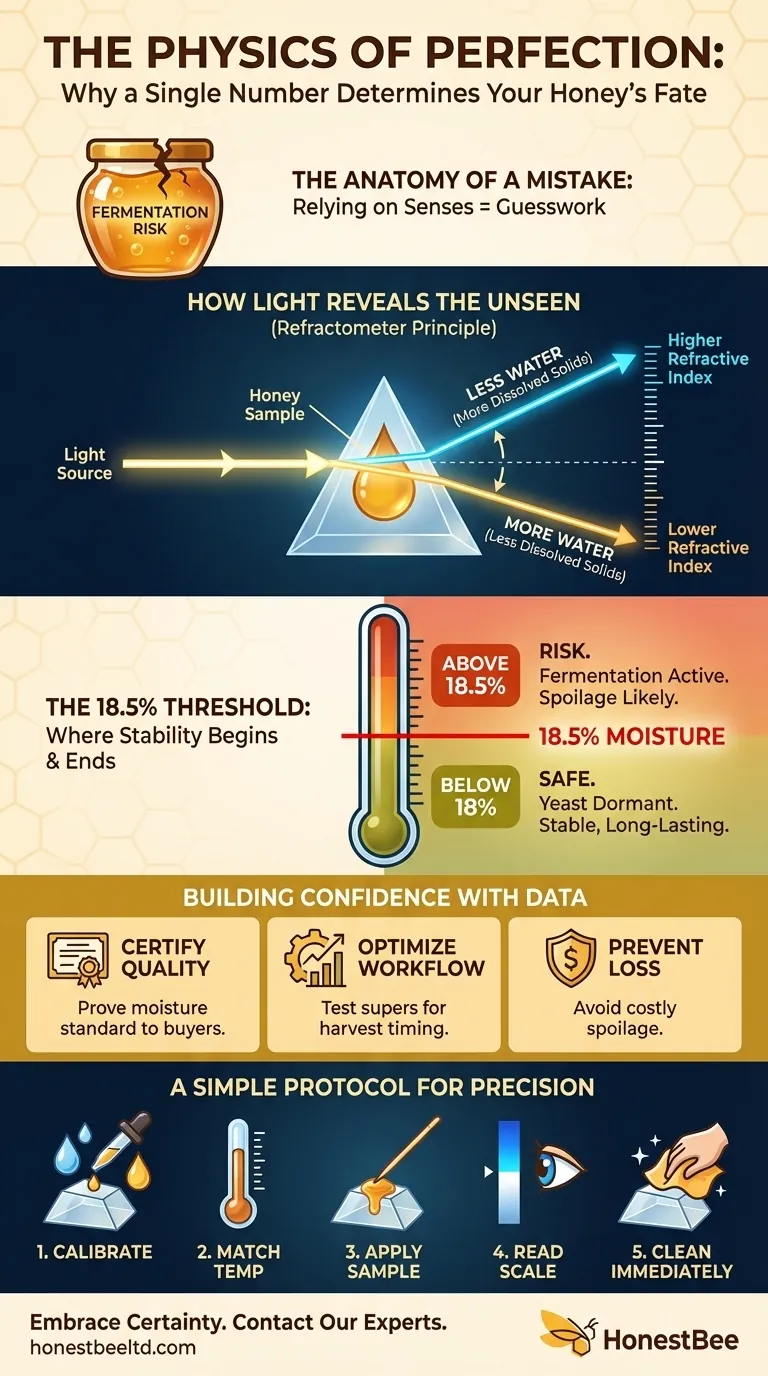
When light passes from air into a liquid, it bends. This is called refraction.
The amount of dissolved solids in the honey—primarily sugars—determines how much the light bends.
- Less Water = More dissolved solids = A higher refractive index (the light bends more).
- More Water = Less dissolved solids = A lower refractive index (the light bends less).
A refractometer simply measures this angle of refraction and translates it directly into the single most important number you need: the moisture percentage.
The 18.5% Threshold: Where Stability Begins and Ends
For honey, there is a clear line between stability and spoilage. That line is approximately 18.5% moisture content.
- Below 18% (The Goldilocks Zone): Your honey is safe. Yeast cannot thrive. This is the target for high-quality, commercial-grade honey that will last indefinitely.
- Above 18.5%: You have created the perfect environment for fermentation. The honey is unstable and at high risk of spoiling.
Environmental factors like nectar source and ambient humidity make it impossible to judge this number visually. A humid week can prevent bees from adequately dehydrating the nectar, even in capped cells. A refractometer cuts through these variables and gives you the one number that matters.
Building a System for Confidence
For a hobbyist, a spoiled harvest is a disappointment. For a commercial apiary, it's a catastrophic business failure.
Professional operations cannot afford to guess. They require a system built on quality control and repeatable processes. A refractometer is not just a tool; it's a cornerstone of that system. It allows you to:
- Certify Quality: Prove to buyers that your honey meets the moisture standard for stability and quality.
- Optimize Workflow: Test samples from different supers to decide which are ready to pull and which need more time in the hive, maximizing both efficiency and quality.
- Prevent Loss: Avoid the financial and reputational damage of a fermented batch reaching the market.
For commercial apiaries and distributors, this isn't just best practice; it's a pillar of operational integrity. Equipment must be reliable, accurate, and built to withstand constant use. That is why serious operations depend on professional-grade tools like the durable honey refractometers supplied by HONESTBEE.
A Simple Protocol for Precision
Using the tool is straightforward, but precision is key.
- Calibrate: Always start by calibrating your refractometer with distilled water or the included calibration oil to ensure accuracy.
- Match Temperatures: Let the refractometer and your honey sample come to the same ambient temperature.
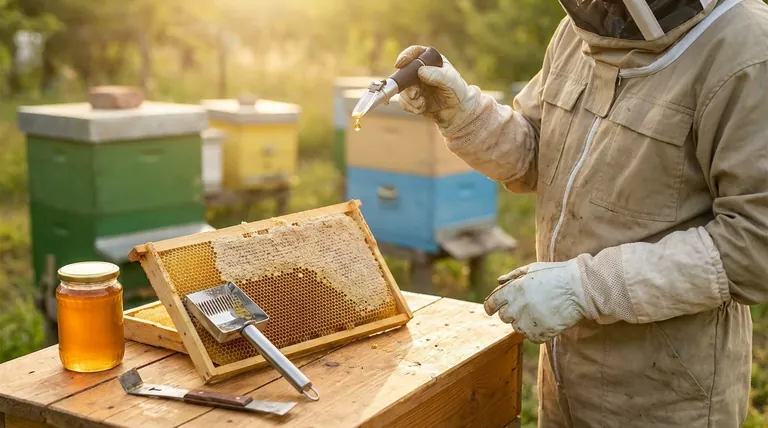
- Apply the Sample: Place just one or two drops of honey on the clean prism. A toothpick is an excellent tool for pulling a sample directly from an uncapped cell.
- Read the Scale: Close the daylight plate, hold it up to a light source, and look through the eyepiece. The line separating the blue and white fields points directly to the moisture percentage.
- Clean Immediately: Wipe the prism clean with a soft, damp cloth and dry it thoroughly. Dried honey will corrupt your next reading.
This simple, two-minute process removes all doubt from your most critical harvesting decision. It transforms your operation from one based on hope to one based on data.
Embrace the certainty that data provides, and ensure every harvest meets the standard of excellence. Contact Our Experts
Visual Guide
Related Products
- Digital Honey Refractometer for Precision Measurement of Optimal Honey Quality
- Precision Honey Refractometer Instrument for Quality Assessment
- Premium Heat-Resistant Glass Honey Dipper
- Professional Honey Filter with Tripod Support Stand
- Professional Stainless Steel Honey Filtering Machine with Water Bath Heating for Beekeeping
Related Articles
- How to Accurately Test Honey Readiness: Science-Backed Methods for Beekeepers
- How to Perfect Honey Moisture Levels: A Beekeeper’s Guide to Refractometer Mastery
- From Ambiguity to Certainty: The Practical Case for Digital Honey Refractometers
- Precision in a Drop: Why Your Honey Refractometer Might Be Lying to You
- Beyond Brix: Why Your Honey's Future Depends on a Single, Temperature-Compensated Number