The Misdiagnosis of a Slow Harvest
Every beekeeper has felt it: the frustration of a slow, messy uncapping process. Frames get damaged, honey is wasted, and a task that should be satisfying becomes a bottleneck.
The common reaction is to blame the tool's quality or one's own technique. We look for a sharper knife, a faster plane, a better method.
But this is often a misdiagnosis. The problem usually isn't the tool itself, but a fundamental mismatch between the tool's design and the unseen geometry of the honeycomb. It’s a problem of mechanical intolerance, an elegant system facing the wrong solution.
The Physics of the Uncapping Problem
The goal of uncapping is simple: shave off a thin wax layer. The reality is a complex interaction between a blade and a surprisingly varied surface.
The Topography of a Honeycomb
No honeycomb is perfectly flat. They have hills and valleys, high spots and low spots. This "topography" dictates everything.
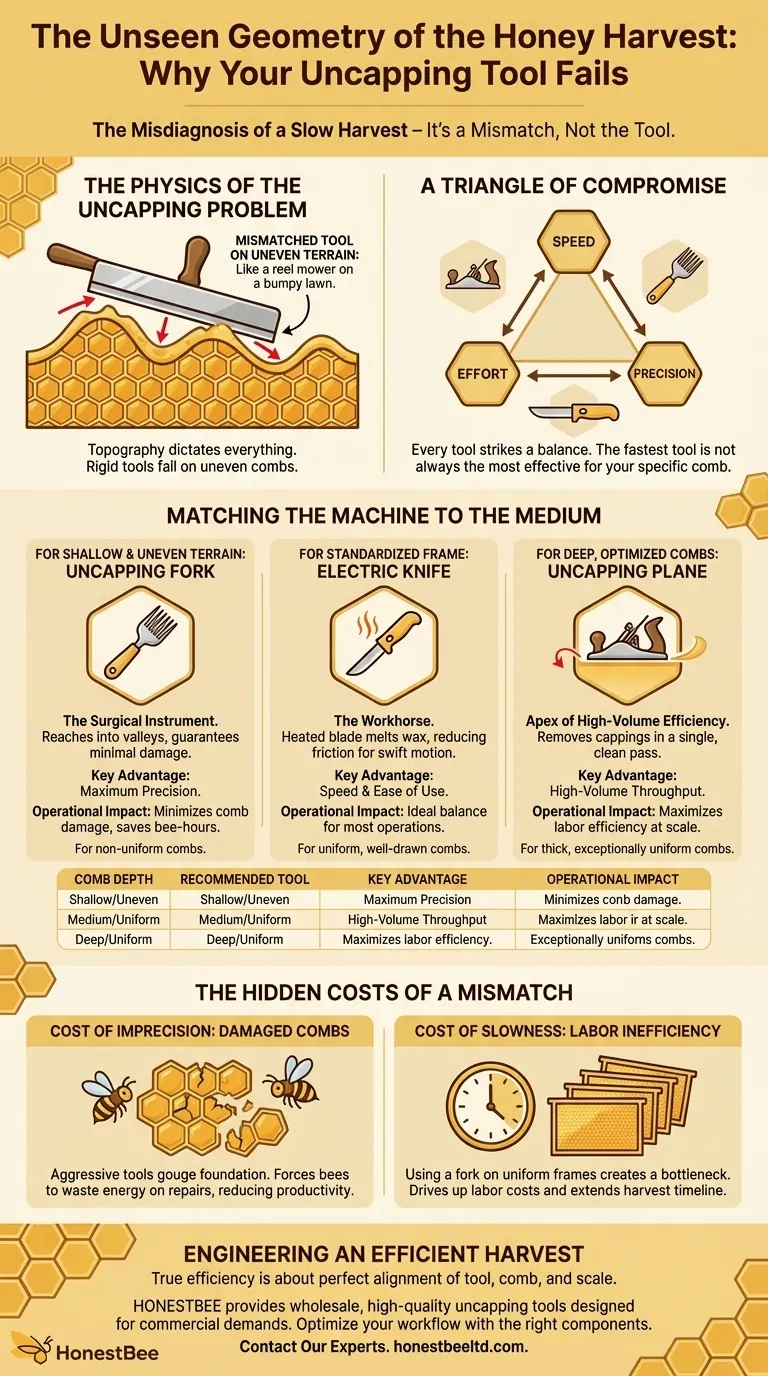
Trying to use a wide, rigid tool like an uncapping plane on an uneven comb is like trying to mow a bumpy lawn with a massive, industrial reel mower. You'll scalp the high points and miss the low spots completely.
A Triangle of Compromise: Speed, Precision, and Effort
Every uncapping tool exists within a triangle of compromise between speed, precision, and the physical effort required.
There is a psychological pull toward the "fastest" tool. But the laws of physics and geometry don't care about our desire for speed. The most effective tool is the one that strikes the right balance for the specific topography of your frames.
Matching the Machine to the Medium
A tool is only as good as its application. For the commercial beekeeper, understanding this isn't just a matter of preference; it's a core operational principle.
For Shallow & Uneven Terrain: The Uncapping Fork
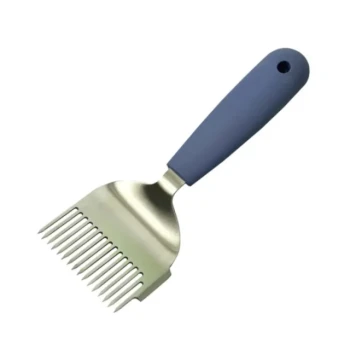
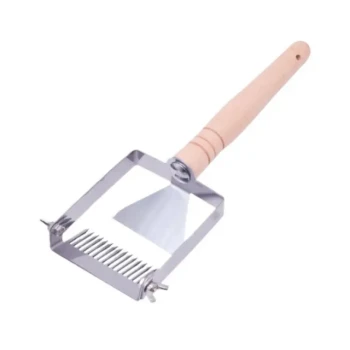
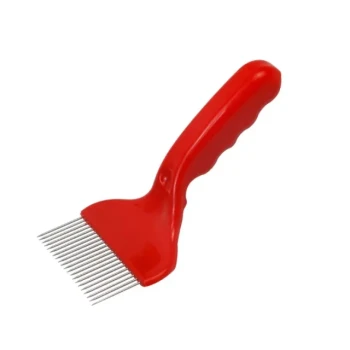
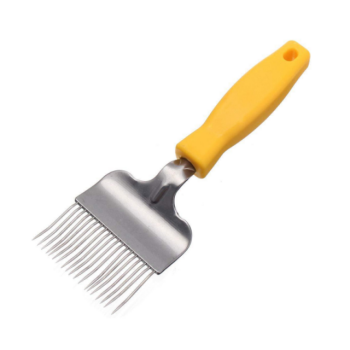
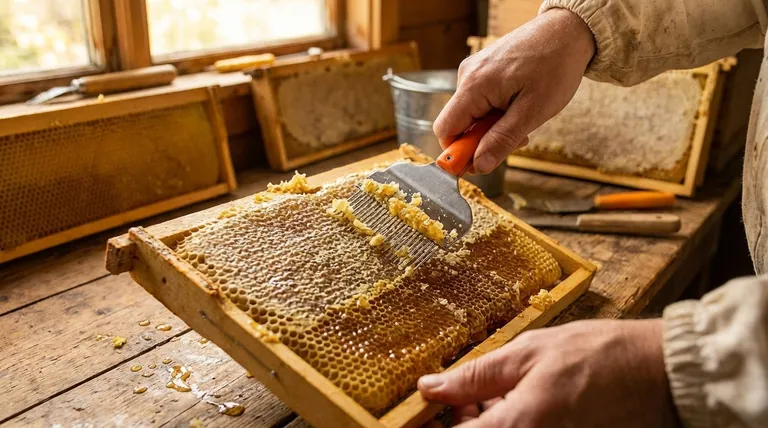
The uncapping fork, or scratcher, is a tool of pure precision. Its tines can reach into the "valleys" of an uneven comb that a blade would simply glide over.
Think of it as a surgical instrument. It is slow and methodical, but it guarantees minimal damage and maximum honey release on challenging frames. It rewards patience and is indispensable for non-uniform combs.
For the Standardized Frame: The Electric Knife
When combs are relatively uniform and well-drawn, the electric knife becomes the workhorse.
The genius of its design is the application of heat. The heated blade doesn't just cut; it melts the wax, dramatically reducing friction and physical effort. This allows for a swift, gliding motion that is significantly faster than a fork. It’s the ideal solution for apiaries that have achieved consistency.
For Deep, Optimized Combs: The Uncapping Plane
The uncapping plane is the apex of high-volume efficiency. It is designed for one specific condition: thick, deep, and exceptionally uniform combs, the kind found in highly optimized commercial operations.
Like a wood plane shaving a perfect layer from a flat board, it removes cappings in a single, clean pass. Its existence is a testament to the beekeeper's ability to produce perfectly consistent frames. Using it on anything less is an exercise in futility.
The Hidden Costs of a Mismatch
Choosing the wrong tool does more than just slow you down. It creates cascading problems that impact the entire health and productivity of your operation.
The Cost of Imprecision: Damaged Combs
Using a fast, aggressive tool on an uneven comb doesn't just miss spots; it gouges the foundation. This damage isn't just cosmetic. It forces the colony to expend precious energy and resources on repairs—energy that could have been used for foraging and honey production.
The Cost of Slowness: Labor Inefficiency at Scale
Conversely, using a high-precision fork on hundreds of perfectly uniform frames is a critical operational error. What is a virtue in a small-scale setting becomes a crippling bottleneck in a commercial one, driving up labor costs and extending the harvest timeline unnecessarily.
| Comb Depth | Recommended Tool | Key Advantage | Operational Impact |
|---|---|---|---|
| Shallow / Uneven | Uncapping Fork | Maximum Precision | Minimizes comb damage, saves bee-hours |
| Medium / Uniform | Electric Knife | Speed & Ease of Use | Ideal balance for most operations |
| Deep / Uniform | Uncapping Plane | High-Volume Throughput | Maximizes labor efficiency at scale |
Engineering an Efficient Harvest
True efficiency isn't about owning the "best" tool. It's about building a system where the tool, the comb, and the scale of the operation are in perfect alignment. It's a beautiful problem of mechanical and biological engineering.
At HONESTBEE, we understand that a commercial apiary is a complex system. Supplying the right equipment is not just about a transaction; it's about providing components that optimize your entire workflow. We provide wholesale, high-quality uncapping tools designed for the specific demands of commercial beekeeping.
To ensure your equipment perfectly matches the unique geometry of your combs and the scale of your operation, Contact Our Experts.
Visual Guide
Related Products
- Professional Multi-Function Uncapping Fork with Ergonomic Rubber Grip
- Adjustable Stainless Steel Honey Uncapping Fork with Scraper for Beekeeping
- Professional Wide Head Honey Uncapping Fork for Beekeeping
- Wide Adjustable Stainless Steel Honey Uncapping Fork with Scraper
- All-Stainless Steel Pivoting Honey Uncapping Fork for Beekeeping
Related Articles
- How Precision Uncapping Tools Improve Hive Health and Beekeeper Efficiency
- The Uncapping Fork: Precision Over Pace in Honey Extraction
- Precision Over Pace: The Strategic Role of the Uncapping Fork in Honey Harvesting
- How Uncapping Forks Protect Honeycombs and Reduce Beekeeping Costs
- Precision in the Apiary: The Unsung Virtues of the Uncapping Fork