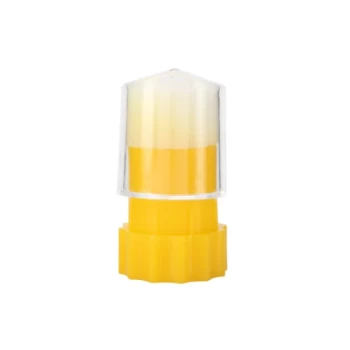
Marking pins act as a precise chronological anchor on the honeycomb. Beekeepers insert these pins into the comb to physically label the specific boundaries where the queen has freshly laid eggs. By identifying exactly when and where the eggs were deposited, the beekeeper can track the development timeline with certainty, ensuring that larvae are selected for grafting at the optimal age—typically about 24 hours after hatching.
By establishing a physical reference point for when eggs are laid, marking pins eliminate the guesswork of visual estimation. This allows you to target the critical 4 to 24-hour post-hatch window, a level of precision that is vital for ensuring the highest quality of resulting queens.
Establishing a Timeline on the Comb
Creating a Reference Point
The primary function of marking pins is to delineate the exact area of new activity. When you identify a section of comb containing freshly laid eggs, you place pins to border that zone.
Tracking the Hatching Cycle
Once the section is marked, the clock starts. Because the development time from egg to larva is biologically consistent, the pins tell you exactly where to look three days later.
Instead of scanning the whole frame for the right sized larvae, you go directly to the marked section. This efficiency is crucial for maintaining the temperature and humidity of the hive during inspections.
Targeting the Critical Age
The 24-Hour Standard
The primary goal of using pins is to identify larvae that are roughly 24 hours old.
At this stage, the larva has hatched and received its initial feeding, but it has not yet matured past the point of optimal caste differentiation. Grafting at this specific time ensures the developing queen has the maximum potential for growth and fertility.
The "Super-Quality" Window
While 24 hours is the standard, the highest quality queens are often raised from even younger larvae.
According to supplementary data, the ideal window is between 4 and 20 hours old. Marking pins are the only reliable way to consistently identify larvae this young, as they are extremely small and difficult to distinguish from slightly older larvae without a time reference.
Visual Verification
Even with pins, you must verify the age visually. In the optimal 4 to 20-hour window, the larvae will have barely begun to form a 'C' shape.
Furthermore, you should look for the presence of segmentation. At this optimal age, the characteristic rings on the larva's body will be either invisible or just beginning to form. If the rings are distinct, the larva may be too old for top-tier queen production.
Understanding the Limitations
The Requirement for Regularity
Marking pins are not a "set and forget" tool. They require you to check the hive frequently to move the pins as the queen expands the brood nest.
If you fail to update the pin locations daily during the laying season, the "marked zone" becomes a mix of ages, rendering the system ineffective.
Environmental Variables
While pins track time, biological development is influenced by hive temperature.
A cold snap can slightly delay hatching, while intense heat might accelerate it. Therefore, pins should be treated as a guide to the correct area, but the final decision to graft must always be based on the visual condition of the larva.
Making the Right Choice for Your Goal
Using marking pins transforms queen rearing from an estimation game into a precise procedure.
- If your primary focus is Maximum Queen Quality: Target the marked section early to find larvae between 4 and 20 hours old, verifying they have no visible rings.
- If your primary focus is Grafting Efficiency: Use the pins to immediately locate the general 24-hour zone, reducing the time the frame is exposed to open air.
Precision in selecting the youngest possible larvae is the foundation upon which superior genetics are built.
Summary Table:
| Feature | Optimal Larvae Window (4-20 Hours) | Standard Larvae Window (24 Hours) |
|---|---|---|
| Visual Shape | Barely beginning to form a 'C' shape | Distinct 'C' shape |
| Segmentation | Rings invisible or just forming | Rings are clearly visible |
| Queen Quality | Maximum growth and fertility potential | High quality, standard for most apiaries |
| Pin Function | Identifies specific sub-24h zones | Directs beekeeper to general grafting area |
Elevate Your Queen Rearing Precision with HONESTBEE
Successful queen rearing starts with the right tools and timing. HONESTBEE is dedicated to supporting commercial apiaries and distributors with high-quality beekeeping equipment that streamlines your operations.
Whether you need specialized hive-making machinery, precision honey-filling systems, or essential consumables for your queen-rearing program, we provide the wholesale solutions you need to scale efficiently. Our comprehensive portfolio ensures that you have access to the best hardware and industry insights to produce superior queens and maximize honey production.
Ready to upgrade your apiary’s performance?
Contact HONESTBEE Today to Explore Our Wholesale Catalog
References
- Ajay Sharma, Anju Sharma. Evaluation of priming media and queen cup material on larval graft acceptance and queen emergence in Apis mellifera L.. DOI: 10.22271/j.ento.2020.v8.i4q.7268
This article is also based on technical information from HonestBee Knowledge Base .
Related Products
- Queen Bee Marking Pen POSCA Queen Marking Pens for Beekeeping Bee Markers
- Queen Bee Marking Pen UNI Medium Point for Queen and Bee Marking
- Plastic Long Marker Device for Catching and Marking Bees Queen Bee Marking Tube and Cage
- One Hand Yellow Queen Marking Catcher Tube Cage Beekeeper Tool Accessory for Queen Bee
- Queen Bee Catcher Plastic Bee Marker Bottle with Piston Marking Tube
People Also Ask
- What role do specialized marking pens and color-coding systems play in honeybee tracking? Enhance Research Precision
- Why are specialized marking pens used for stingless bee queens? Essential Tools for Large-Scale Breeding Success
- How should a new paint pen be primed before marking a queen bee? Essential Tips for Safe & Clear Markings
- How should a queen bee marking pen tip be properly primed? Master the Art of Safe Queen Marking
- What specifications are required for a high-quality queen bee marking pen? Ensure Safety and Precision for Your Colony