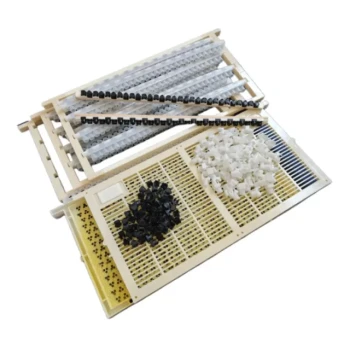
Artificial swarming tools and queen rearing equipment function as essential control mechanisms for maximizing productivity. In resource-rich mangrove regions, these tools allow beekeepers to intervene before natural biological triggers cause a colony to split. By proactively managing colony expansion and replacing aging queens, you prevent the significant loss of worker bees that occurs during natural swarming, keeping the colony’s workforce intact and focused on production.
By shifting from reactive to proactive management, these tools ensure colonies are led by young, fertile queens. This approach maintains maximum population density, directly enabling high annual honey yields that can average 65.37 kg per colony.
Proactive Colony Management
Preventing Resource Loss
Mangrove regions are often resource-rich, which naturally triggers a colony's impulse to swarm.
Without intervention, a natural swarm results in the loss of a significant portion of the worker bee population. Artificial swarming tools allow you to simulate this process under controlled conditions, retaining the workforce within your managed apiary rather than losing them to the wild.
Timing Expansion
Using these tools gives you control over the exact timing of colony division.
Instead of waiting for the bees to dictate expansion based on immediate environmental cues, you can split colonies when it best suits your production schedule. This ensures that the population is optimized for upcoming nectar flows.
The Importance of Queen Quality
Ensuring High Fecundity
The primary reference indicates that high yields are heavily dependent on the quality of the colony's leader.
Queen rearing equipment allows for the systematic introduction of young, high-fecundity queens. These queens are capable of laying eggs at a rate that sustains the massive worker populations required for industrial-level honey production.
Replacing Aging Genetics
A colony led by an older queen will naturally decline in vigor and honey output.
Rearing equipment enables you to replace queens before their performance dips. This creates a cycle of perpetual peak performance, preventing the lull in productivity associated with queen senescence or natural replacement failures.
Understanding the Operational Requirements
The Necessity of Active Management
Possessing these tools is not enough; they require a shift in operational philosophy.
You must move away from "keeping" bees to actively "managing" their biology. This requires strict adherence to schedules for splitting hives and grafting queens to match the floral resources of the mangrove environment.
Balancing Population and Resources
While these tools maximize population, they also increase the metabolic demand of the apiary.
Maintained at high capacity with young queens, colonies will consume resources rapidly. In the event of a nectar dearth in the mangroves, supplemental feeding or precise migration strategies become critical to support the artificially sustained population levels.
Making the Right Choice for Your Goal
To effectively utilize these tools in a mangrove setting, align your strategy with your specific objectives:
- If your primary focus is Maximum Honey Yield: Prioritize queen rearing schedules to ensure every colony is headed by a young queen, aiming for the 65.37 kg benchmark.
- If your primary focus is Colony Retention: Use artificial swarming tools to split strong hives immediately before the swarm season peaks to prevent the loss of livestock.
Mastering these tools allows you to dictate the pace of biology, turning natural impulses into calculated production gains.
Summary Table:
| Tool Category | Primary Function | Impact on Hive Management |
|---|---|---|
| Artificial Swarming Tools | Controlled colony splitting | Prevents loss of workers; retains workforce for peak nectar flow. |
| Queen Rearing Equipment | Systematic queen replacement | Ensures high fecundity and sustains massive worker populations. |
| Population Control | Managing density | Reaches benchmark yields (avg. 65.37 kg/colony) through active management. |
| Expansion Planning | Timing division | Syncs colony size with mangrove floral cycles for maximum efficiency. |
Maximize Your Apiary's Potential with HONESTBEE
At HONESTBEE, we understand that professional beekeepers and commercial apiaries need more than just supplies—they need precision and reliability to achieve industrial-level yields. Whether you are managing complex mangrove operations or expanding your distribution network, we provide the full spectrum of beekeeping tools, machinery, and essential consumables designed for high-performance colony management.
From queen rearing kits that ensure colony vigor to automated honey-filling machines that streamline your harvest, our wholesale offerings empower you to turn natural biology into calculated profit.
Ready to elevate your production and scale your beekeeping business?
Contact HONESTBEE Today for Wholesale Solutions
References
- Crhistian Laynes-Magaña, Saikat Kumar Basu. Honey production, an economic alternative for coastal areas with mangrove ecosystems: a case study in Sabancuy, Campeche, southeastern Mexico. DOI: 10.1186/s13002-025-00794-0
This article is also based on technical information from HonestBee Knowledge Base .
Related Products
- Retractable Chinese Queen Rearing Grafting Tools Equipment
- No Grafting Queen Rearing Kit: System for Royal Jelly Production and Queen Rearing
- Nicot Queen Rearing Kit for Beekeeping and Grafting in Nicot System
- Premium Nicot Style Queen Rearing Kit with Hair Roller Bee Cages
- Stainless Steel Queen Grafting Tool for Beekeeping and Bee Queen Grafting
People Also Ask
- Which specialized tools are necessary for implementing standardized queen rearing? Scale Your High-Yield Apiary
- Why are specialized queen rearing tools necessary to mitigate winter hive losses? Boost Apiary Survival and Recovery
- How do queen-rearing tools facilitate the sustainability and expansion of a commercial apiary? Drive Scalable Growth
- In what ways do modern queen rearing equipment and grafting tools improve competitiveness? Boost Breeding Success Rate
- What role do specialized queen rearing tools and consumables play in modern large-scale apiculture? Drive Production & Scale