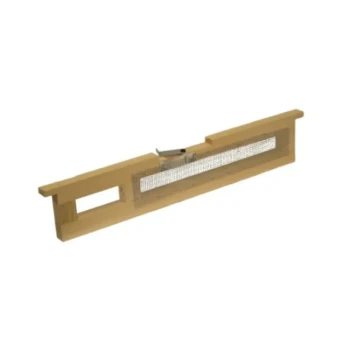
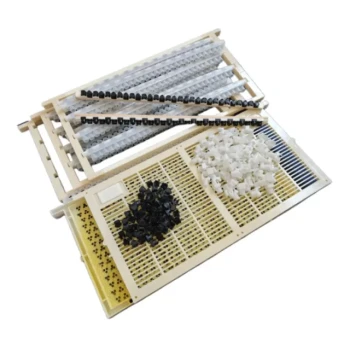
The relationship between grafting frames and feeders is best understood as a partnership between structural organization and metabolic fuel.
During artificial queen rearing, the grafting frame serves as the physical chassis that holds transplanted larvae in artificial cells, while the feeder acts as the external engine, providing the continuous nutrition necessary to drive the colony's behavior. Together, they create an environment where nurse bees are both physically directed toward specific larvae and metabolically charged to care for them.
Core Takeaway The grafting frame organizes larvae for mass production, but the feeder is what guarantees their acceptance and development. By ensuring a surplus of nutrition, the feeder empowers nurse bees to secrete the massive quantities of royal jelly required to transform the larvae held within the frame into viable queens.
The Structural Role of the Grafting Frame
Centralizing Larval Management
The grafting frame acts as a modular support system designed to hold dozens of queen cell cups simultaneously. Instead of searching for queen cells scattered across a natural comb, beekeepers can concentrate rearing efforts on a single frame.
This hardware configuration utilizes removable bars or fixed interfaces to present larvae in a standardized arrangement. It allows technicians to monitor progress and manage the rearing cycle of a large batch of queens without disturbing the rest of the hive.
Simulating Natural Architecture
To induce the colony to accept the graft, the frame utilizes standardized wax or plastic queen cups. These components mimic the physical structure of natural queen cells found in a hive.
When placed into a queenless "starter" or "finisher" colony, this structure triggers the nurse bees' instinct to build. The frame provides the physical foundation that allows the bees to draw out the cell walls and seal them at the appropriate stage.
The Metabolic Role of the Feeder
Fueling Royal Jelly Secretion
The presence of larvae alone is not enough to guarantee high-quality queens; the nurse bees must have the biological resources to feed them. The feeder, placed outside or adjacent to the frames, provides a continuous supply of syrup or nutrition.
This constant influx of food ensures nurse bees have sufficient energy to synthesize royal jelly. Without this artificial abundance, the colony might ration food, leading to undernourished larvae and queens with lower physiological quality.
Creating a Resource Surplus
In nature, queen rearing often happens during times of plenty. The feeder simulates a heavy "nectar flow," tricking the hive into a state of resource abundance.
This psychological effect on the colony is critical. It lowers the threshold for accepting the grafted larvae on the frame and encourages the bees to feed them aggressively, resulting in superior egg-laying capacity in the final queen.
System Integration and Trade-offs
The "Demand and Supply" Loop
The grafting frame creates the "demand" by presenting the colony with young larvae requiring care. The feeder provides the "supply" that enables the colony to meet that demand.
When these work in unison, the nurse bees concentrate their glandular secretion of royal jelly specifically on the target larvae within the frame cups. This precise channeling of colony resources is the key to artificial queen rearing efficiency.
Biological Monitoring
Beyond production, this combination allows for scientific observation. The controlled environment of the frame, paired with specific nutritional inputs from the feeder, creates a baseline for studying bee biology.
Specifically, this setup allows researchers to observe changes in worker bee ovaries under specific nutritional conditions. It separates the variables of housing and food, allowing for a clearer analysis of how nutrition impacts development.
Common Pitfalls to Avoid
Overloading the Frame
A common mistake is assuming that because a frame can hold dozens of cups, it should. If the feeder (or the colony's population) cannot supply enough resources to match the number of grafts, the bees will produce small, inferior queens.
Inconsistent Feeding
The feeder must provide a continuous supply, not an intermittent one. A break in nutrition can cause nurse bees to cannibalize the larvae on the grafting frame or reduce the volume of royal jelly, permanently stunting the developing queens.
Making the Right Choice for Your Goal
To maximize the effectiveness of this system, you must balance the physical capacity of the frame with the nutritional output of the feeder.
- If your primary focus is Commercial Volume: Use grafting frames with removable bars to maximize the number of cells, but ensure you pair this with aggressive, continuous feeding in very strong finisher colonies.
- If your primary focus is Queen Quality: Reduce the number of cups on the grafting frame to concentrate the nurse bees' attention, ensuring the feeder provides a surplus that exceeds the colony's daily needs.
Success in queen rearing comes not from the tools alone, but from using the feeder to convince the bees that the larvae on the frame are the colony's highest priority.
Summary Table:
| Component | Primary Function | Impact on Queen Rearing |
|---|---|---|
| Grafting Frame | Structural Chassis | Organizes and centralizes larval management for mass production. |
| Queen Cups | Natural Simulation | Triggers building instinct by mimicking natural queen cell architecture. |
| Feeder | Metabolic Fuel | Ensures a surplus of nutrition to drive royal jelly secretion by nurse bees. |
| System Synergy | Resource Channeling | Converts high nutrient intake into superior larval development and acceptance. |
Scale Your Queen Rearing Success with HONESTBEE
At HONESTBEE, we specialize in empowering commercial apiaries and distributors with the professional-grade tools needed for high-yield queen production. Whether you require precision grafting frames, high-capacity feeders, or advanced hive-making and honey-filling machinery, our comprehensive wholesale catalog is designed to meet the demands of large-scale operations.
From essential consumables to specialized hardware and honey-themed cultural merchandise, we provide the full spectrum of equipment to optimize your business. Contact us today to discuss your wholesale needs and discover how our expertise can drive your apiary's growth and efficiency.
References
- A. Elbassiouny. OCCURANCE OF LAYING WORKERS AT DIFFERENT HONEY BEE COLONIES STATUS. DOI: 10.21608/ajs.2005.15527
This article is also based on technical information from HonestBee Knowledge Base .
Related Products
- JZBZ Langstroth Queen Rearing Frame for Beekeeping
- Professional Wooden Requeening Frame for Beekeeping
- Portable Bee Mating Hive Boxes Mini Mating Nucs 8 Frames for Queen Rearing
- Retractable Chinese Queen Rearing Grafting Tools Equipment
- Nicot Queen Rearing Kit for Beekeeping and Grafting in Nicot System
People Also Ask
- Why use finishing colonies for queen cell capping? Secrets to Superior Queen Quality and Performance
- How do queen rearing frames and grafting needles function together? Master the Doolittle Method for High-Quality Queens
- What is the purpose of queen rearing frames? Master Controlled Queen Production for Your Apiary
- What are the functions of queen rearing frames and artificial queen cells? Master Bee Genetic Improvement
- What roles do professional queen rearing frames and artificial queen cells play? Scaling Your Queen Bee Production