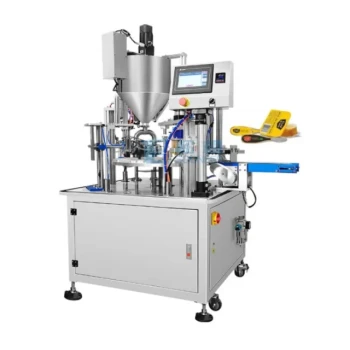
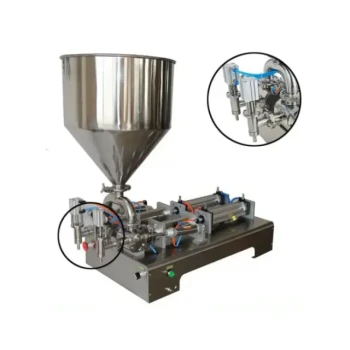
Industrial honey filling machines guarantee export compliance primarily through precise weight metering and vacuum sealing technology. By automating the packaging process, these systems ensure that the net content of every unit meets strict international legal regulations while simultaneously establishing an airtight seal. This approach eliminates the risk of secondary moisture absorption and environmental contamination, ensuring the product maintains physical stability throughout the complex logistics of export transportation.
Core Takeaway Export compliance relies on consistency that manual processing cannot achieve. Industrial filling machines bridge the gap between production and regulation by enforcing exact weight standards and creating a hygienic, vacuum-sealed environment that preserves the honey's chemical and sensory integrity during global transit.
Ensuring Measurement Accuracy and Legal Compliance
Precision Weight Metering
To meet international trade laws, the net content of a package must match its label exactly. Industrial machines use high-precision metering systems to control fill weights within tight tolerances. This eliminates the variances common in manual filling, ensuring every bottle complies with legal weight regulations.
Automated Labeling Integration
Beyond the fill itself, compliance extends to packaging information. These machines often integrate with labeling systems to apply mandatory legal warnings, such as infant botulism risks. This automation ensures that every unit leaving the facility meets the specific packaging and safety warning requirements of the destination country.
Preserving Product Integrity and Hygiene
Vacuum Sealing Technology
Honey is hygroscopic, meaning it naturally absorbs moisture from the air, which can lead to fermentation and spoilage. Vacuum sealing technology removes air from the package before sealing, creating an airtight environment. This prevents secondary absorption of moisture and stabilizes the honey’s physicochemical properties.
Preventing Environmental Contamination
Export markets, particularly those requiring organic certification, demand zero contamination. Automated filling occurs in a closed, controlled environment that acts as a barrier against external pollutants. This "sterile filling" process prevents cross-contamination and inhibits microbial growth, preserving the honey's purity and sensory characteristics.
Standardization for Organic Certification
For producers targeting high-end organic markets, aseptic packaging is non-negotiable. Industrial machines utilize aseptic technologies that maintain the specific hygiene indicators required for organic certification. This ensures the product remains compliant with rigorous standards like NMX-F-036-NORMEX-2006.
Enhancing Physical Stability for Logistics
Withstanding Export Transportation
Exporting honey involves long transit times and fluctuating environmental conditions. The physical stability provided by vacuum sealing ensures the product does not leak or degrade during shipping. This mechanical reliability is essential for preventing product loss and rejection upon arrival at foreign ports.
Understanding the Trade-offs
Capital Investment vs. Volume
While these machines solve compliance issues, they represent a significant capital expenditure. For smaller apiaries with low export volume, the cost of high-precision metering and vacuum technology may outweigh the efficiency gains. These systems are most economically viable when overcoming "bulk pricing bottlenecks" to enter high-volume retail markets.
Maintenance and Complexity
High-precision equipment introduces technical complexity into the production line. Maintaining the accuracy of flow control systems and vacuum seals requires specialized calibration and regular maintenance. A failure in the automated line can halt production entirely, unlike manual processes where labor is flexible.
Making the Right Choice for Your Goal
To select the right machinery, you must align the technology with your specific export strategy.
- If your primary focus is Organic Market Access: Prioritize machines with aseptic packaging and sterile filling features to meet rigorous organic certification audits.
- If your primary focus is Global Retail Distribution: Prioritize systems with high-precision metering and integrated labeling to ensure strict adherence to net-content laws and safety warning requirements.
- If your primary focus is Logistics and Shelf Life: Prioritize equipment with advanced vacuum sealing technology to prevent moisture absorption and ensure stability during long ocean freights.
Invest in the machine that mitigates your specific regulatory risks, transforming your honey from a raw commodity into a compliant, export-ready consumer product.
Summary Table:
| Compliance Factor | Technology Feature | Export Benefit |
|---|---|---|
| Legal Weights | High-precision Metering | Eliminates net-weight variances to meet international trade laws. |
| Product Purity | Vacuum Sealing | Prevents moisture absorption, fermentation, and environmental contamination. |
| Certification | Aseptic/Sterile Filling | Meets rigorous hygiene indicators required for organic certification. |
| Logistics | Airtight Sealing | Ensures physical stability and prevents leakage during long-distance transit. |
| Labeling | Integrated Systems | Automatically applies mandatory legal warnings and safety information. |
Elevate Your Apiary for the Global Market with HONESTBEE
Transitioning from raw honey production to a high-volume export business requires more than just quality honey—it requires precision engineering. HONESTBEE specializes in empowering commercial apiaries and distributors with the specialized machinery needed to conquer international markets.
Why partner with HONESTBEE?
- Comprehensive Wholesale Range: From high-precision honey-filling machines to hive-making hardware, we supply the full spectrum of beekeeping equipment.
- Global Compliance Standards: Our machinery is designed to meet the rigorous hygiene and weight accuracy demands of international retail and organic certifications.
- Total Industry Support: We provide not just machines, but essential consumables and cultural merchandise to build your brand.
Ready to scale your production and ensure every bottle is export-ready? Contact our experts at HONESTBEE today to find the perfect machinery solution for your business.
References
- Artem Antoniv, Dina Lisohurska. COMPARISON OF INTERNATIONAL REQUIREMENTS FOR QUALITY AND SAFETY OF BEEKEEPING PRODUCTS. DOI: 10.64378/iriush.journals.2025.1.1
This article is also based on technical information from HonestBee Knowledge Base .
Related Products
- Precision Durable Efficient HONESTBEE Rotary Honey Filling Machine
- Semi Automatic Small Honey Bottle Filling Machine Honey Filler
- Economy Small Honey Filling Machine Honey Bottle Filler Packaging Machine
- Commercial Rotary Honey Filling Machine for Production
- Fully Automatic Honey Filling Packaging Machine for Processing Line
People Also Ask
- What are the common types of bottling machines used for honey? Choosing the Right Solution for Your Apiary
- How do high-precision honey filling machines ensure quality? Optimize Your Commercial Production with HONESTBEE
- What quality control role does professional honey filling equipment perform? Ensure Consistency and Product Stability
- What is a key feature of the new generation of the honey filling machine? The Advanced Electronic Control Unit
- How do honey filling machines work? Achieve Precision & Speed for Your Apiary