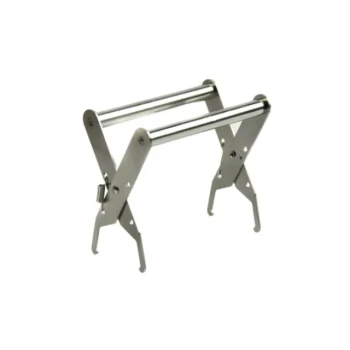
Standardized hive frames function as the critical control variable in honeybee research by establishing a uniform physical environment for all experimental colonies. By regulating the available space for comb building and brood rearing, these frames ensure that comparisons between different honeybee subspecies or groups reflect true biological differences rather than inconsistencies in the hive structure.
Standardization eliminates the "noise" of physical variability. By locking down the structural parameters of the hive, researchers create a consistent baseline that allows for precise, reproducible data collection regarding biological traits and environmental responses.
Eliminating Structural Bias
To establish valid experimental populations, researchers must remove variables that could skew results.
Ensuring Uniform Comparison Space
The primary function of a standardized frame is to provide a fixed volume and surface area. This ensures that every colony in an experiment operates within the exact same physical constraints.
Controlling Population Scale
Frames directly dictate the distribution of brood and the capacity for adult bees. By using uniform specifications, you ensure that population metrics are compared on an equal scale, preventing larger or distinctively shaped hives from artificially boosting colony performance numbers.
Removing Physical Variables
In comparative research, particularly involving different honeybee subspecies, physical differences in housing can mask genetic traits. Standardized frames eliminate variables related to container structure or materials, isolating the biological performance of the bees.
Enabling Precise Quantification
Process control relies on the ability to measure outputs accurately. Standardized frames act as a physical grid for data collection.
The Frame as a Reference Unit
Technicians utilize the known area of a standardized frame to estimate colony metrics. By subdividing the frame into tenths or percentages, observers can quickly and accurately quantify brood area, honey stores, and pollen reserves.
Facilitating Phenotypic Comparisons
This measurement system allows for consistent phenotypic comparisons across different generations and regions. Whether assessing hygienic behavior or honey yield, the standardized frame provides the consistent denominator required for statistical validity.
Streamlining Large-Scale Breeding
For high-volume projects, such as breeding mite-resistant bees, standardization supports systematic monitoring. It allows for efficient, high-throughput assessment of traits without the need for complex, chemically-based interventions.
Isolating Environmental Responses
When studying how bees interact with their environment, the equipment must not interfere with the data.
Validating Humidity Regulation
Research often examines how different subspecies regulate hive humidity. Standardization ensures that observed differences in humidity are attributed to the bees' biological characteristics or geographical climate factors, rather than the ventilation properties of different hive designs.
Enhancing Reproducibility
Scientific validity depends on repeatability. Using uniform hardware across different geographical regions ensures that experiments can be replicated with high fidelity, confirming that results are not artifacts of local equipment variations.
Understanding the Trade-offs
While standardization provides rigorous control, it is essential to recognize the limitations inherent in a "one-size-fits-all" approach.
Manufacturing Consistency is Critical
The term "standardized" implies zero variance, but manufacturing tolerances can drift. If "standard" frames from different batches or suppliers vary even slightly in dimension, the integrity of the process control is compromised.
Constraint of Natural Behavior
Standardized frames force colonies into a specific configuration that may not perfectly match the natural comb-building tendencies of every subspecies. While this creates a control for measurement, it imposes an artificial constraint that must be acknowledged when interpreting "natural" behavior.
Making the Right Choice for Your Goal
Standardization is a tool, and its application depends on your specific experimental objectives.
- If your primary focus is Comparative Genetics: Prioritize frame uniformity to ensure that performance differences are strictly due to subspecies traits, not hive volume.
- If your primary focus is Selective Breeding: Use the frame as a granular measurement grid to efficiently quantify phenotypic traits like hygienic behavior across large populations.
- If your primary focus is Environmental Interaction: Rely on standardized hardware to prove that internal hive climate variations are driven by biology and geography, not equipment design.
By treating the hive frame as a scientific instrument rather than simple storage, you transform beekeeping into a controlled, quantifiable scientific process.
Summary Table:
| Aspect of Control | Contribution of Standardized Frames | Benefit for Researchers |
|---|---|---|
| Structural Bias | Provides fixed volume and surface area | Eliminates physical variables between subspecies |
| Data Quantification | Acts as a uniform reference unit | Allows accurate measurement of brood and honey stores |
| Genetic Isolation | Creates a consistent baseline | Ensures observed differences are biological, not environmental |
| Reproducibility | Uniform hardware across regions | Facilitates experiment replication and scientific validity |
| Breeding Efficiency | High-throughput assessment tool | Supports large-scale monitoring of mite-resistant traits |
Elevate Your Research with HONESTBEE Precision Equipment
At HONESTBEE, we understand that in commercial beekeeping and research, consistency is the key to success. We cater to commercial apiaries and distributors by providing a comprehensive wholesale range of high-precision beekeeping tools, machinery, and essential consumables.
Whether you need standardized frames to ensure experimental integrity or specialized hive-making and honey-filling machines to scale your operations, our portfolio is designed to meet the rigorous demands of the modern industry. From hardware to honey-themed cultural merchandise, we provide the full spectrum of equipment to help you achieve quantifiable results.
Ready to standardize your success? Contact us today to explore our wholesale solutions and discover how HONESTBEE can optimize your apiary’s performance.
References
- Ahmad A. Al-Ghamdi, Yehya Alattal. Expression Levels of Heat-Shock Proteins in Apis mellifera jemenetica and Apis mellifera carnica Foragers in the Desert Climate of Saudi Arabia. DOI: 10.3390/insects14050432
This article is also based on technical information from HonestBee Knowledge Base .
Related Products
- Wooden Bee Hive Frames for Beekeeping and Wholesale
- Plastic Bee Frame Beekeeping Hive Frames for Wholesale
- Professional Galvanized Steel Frame Rest for Beehives
- Assembled Wooden Bee Frames with Plastic Foundation for Durability and Convenience by HONESTBEE
- Precision Stainless Steel Frame Cleaner for Hive Grooves and Corners
People Also Ask
- How does balancing the number of frames impact hive productivity? Optimize Your Apiary's Biological Output
- How do wooden and plastic hive frames compare in terms of durability? Wood vs. Plastic Longevity & Repairability
- What are the main considerations when choosing between wooden and plastic bee hive frames? Optimize Your Apiary's Efficiency
- How should beehive frames be maintained to prolong their lifespan? 5 Pro Tips for Durable Beekeeping Equipment
- What are frames and combs used for in beekeeping? The Foundation of Modern Hive Management