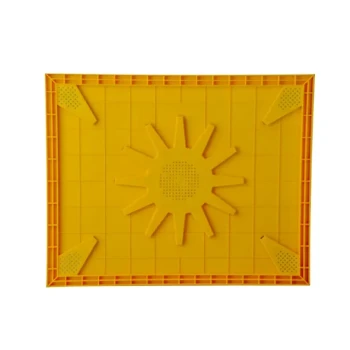
Sticky boards serve as a critical diagnostic tool for quantifying Varroa mite infestations within a beehive. Treated with adhesive substances like petroleum jelly, these boards are placed at the bottom of the hive to trap mites that naturally fall or are groomed off bees. By immobilizing the parasites on a tacky surface, the boards prevent mites from crawling back into the colony or being dispersed by wind, ensuring an accurate sample for assessment.
By preventing the escape or dispersal of falling parasites, adhesive sticky boards transform a passive mechanical occurrence into a precise data-gathering instrument for long-term population monitoring.
The Mechanics of Capture
Immobilizing the Parasite
The primary function of the adhesive coating, such as petroleum jelly, is immediate retention. Without this tacky surface, a Varroa mite that falls to the bottom board remains mobile and could easily crawl back up into the hive to re-attach to a host bee. The adhesive ensures that once a mite falls, it is permanently removed from the colony's population.
Preventing Environmental Interference
External factors can easily corrupt data collection in an open hive environment. A non-sticky surface would allow light debris and mites to be blown away by the wind or hive ventilation. The adhesive layer anchors the mites in place, preserving the "evidence" until the beekeeper can perform an inspection.
Enhancing Measurement Precision
The Role of Coordinate Grids
Raw data is useless if it cannot be processed efficiently. Sticky boards are frequently used in conjunction with coordinate grid paper. This visual aid divides the board into manageable sections, allowing the beekeeper to scan the surface systematically rather than guessing.
Increasing Counting Accuracy
The combination of the adhesive trap and the grid significantly increases the accuracy and efficiency of the count. Instead of estimating based on a chaotic scattering of debris, the beekeeper can obtain a precise number. This precision is vital for determining if the mite load has crossed a specific treatment threshold.
Monitoring Population Dynamics
Single data points are less valuable than trends. By consistently using sticky boards, beekeepers can track long-term population dynamics. This historical data reveals whether the mite population is stable, rising slowly, or exploding, allowing for timely intervention.
The Role of the Screened Bottom Board
Facilitating the Drop
While the sticky board catches the mites, the screened bottom board acts as the delivery mechanism. As worker bees groom themselves after flights, they dislodge mites from their bodies.
Mechanical Separation
The mesh screen creates a physical barrier between the colony and the debris zone. Mites fall through the mesh and land on the sticky board below. This mechanical control slows population growth by preventing immediate re-entry, while the sticky board below confirms the drop occurred.
Understanding the Trade-offs
Natural Fall vs. Total Population
It is important to recognize that a sticky board counts natural mite fall, not the total number of mites in the hive. It is a sampling method. A low count on the board usually indicates a low population, but it requires interpretation based on the size of the colony and the season.
Debris Accumulation
The adhesive does not discriminate between mites and other hive debris. Wax cappings, pollen, and general detritus will also stick to the board. In periods of high hive activity, this "noise" can make identifying and counting mites more challenging, requiring a keen eye and patience.
Making the Right Choice for Your Goal
To get the most out of sticky boards, tailor your usage to your specific management objectives:
- If your primary focus is establishing a baseline: Use the grid system to record exact numbers weekly to understand the standard "mite drop" for your specific apiary.
- If your primary focus is treatment efficacy: Insert a sticky board immediately after applying a mite treatment to visualize the "knockdown" rate and confirm the treatment is working.
Consistent monitoring turns simple sticky paper into your first line of defense against colony collapse.
Summary Table:
| Feature | Function in Mite Assessment | Benefit to Beekeeper |
|---|---|---|
| Adhesive Coating | Immobilizes fallen mites instantly | Prevents re-infestation & data loss |
| Coordinate Grid | Systematic surface division | Increases counting speed & accuracy |
| Screened Bottom | Mechanical separation barrier | Allows mites to fall while blocking re-entry |
| Long-term Tracking | Monitors population dynamics | Enables data-driven treatment timing |
Maximize Your Apiary Productivity with HONESTBEE
Precise monitoring is the first step toward a thriving honey harvest. At HONESTBEE, we specialize in supporting commercial apiaries and distributors with a full spectrum of professional-grade beekeeping tools and machinery. Whether you need high-precision honey-filling machines, durable hive-making hardware, or essential industry consumables, our wholesale solutions are designed to scale your operations.
Ready to elevate your beekeeping business? Contact us today to explore our comprehensive portfolio and discover how our expertise can drive your success.
References
- Wenjun Peng, Zhijiang Zeng. A descriptive study of the prevalence of parasites and pathogens in Chinese black honeybees. DOI: 10.1017/s0031182015000840
This article is also based on technical information from HonestBee Knowledge Base .
Related Products
- Langstroth Solid Bottom Board for Beekeeping
- Solid Bottom Board Australian Pine Wood Langstroth Bottom Board for Wholesale
- Langstroth Screen Bottom Board for Beekeeping Wholesale
- HONESTBEE Multi Exit Plastic Bee Escape Board for Efficient Honey Harvesting
- Australian Pine Wood Langstroth Screen Bottom Board for Wholesale
People Also Ask
- What are the functions of solid bottom boards for a beehive? Essential Thermal Protection and Winter Survival Tips
- What is the purpose of a solid bottom board for bee hives? Enhance Hive Health and Winter Survival
- How does climate influence the choice between a solid and screened bottom board? Optimize Your Hive for Local Weather
- What is the primary function of a bottom board in a modern modified beehive system? Essential Foundation Guide
- What are the characteristics of a solid bottom board for a beehive? Boost Colony Health and Thermal Insulation