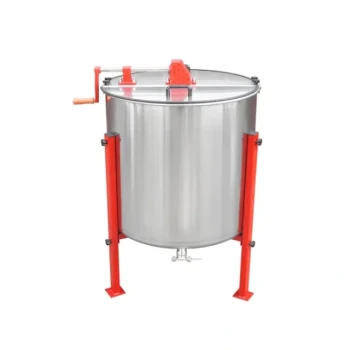
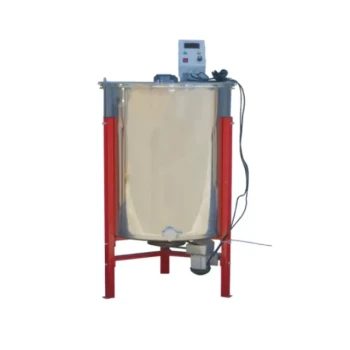
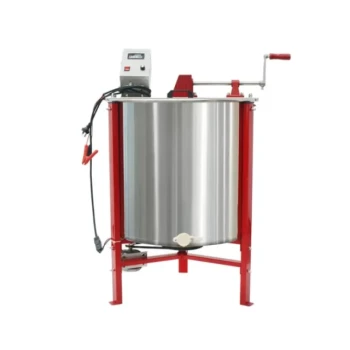
Tangential honey extractors operate by holding honeycomb frames flat against the inner basket, with the face of the comb parallel to the drum's wall. Using centrifugal force, the machine spins the basket to pull honey out of the outward-facing cells, necessitating a manual process where the user must stop the machine and flip the frames to extract the opposing side.
Tangential extraction is the standard method for small-scale and hobbyist beekeeping, defined by a "spin-flip-spin" workflow that extracts honey from one side of a frame at a time.
The Mechanics of Extraction
Frame Orientation
Unlike radial extractors that position frames like spokes on a wheel, tangential extractors place the frames broadside to the tank wall. The honeycomb surface faces directly outwards, perpendicular to the radius of the spinning basket.
The Role of Centrifugal Force
The extractor operates on the principle of centrifugal force. As the internal basket spins, the rotational energy overcomes the surface tension holding the honey in the cells.
Honey Collection
The force expels the honey from the uncapped cells and throws it against the inner wall of the drum. Gravity then pulls the liquid down to the bottom of the tank, where it collects for bottling, leaving the wax comb structure intact.
The Operational Workflow
The One-Sided Limitation
The defining characteristic of this design is that it can only extract honey from the outward-facing side at any given moment. The side facing the center of the drum remains full during the initial spin.
The Flipping Requirement
To complete the extraction, the operator must stop the spinning basket. Each frame must be physically removed or reversed so the second side faces the outer wall, and the spinning process is repeated.
Power Sources
These extractors are available in both manual and electric configurations. Manual models rely on a hand crank for rotation, while electric models use a motor to automate the spinning speed and duration, though the manual flipping of frames remains necessary in both.
Understanding the Trade-offs
Suitability for Scale
Tangential extractors are most common among hobbyists and small-scale operations. Their design is typically simpler and more compact, making them accessible for those managing a limited number of hives.
Efficiency Considerations
The primary downside is the interruption in workflow caused by the need to flip frames. While effective, this method is slower than radial extraction, which extracts both sides simultaneously without operator intervention.
Comb Preservation
A key advantage of this centrifugal method is that it extracts liquid without destroying the comb. This allows the beekeeper to return the empty wax frames to the hive, saving the bees the energy required to rebuild them.
Making the Right Choice for Your Goal
Tangential extractors are tools of precision and tradition, but they dictate a specific pace of work.
- If your primary focus is budget and small-scale management: The tangential extractor is likely your best option, as it is cost-effective and perfectly adequate for processing a small number of frames (e.g., 2 to 8).
- If your primary focus is high-volume efficiency: You may find the "stop-and-flip" requirement a bottleneck; a radial extractor would be better suited to save time and labor.
By understanding the mechanical necessity of flipping frames, you can accurately gauge the time investment required for your harvest.
Summary Table:
| Feature | Tangential Extractor Details |
|---|---|
| Mechanism | Centrifugal force via spinning basket |
| Frame Orientation | Parallel to the drum wall (flat-facing) |
| Extraction Method | One side at a time (requires flipping) |
| Power Options | Manual hand-crank or electric motor |
| Best For | Hobbyists and small-scale commercial apiaries |
| Main Advantage | Preserves wax comb and cost-effective design |
Scale Your Honey Production with HONESTBEE
Maximize your harvest efficiency with professional-grade equipment from HONESTBEE. As a premier partner for commercial apiaries and distributors, we provide everything from precision tangential and radial extractors to high-capacity honey-filling machines and hive-making hardware.
Whether you are stocking essential industry consumables or upgrading your facility with automated machinery, our comprehensive wholesale offering ensures your business stays productive and competitive.
Ready to elevate your beekeeping operation? Contact our expert team today to explore our full spectrum of tools and cultural merchandise tailored for your success.
Related Products
- Electric 4 Frame Tangential Honey Extractor
- 24 Frame Honey Extractor Commercial Radial Honey Frame Extraction Machine
- HONESTBEE 72 Frame Industrial Electric Honey Extractor for Beekeeping
- Stainless Steel Manual 8 Frame Radial Honey Extractor Machine for Beehives
- 32 Frame Commercial Electric Honey Extractor for Beekeeping and Honey Production
People Also Ask
- What are the characteristics of electric honey extractors? Boost Your Apiary Efficiency with Automated Technology
- What are the disadvantages of using an electric honey extractor? Weighing Cost, Power, and Comb Safety
- What are the advantages of an electric honey extractor? Boost Efficiency and Scale Your Honey Production
- What are the advantages of electric honey extractors? Boost Harvest Speed & Efficiency
- What are the technical advantages of electric honey extractors? Maximize Yield and Protect Your Bee Colony