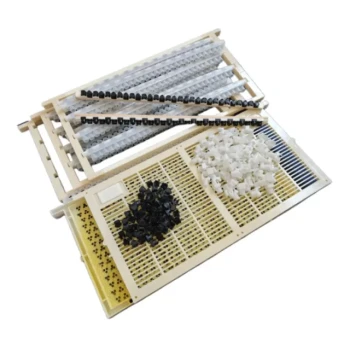
Wooden cell bars and queen rearing frames act as the structural backbone of modern royal jelly production. These tools function as a comprehensive modular system where wooden bars, each serving as a base for approximately 15 queen cell cups, are integrated into frames to allow for precise organization, scalable volume, and efficient mass harvesting.
The core value of this system lies in transforming the hive into a standardized production line; it allows beekeepers to simulate the ideal biological environment for jelly secretion while decoupling the delicate grafting process from the hive environment.
The Mechanics of the Modular System
Standardized Production Units
The wooden cell bar is the fundamental unit of measurement in this system. Acting as a base, each bar securely holds approximately 15 queen cell cups.
By standardizing the number of cups per bar, producers can easily calculate and predict potential yields. This turns a biological process into a measurable workflow.
Scalability and Flexibility
These bars are designed to slot directly into the queen rearing frame. This modular design allows you to adjust the scale of production based on specific requirements or colony strength.
If a colony is weaker, you can reduce the number of bars to ensure the remaining larvae are well-fed. Conversely, strong colonies can accommodate fully loaded frames for maximum output.
Streamlining the Workflow
The system separates the preparation phase from the hive environment. Because the bars are removable, technicians can perform precise larval grafting in a controlled laboratory setting.
This protects delicate larvae from weather and hive aggression during the transfer. Once grafted, the bars are slotted into the frames and introduced to the hive, and later, entire sets of cells can be removed simultaneously for large-scale harvesting.
Optimizing Biological Output
Strategic Internal Positioning
The rearing frame allows you to control exactly where the larvae are located within the hive. The physical structure of the frame ensures that artificial queen cells are maintained at uniform temperatures and humidity.
This positional control is critical because the location within the frame directly impacts yield.
Leveraging Microclimates
Supplementary data indicates that placing cell bars in the middle or center of the frame typically results in heavier royal jelly yields.
The center of the frame experiences the highest density of nurse bees and the most stable microclimate, shielded from external temperature fluctuations. The frame structure allows you to concentrate production in this "sweet spot."
Understanding the Trade-offs
The Density vs. Quality Balance
While frames allow for high-density arrangements of hundreds of cups, there is a biological limit. Overloading a frame with too many bars in a colony with insufficient nurse bees will lead to low acceptance rates and meager jelly secretion.
Positional Sensitivity
Not all positions on the frame perform equally. While the modular system allows you to fill the entire frame, cups placed on the periphery (front or rear) often yield less royal jelly than those in the center.
You must balance the desire for maximum cup count against the reality that edge-placed cups may lower your average yield per larva.
Making the Right Choice for Your Goal
To maximize your results, you must adapt how you load your frames based on your specific operational capacity.
- If your primary focus is maximizing yield per cup: Prioritize loading cell bars only in the central positions of the frame to leverage the highest density of nurse bees and stable temperatures.
- If your primary focus is large-scale commercial volume: Utilize fully loaded frames but ensure your colonies are exceptionally strong to support the high nutritional demand of hundreds of larvae.
Success in royal jelly production comes not just from using the tools, but from placing the right volume of cups in the precise zone where the colony's nursing instinct is strongest.
Summary Table:
| Feature | Benefit for Royal Jelly Production |
|---|---|
| Modular Design | Allows for customizable production scale based on colony strength. |
| Standardized Bars | Holds ~15 cups per bar for predictable yields and easy volume calculation. |
| Removable Components | Enables precise larval grafting in controlled environments, protecting delicate larvae. |
| Strategic Positioning | Focuses production in hive 'sweet spots' for uniform temperature and humidity. |
| Scalable Architecture | Facilitates mass harvesting by allowing entire sets of cells to be removed at once. |
Maximize Your Royal Jelly Output with HONESTBEE
At HONESTBEE, we understand that large-scale royal jelly production requires precision and reliability. Whether you are a commercial apiary looking to streamline your workflow or a distributor seeking high-quality beekeeping equipment, we provide the comprehensive wholesale solutions you need.
From standardized wooden cell bars and queen rearing frames to advanced honey-filling machines and specialized hive-making hardware, our portfolio covers the full spectrum of industry essentials. Partner with us to access professional-grade tools and cultural merchandise designed to grow your business.
Ready to scale your operations? Contact our expert team today to discuss our wholesale offerings and industrial solutions!
References
- Mohammad A.A. Salem Salem, Sohair A Gad Alla. STUDIES ON SOME FACTORS AFFECTING ROYAL JELLY PRODUCTION OF HONEYBEE COLONIES, Apis mellifera L.. DOI: 10.21608/zjar.2021.191284
This article is also based on technical information from HonestBee Knowledge Base .
Related Products
- No Grafting Queen Rearing Kit: System for Royal Jelly Production and Queen Rearing
- Premium Nicot Style Cell Bar Holder and Queen Cell Cup Holder System
- JZBZ Langstroth Queen Rearing Frame for Beekeeping
- Brown Nicot Queen Cell Cups for Breeding Queen Bees Beekeeping
People Also Ask
- What is the primary function of a queen rearing kit? Eliminate Manual Grafting for Superior Bee Breeding
- How do specialized queen rearing kits and queen management tools improve the success rate of bee colony expansion?
- What are some alternative methods to grafting for queen cell production? Discover Graft-Free Queen Rearing Systems
- Are queen rearing systems generally suitable for all honeybee species? Master Efficient Breeding Methods
- Are queen rearing systems suitable for all beekeepers? Modern Tools for Every Experience Level